Enterprise Contract Management: The Complete Guide
01/05/2026
16 min read

Every single department in your enterprise handles contracts. Procurement, sales, finance, HR, and legal all rely on those documents, yet each team often uses disparate templates and disconnected processes. When siloed systems bury critical agreements, your company pays a steep price: limited visibility into contract status, increased time-to-signature, and higher risk of compliance violations.
In this guide, we’ll explore how enterprise contract management (ECM) solutions streamline your workflow, establish a single source of truth, and empower teams to handle contracts efficiently—from creation through post-signature obligations—by connecting documents, systems, and stakeholders into a single unified platform that scales with your business.
Key Highlights:
- Enterprise contract management solutions unify every phase of the contract lifecycle, from creation to negotiation, execution, and renewal, within a single, centralized platform.
- Fragmented templates, siloed systems, and slow contract approval cycles drain business value and heighten risk.
- With a unified enterprise contract management solution, you gain complete visibility and control over every agreement, accelerating execution, strengthening compliance, and turning contracts into strategic business assets.
- Conga CLM helps large organizations automate and manage complex, multi-department contract processes through an integrated, enterprise-grade platform.
What is Enterprise Contract Management?
Enterprise contract management is a comprehensive, centralized approach to managing the entire lifecycle of all contracts across a large organization. ECM is strategic, leveraging specialized software to centralize processes, ensure compliance, maximize operational excellence and financial performance, and mitigate enterprise-wide risks.
While traditional methods are fragmented and manual, ECM solutions automate contract management into a unified platform. Here's an overview:
| Core component of contract management | Traditional contract management tool | Enterprise contract management software |
| Centralized contract storage and search | Decentralized storage on shared drives and emails, and manual, time-consuming search | A single, secure repository and an intelligent search based on full text, metadata, and AI |
| Contract authoring and drafting | Manually copying/pasting clauses from old documents or creating every new contract from scratch | Use of pre-approved templates and a controlled clause library to standardize and accelerate drafting |
| Contract negotiation, redlining, and collaboration | Email chains with attached documents | A unified platform with automated approval workflows, redlining, and commenting |
| Contract signing and execution | Reliance on paper-based signatures or third-party eSignature tools | Integrated eSignature workflows that automatically file the fully executed document back into the central repository |
| Obligation management | Manual tracking of deadlines and deliverables in spreadsheets | Automated monitoring and alerts for key dates, milestones, and obligations |
| Compliance | The process relies on individual knowledge to follow rules and requires manual effort for audits | Automated deadline tracking, proactive risk management, and a complete, easily accessible audit trail for regulators |
| Integration with enterprise systems | Manually copying data between disconnected tools like CRM and ERP | Seamless, real-time integration with other enterprise solutions |
| Analytics and reporting | Manual data extraction into static spreadsheets with delayed and incomplete contract insights | Real-time dashboards that track cycle times, flag risks, and measure deal performance to support better decisions |
How do I know I need an enterprise contract management system?
According to Grand View Research, the contract management software market is projected to reach $5.65 billion by 2030, growing at a CAGR of 12.7% from 2025. This growth reflects the need to overcome the inefficiencies in the manual contract management process and risks that slow enterprise operations and limit visibility.
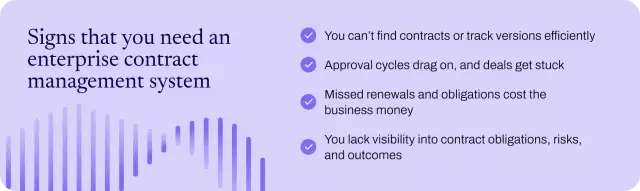
You know it’s time for an ECM solution when you face these common challenges of enterprise contract management:
You can’t find contracts or track versions efficiently
Contracts scattered across emails, shared drives, and disconnected systems waste teams' valuable time searching for the latest version of the agreement. This fragmentation leads to version-control errors, such as outdated or conflicting documents, duplicate data entry across tools, and unnecessary manual follow-ups.
Legal, finance, and procurement teams waste productivity by spending more time managing files than focusing on outcomes. An ECM platform centralizes all contracts in a secure, searchable repository and enforces strict version control, ensuring everyone works from a single, accurate source of truth.
Approval cycles drag on, and deals get stuck
When reviews depend on manual routing or endless email threads, deals stall, and revenue suffers. These inefficiencies grow as organizations scale, making it harder to meet internal service-level agreements (SLA) and respond quickly to new sales deals. Automated, configurable workflows route contracts to the right stakeholders in the correct order, accelerating reviews and keeping deals moving forward.
Missed renewals and obligations cost the business money
Without automated tracking and clear visibility into contract milestones, you risk missing renewals and obligations. Plus, for enterprise teams managing hundreds or thousands of agreements, manual tracking simply doesn’t scale. Intelligent alerts and automated reminders in an ECM solution keep teams ahead of renewal deadlines and obligations, protecting revenue and reducing financial risk.
5 reasons why your business needs an automated contract renewal strategy
You lack visibility into contract obligations, risks, and outcomes
When contracts live in silos, leadership and legal teams operate with a blind spot, losing time searching for information instead of making informed decisions. Fortune Business Insights reports that CEOs, CFOs, and other executives spend 18% of their time managing agreements when systems are fragmented. Unified dashboards and real-time analytics within an enterprise contract management system give leaders complete visibility into the portfolio, enabling smarter, data-driven decisions and proactive risk management.
See how Conga CLM empowers enterprises with the visibility, automation, and control needed to eliminate manual bottlenecks and manage contracts at scale. Book our CLM demo now.
Who should use enterprise contract management software and why
Any organization that manages a high volume of agreements or multi-stakeholder workflows can benefit from enterprise contract management services. These teams, in particular, can gain the most:
| Teams that benefit from enterprise contract management software | What teams gain | Overall impact of ECM |
| Legal | Standardized templates, automated approvals, and full visibility into risk exposure | Fewer errors, faster reviews, and a shift for legal from a reactive cost center to a strategic business partner |
| Procurement | Consistent supplier performance tracking, spend control, and compliance with corporate and regulatory policies | Lower risk, optimized costs, and consistent supplier performance |
| Sales | Self-service contracts, integrated redlining, and direct CRM connections | Faster deal cycles with maintained compliance and fewer handoffs or delays |
| Finance | Automated obligation tracking, streamlined audits, and accurate revenue recognition | Greater accuracy, reduced manual effort, and reliable data for financial decision-making |
How unified contract management software benefits enterprises
Enterprise contract lifecycle management (CLM) improves efficiency, reduces risk, and ensures contracts support business objectives. With a centralized system, you standardize workflows, maintain compliance, and gain real-time visibility into all documents.
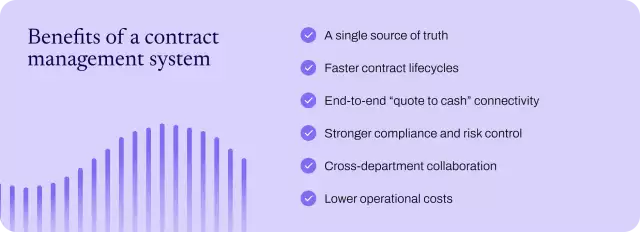
Key benefits of a contract management system include:
Providing a single version of truth
A unified enterprise CLM platform creates a single searchable repository for all agreements, ensuring every team works from the latest version. The enterprise CLM software eliminates duplication, manual searches, and version confusion, so every stakeholder works from accurate, up-to-date information.
How it impacts your business:
- Strategic decision-making with instant access to contract intelligence across the entire portfolio
- Audit readiness through a complete, immutable record of all changes and interactions
Accelerating every stage of the contract lifecycle
Manual handoffs and review processes create a significant bottleneck to revenue. An enterprise solution digitizes and automates workflows for approvals, redlining, and execution, reducing the time it takes to finalize contracts. Automation boosts sales velocity and improves operational efficiency across the enterprise.
How it impacts your business:
- Revenue realization as deals close faster and cash flows sooner
- Team capacity expansion, allowing the exact headcount to manage significantly higher contract volumes
Connecting the full “quote to cash” lifecycle
Tech stack integration is essential because contracts impact all revenue and cost data. ECM platforms integrate seamlessly with your CRM and ERP systems, linking the initial proposal (quote) to the final agreement and subsequent payment (in cash). This integration ensures data consistency, eliminates manual data entry errors, and provides a continuous flow of information crucial for financial accuracy.
How it impacts your business:
- Data consistency and integrity between sales, legal, and finance systems
- Cash flow visibility and forecasting with a direct link from contract value to revenue
Explore the key steps of the quote-to-cash process.
Enhancing compliance and risk mitigation
Enterprise contract management enforces the use of legally approved clause libraries and provides a complete, unalterable audit trail for every contract interaction. Advanced systems analyze third-party papers by comparing them to your playbook, scoring risk, and suggesting protective redlines.
How it impacts your business:
- Risk reduction through enforced use of pre-approved legal language and automated clause analysis
- Regulatory compliance and reduced exposure to legal penalties across all agreements
Improving cross-department collaboration
Working within a single digital contract management environment eliminates information silos and reduces friction between legal, sales, procurement, and finance teams. ECM software enables teams to collaborate efficiently on a single source of truth, reducing reliance on manual email chains and aligning all departmental goals with the terms of the executed agreement.
How it impacts your business:
- Departmental alignment and elimination of information bottlenecks across the organization
- Consensus and resolution speed for contractual issues through transparent collaboration
Reducing costs
Research by World Commerce & Contracting indicates that poor contract management results in businesses losing an average of 9% of their value annually. ECM directly addresses this leakage by automating obligation tracking, preventing unwanted auto-renewals, and alerting teams to renegotiation windows. Improved governance stops revenue loss and contributes to a healthier bottom line.
How it impacts your business:
- Value recovery by preventing revenue leakage and unnecessary auto-renewals
- Operational cost reduction through automation of manual tracking and administration

How to choose an enterprise contract management platform
The best ECM system integrates with your broader tech stack, delivers a measurable ROI, and scales to meet your organization’s evolving needs. To choose an enterprise contract management platform, follow this evaluation process:
1. Map your current contract process and use cases for automation
Begin evaluating how your organization currently creates, reviews, approves, and stores agreements from end to end. Identify specific contract management pain points and define where an enterprise CLM solution can have the most significant impact.
What to look for:
- Points of duplicate data entry or manual document handling
- Bottlenecks in reviews, approvals, or renewals
- Disconnected systems or limited contract visibility across teams
2. Define CLM platform requirements
Based on your pain points and the needs of all affected departments, create a detailed list of must-haves. Key requirements often include:
- Integration: seamless connection with existing core systems
- Repository: a secure, searchable, and centralized contract repository
- Workflow: support for complex, customizable, rule-based approval processes
- Scalability: the capacity to manage growing contract volumes and multi-region operations
3. Research and evaluate vendors
Start your research to build a concise shortlist of providers. Confirm that the vendor possesses the necessary documented success and technical capacity to handle the complexities of your industry and scale of operations. Focus your research on these areas:
- Analyst shortlisting: use reports to identify platforms proven in the enterprise space
- Case study validation: look for documented results that address your specific pain points
- Industry expertise: confirm the vendor has demonstrated results in your sector
For example, Conga CLM has documented success in highly regulated sectors, such as finance. We helped AXA automate its reinsurance contracts, manage a library of over 7,000 clauses, and achieve a 20% increase in signed agreements by replacing error-prone manual processes with a centralized, auditable system.
Read our AXA success story.
4. Conduct demos and validate with proof of concept
Schedule tailored demos and proceed quickly to a proof of concept (POC) to move beyond vendor claims and confirm the platform's real-world capability to execute a live portion of your actual workflow (for example, contract creation in Salesforce).
Use the demo and POC to validate:
- Usability: assess how intuitive the interface is for legal, sales, and procurement
- Specific use cases: confirm that the vendor can demonstrate solutions for your most complex workflow bottlenecks
- Data validation: ensure the platform can import and interpret your actual contract data structure
- Performance: evaluate whether the system maintains speed and reliability under realistic load conditions
5. Calculate total cost and validate ROI
Calculate the total economic impact (TEI), including all expenditures beyond subscription fees, and validate the return on investment (ROI) by quantifying expected savings from accelerated revenue and cost avoidance.
Make sure to calculate:
- Financial benefits: quantify gains from accelerated revenue and cost avoidance (preventing missed renewals or penalties)
- Payback period: establish the timeline to recoup your initial investment through documented benefits
Explore the financial value of enterprise contract lifecycle management (CLM)
Features to look for in enterprise contract management software
Selecting the right contract management platform requires evaluation of capabilities that align with your organization's specific needs.
To help guide your selection process, we've identified the features to look for in enterprise contract lifecycle management software:
| Evaluation factor for enterprise contract management solutions | What to look for when comparing enterprise CLM systems | Why this criterion matters |
| Cross-functional coverage | Features for legal, sales, and procurement with role-specific workflows | Organization-wide adoption and support for end-to-end contract management |
| Integrations | Native or API connections with CRM, ERP, CPQ, and eSignature tools | Elimination of silos through the connection between contracts, operations, and revenue |
| Security | RBAC, MFA, data encryption, and ISO/SOC certifications | Protection of sensitive data (IP, pricing, PII) with enterprise-grade security |
| Compliance | Automated clause governance, audit reporting, and regulatory updates | Legal risk reduction and stronger regulatory legal compliance |
| Scalability | Cloud-native, handles high volume, and supports multi-region and multi-language | Scalability to support growth while maintaining performance |
| Ease of use | Intuitive UI/UX, minimal training | User adoption and faster implementation timelines |
| Workflow automation | Rules-based routing, task assignment, and notification reminders | Shorter contract lifecycles through the removal of manual bottlenecks |
| AI | Clause ID, risk scoring, data extraction, and search tagging | Faster reviews, improved risk visibility, and searchable contracts |
| Vendor support | Customer success managers, technical support, SLAs, and product roadmap | Platform reliability, smooth implementation, and simplified maintenance |
| Use cases | Prebuilt solutions or templates for specific functions (for example, procurement contracts) | Streamlined deployment tailored to unique contracting scenarios |
| Dashboards | Customizable KPIs: cycle time, renewals, and risk exposure | Data-driven decision-making and executive-level visibility |
| Value | Total cost of ownership (TCO) analysis, including licensing, implementation, integration, and ROI | Verified financial return extending beyond initial costs |
How to manage enterprise contracts: steps and tools
To manage enterprise contracts effectively, you need a structured, data-driven process supported by automation. Take a look at these five steps to manage the enterprise contract lifecycle:
Step 1: define requirements and draft the contract
Contract lifecycle management starts with standardization. Set the foundation for the agreement's terms, to ensure speed and compliance from the first draft. Here's how to define your requirements and generate your contract:
- Implement guided intake: use forms to define the agreement's scope, pricing, terms, stakeholders, and risk level
- Leverage pre-approved content: generate the contract draft with pre-approved templates and a centralized clause library
- Enforce business rules: use automation to verify that all required fields are complete and apply the correct legal language to prevent compliance errors upfront
Step 2: negotiate, review, and approve the contract with stakeholders
Once the draft is ready, legal, sales, and procurement teams must review and align on terms—a stage that can be slow, confusing, and costly without automation. According to a KPMG report, the average cost of reviewing and processing a low-complexity negotiated agreement is $6,900, rising to $10,000 or more for inefficient processes.
Accelerate contract cycles with these key actions:
- Enable collaborative redlining contract: use tools such as Conga CLM to allow simultaneous, tracked changes in a shared digital environment
- Use automated version control: eliminate email threads and confusion, ensuring only the current, active draft is available to stakeholders
- Automate approval workflows: configure rules-based workflows that route the contract to the appropriate approvers in the correct sequence, avoiding delays
Step 3: execute the contract and track compliance
A well-managed signing process safeguards compliance and ensures every finalized agreement is instantly accessible to all stakeholders. Follow these steps to complete the execution stage:
- Integrate eSignature: use a solution such as Conga Sign to provide legally binding and secure eSignatures compliant with global standards (ESIGN, UETA, eIDAS)
- Automate repository storage: set up the CLM system to automatically store the signed contract in a centralized repository
- Tag with searchable metadata: tag the contract with searchable data (value, terms, dates) to give teams complete visibility into its status, obligations, and compliance checkpoints
Step 4: manage contract obligations
Most value leakage occurs after contracts are signed, when missed renewals, overlooked SLAs, or unmonitored obligations result in unnecessary costs. Manage obligations and monitor performance with:
- Key terms: use the CLM system to extract and link key terms (for example, delivery dates, payment milestones) to automated alerts
- Contract dashboards: monitor real-time status of critical obligations and SLAs across the entire contract portfolio
- Automated alerts: configure the system to send proactive reminders to the responsible parties well in advance of key milestones and due dates
How to manage your contractual obligations to gain a strategic advantage
Step 5: renew, amend, or close the contract
For the final stage of the lifecycle, rely on data to support strategic decision-making regarding the contract's future. Here's how to approach the closure phase strategically:
- Leverage contract analytics: use dashboards to highlight cycle time, realized contract value, and renewal trends
- Identify renegotiation windows: set automated reminders for optimal times to engage in renewal or renegotiation discussions
- Drive continuous improvement: use performance data to optimize supplier relationships, refine internal processes, and improve future contract terms
Best practices for effective contract management in enterprises
Enterprise contract management involves standardizing templates, centralizing contracts in a single repository, and leveraging CLM software to automate approvals and track obligations. Follow these best practices for achieving these goals:
- Standardize templates and clause libraries: use preapproved and automated templates to ensure consistency, speed up drafting, and reduce legal review time. According to Reuters, lawyers report up to 82% time savings when leveraging document automation to generate contracts and other legal documents.
- Automate approvals and obligation reminders: replace manual handoffs with workflows that route contracts and trigger alerts for key deadlines
- Integrate CLM with CRM, ERP, and procurement systems: connect contract data to operational systems to eliminate silos and improve reporting
- Drive user adoption with onboarding and role-based training: train teams on workflows, reporting tools, and compliance features
- Maintain and update governance frameworks: regularly review templates, approval hierarchies, and compliance rules to keep the system current and scalable
Manage enterprise contracts with Conga
Conga CLM provides the unified, scalable platform your business needs. Our solution integrates with your CRM, ERP, and eSignature systems, offering a single source of truth for all agreements. You benefit from centralized storage, expiration tracking, automated alerts, and more.
With AI-powered insights, clause validation, and real-time dashboards, Conga empowers teams across legal, procurement, and sales to collaborate seamlessly, reduce risk, and accelerate contract execution. Enterprise customers have seen the results that include:
- 75% increase in contract accuracy with pre-approved templates
- 50% higher contract volume with less manual effort
- $1M saved in administrative costs
See how to manage enterprise contracts with Conga CLM
Frequently Asked Questions
-
Which enterprise system enables contract management?
An enterprise system that enables contract management is Conga CLM. Our unified platform manages the entire contract lifecycle, integrating with critical business systems such as Salesforce, ERP, and Microsoft. Conga CLM provides a single source of truth, automated workflows, and centralized contract repository management designed specifically for complex, multi-department enterprise environments.
Learn more: Conga is recognized as a market leader in multiple analyst reports.
-
What are the biggest compliance risks of not using enterprise CLM software?
The biggest compliance risks of not using enterprise CLM software are:
- Missed regulatory obligations, such as GDPR, SOX, or data retention requirements
- Uncontrolled clause variations, increasing legal exposure from inconsistent language
- Lost audit trails, making it difficult to prove compliance during internal or external reviews
- Untracked obligations and renewals, leading to financial penalties or unfavorable renewals
- Lack of visibility into risk exposure, especially across global operations and multi-party contracts
-
How long does it take to implement an enterprise-grade contract management system?
It takes from a few months to over a year to implement an enterprise-grade contract management system, depending heavily on the project's complexity. Key factors determining the timeline of your CLM implementation include the number of departments involved (legal, sales, procurement), the volume and complexity of the automated workflows, and the depth of required integrations with existing core systems (CRM, ERP).
For organizations looking to go live faster, Conga offers Accelerators: a pre-packaged, ready-to-use solution from Conga Professional Services. With this program, teams can achieve a measurable ROI and user adoption in as little as seven weeks, benefiting from pre-built configurations, proven best practices, and guided implementation support tailored to your business needs.
-
What are the main integrations that my enterprise contract management software needs?
The main integrations your enterprise contract management software needs include:
- CRM: to generate and track contracts directly from opportunities or quotes.
- ERP: to sync financial data, pricing, and supplier information
- CPQ (for example, Conga CPQ): to ensure accurate terms and pricing flow seamlessly into contract templates
- eSignature platforms: to automate secure signing
-
How to measure ROI from an enterprise contract management system?
You can measure ROI from an enterprise contract management system by quantifying the value gained from risk avoidance and operational efficiency. Track these specific metrics against your baseline performance before implementation:
- Time-to-signature reduction: how much faster you finalize contracts, showing accelerated revenue lifecycles
- Contract cycle time: the total duration from request to execution, reflecting operational efficiency
- Compliance rate: the percentage of contracts meeting internal and regulatory standards, reducing legal risk
- Renewal capture rate: how many desirable contracts you renew, preventing revenue loss
- Time savings from contract automation: hours saved through automated drafting, review, and approvals, freeing teams for strategic work
-
Do enterprise contract management solutions require customization, or are they ready out of the box?
Both. Enterprise contract management solutions, such as Conga CLM, offer powerful out-of-the-box functionality (prebuilt workflows, clause libraries, and integrations) while allowing for flexible configuration to match your organization’s processes. With Conga, you can start quickly with standard features, then scale or customize as your business needs evolve, ensuring long-term adaptability without heavy reliance on IT.
Related resources
-
Connect and Learn With Peers in the Conga Customer Community BlogCLMConnect and Learn With Peers in the Conga Customer Community
Join 40,000+ peers in the Conga Customer Community—connect, learn, and grow with resources, training, and support to fuel smarter business outcomes.09/30/20266 min read -
The Contract Management Strategy You Might Be Overlooking BlogCLMThe Contract Management Strategy You Might Be Overlooking
Discover the contract management strategy that improves collaboration, clarity, and results—without overcomplicating your process.07/15/20257 min read -
The Quote to Cash Process in 10 Steps BlogCLMThe Quote to Cash Process in 10 Steps
Discover how to streamline your quote-to-cash (Q2C) process to accelerate sales cycles, improve customer experience, and boost revenue. This comprehensive guide covers every stage—from configuration and pricing to contract management, billing, and renewals—plus tips for finding the right automation solution. Learn how to eliminate silos, reduce errors, and drive efficiency across your CRM and ERP systems.12/01/20259 min read -
The Complexity Tax: How Manufacturers Can Stop Leaving Revenue on the Table BlogManufacturingThe Complexity Tax: How Manufacturers Can Stop Leaving Revenue on the Table
Product lines grow. Quoting slows. Contracts pile up. Learn how manufacturers are tackling commercial complexity with CPQ and CLM to recover lost revenue.07/13/20267 min read