Essentials of Contract Obligation Management
01/08/2026
11 min read

Obligation management monitors and fulfills commitments under binding agreements
Poor obligation tracking causes financial loss and compliance violations
CLM integration enables monitoring, automated alerts, and audit-ready compliance
Conga CLM automates large-scale obligation tracking across centralized repositories
When you sign an agreement, you take on contract obligations, such as tasks, payments, deadlines, and compliance requirements. Without clear visibility and control over those commitments, you risk missed deadlines, non-compliance, financial penalties, and damaged relationships.
Effective contract obligation management provides a mechanism for enforcing accountability and ensuring that obligations are fulfilled on time and in accordance with the terms of the agreement. In this guide, we’ll cover the essentials of this process—what it is, why it matters, and how to streamline it with a contract lifecycle management (CLM) technology.
What Is Obligation Management?
Obligation management is the process of identifying, tracking, and ensuring the fulfillment of all commitments made between parties in a legally binding agreement. It verifies that your organization meets its duties while confirming that counterparties honor theirs, protecting contract value and preventing disputes.
Enterprises manage several types of obligations in a contract, including:
- Financial: monetary commitments such as scheduled payments, service fees, volume-based discounts, or penalties
- Performance: actions and deliverables that must meet agreed standards, including delivery timelines, quality benchmarks, or work scopes
- Regulatory: compliance with external laws, industry standards, or certifications covering data protection, security protocols, or environmental requirements
- Reporting: required information delivery, such as progress updates, usage reports, or periodic financial audits
- Renewal: critical dates throughout the agreement lifecycle, including notice periods for extensions, auto-renewal triggers, or termination deadlines
What are the Consequences of not Meeting a Contractual Obligation?
According to a KPMG report, inefficiencies in contract management result in organizations losing up to 40% of a deal’s value. When multiple performance obligations exist in a contract, failing to meet them leads to financial penalties, legal exposure, and operational disruption—the core drivers of these losses.

Financial Penalties and Revenue Loss
Unfulfilled payment terms, missed delivery dates, or non-performance lead to financial losses. Poor contract obligation tracking can delay revenue recognition, erode the overall value of the contract, and incur substantial legal defense costs. Effective contract development and management, on the other hand, can save a company an average of 9% of its annual revenue, according to World Commerce & Contracting research.
Implementing contract lifecycle management (CLM) software, such as Conga CLM, helps to prevent contractual losses by:
- Automatically monitoring payment terms, renewal dates, and performance milestones
- Flagging key dates before deadlines pass
Legal and Compliance Risks
When organizations fail to meet contract obligations tied to regulations or industry standards, they face greater exposure to legal action, audits, and loss of certification. A failure to perform a fundamental duty gives the counterparty the right to terminate the agreement.
A Fenergo report found that nearly 50 fines were issued by U.S. regulators, with North America accounting for 95% of the $4.6 billion in global financial penalties—evidence of the critical importance of compliance oversight. A contract obligations tracker can help organizations meet and document every regulatory requirement, protecting them from sanctions through clear accountability and audit trails.
Why contract intelligence for Legal is so important
Reputational and Operational Impact
Missed obligations can weaken customer relationships, disrupt supply chains, and impact brand credibility. By establishing cross-functional accountability with the best CLM software, organizations automate alerts, centralize visibility, and facilitate collaborative workflows, enabling all teams to monitor contracts and obligations together.
Risks and Challenges in Managing Contract Obligations
Managing obligations is harder when your organization lacks the infrastructure to identify, track, and enforce commitments systematically. Let’s break down the most common challenges enterprises face in this process:
Contract obligation challenges | What it means | How it impacts your organization |
Limited contract visibility | Contracts stored in silos, lacking a central, searchable repository | Teams can’t quickly locate specific clauses, leading to missed deadlines and hindered audits |
Lack of process compliance | Tracking contract obligations through spreadsheets or calendar alerts | An error-prone manual process makes it impossible to demonstrate consistent regulatory adherence |
Risk from non-standard language
| The use of unapproved clauses introduces ambiguous, inconsistent, or poorly defined terms into contracts | Obligations become difficult to interpret, assign, and track, leading to disputes over contract performance |
Difficulty standardizing third-party contracts | Agreements arrive in non-digital formats with proprietary language and inconsistent structure | Manual governance of obligations from diverse documents is difficult, slow, and scales poorly |
Poor data hygiene | Inaccurate tagging, missing metadata, or redundant entries undermine any automated tracking effort | Lack of reliable insights results in a reactive rather than a proactive posture to contract risk management |
How to Track Contract Obligations and Compliance Deadlines
To track obligations in a contract, you need a structured process that combines ownership, visibility, and document automation.
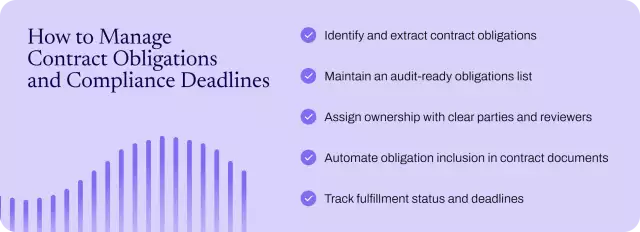
Follow these five steps to manage contract obligations and compliance deadlines:
1. Identify and extract contract obligations
Begin by reviewing all active contracts to identify specific commitments that require action. Look for clauses containing payment terms, delivery schedules, performance benchmarks, reporting requirements, renewal notices, and compliance certifications.
To streamline this process:
- Use AI-powered clause extraction to scan contracts and flag obligations automatically
- Reduce extraction time by automatically populating your obligation-tracking system with accurate requirement details, such as due dates, owners, and required actions
When teams miss or misinterpret key commitments during extraction, they create blind spots that delay actions, cause compliance failures, and lead to preventable revenue loss. A complete and reliable inventory of obligations provides every process with the clarity needed to operate effectively.
2. Assign contract obligation ownership with clear parties and reviewers
Every obligation in a contract needs a named owner accountable for fulfillment and a reviewer to validate completion. To establish accountability and prevent missed handoffs:
- Assign a secondary reviewer for high-risk obligations to create accountability checkpoints
- Schedule regular ownership reviews to reassign obligations as roles change
- Document contact information and escalation paths directly in your tracking system
Failing to assign responsibilities causes deadlines to slip, breaks handoffs, and forces people to waste time figuring out who should act. Strong ownership reduces contract risk by giving every obligation an accountable owner and a reviewer who confirms completion.
3. Track obligation fulfillment status and deadlines
Implement a status taxonomy that provides instant visibility into contract obligation progress. For example, pending for newly identified commitments, in progress for active work, completed for fulfilled obligations, at risk for items approaching deadlines without confirmed progress, and overdue for missed commitments requiring immediate attention.
To avoid missed deadlines:
- Set automated milestone alerts (for example, 90, 30, 7, and 1 day before deadlines)
- Send reminders to both owners and reviewers to maintain accountability
- Use a centralized obligations tracker to monitor real-time progress across teams
Without structured statuses and active deadline monitoring, teams overlook obligations until they become urgent or overdue, resulting in penalties, compliance failures, and strained relationships. Proactive tracking helps you intervene early and keep commitments on schedule.
4. Maintain an audit-ready obligations list
Build a centralized obligations register that captures every commitment across your contract portfolio in a format that meets governance and audit requirements. For consistent documentation and easier compliance reporting:
- Include key fields, such as contract ID, obligation description, category, owner, deadline, status, supporting documentation, and evidence of completion
- Enable filtering and reporting by contractual duty, business unit, risk level, or time period
- Conduct quarterly reviews to archive fulfilled contract obligations and validate new entries
Scattered or inconsistent documentation slows audits, creates reporting gaps, and increases regulatory risk. Centralized, well-structured records enable faster reporting and support stronger governance.
5. Automate obligation inclusion in contract documents
Standardize how obligations appear in new contracts by embedding them in approved templates and clause libraries. To make tracking seamless from agreement creation to execution:
- Organize your clause library by category to ensure consistent language across all contracts
- Integrate your agreement generation and tracking systems so key commitments populate automatically upon execution
- Link creation directly to tracking for instant visibility once agreements are signed
When teams don’t record obligations properly in the CLM system or rely on scattered spreadsheets and emails, they lose contract visibility after execution and overlook requirements. Automating how teams extract, assign, monitor, and update obligations keeps every commitment aligned from drafting to fulfillment, improves compliance, and reduces manual effort.
How to become proactive in managing contractual obligations
How Contract Obligation Management Software Simplifies Tracking and Compliance
Contract obligation management software centralizes and automates the entire process of tracking commitments and ensuring compliance. It provides a single source of truth for identifying obligations, monitoring progress, and generating compliance reports. Key capabilities include:
Capabilities of contract obligation compliance management software | How it works | Benefits |
Centralized obligations repository | Unified, searchable database consolidating all commitments from every contract | Complete visibility into tasks, responsible owners, and deadlines across the organization |
Automated obligation extraction | An AI solution, such as AI included in Conga CLM, scans executed contracts to identify, categorize, and capture key commitments | Accurate, complete data with minimal manual effort, reducing human error and review time |
Workflow and accountability automation | Automatic routing of obligations to assigned owners with built-in reminders and escalation | Consistent fulfillment tracking and clear accountability, ensuring on-time compliance |
Proactive alerting | Notifications for upcoming deadlines, renewals, and reporting requirements via system or email | Early awareness of critical dates, minimizing missed milestones, and avoiding financial penalties |
Integrated audit trail | Continuous logging of obligation actions with timestamps and supporting documentation | Reliable, audit-ready record demonstrating performance, compliance, and due diligence |
With Conga CLM software, you centralize contract obligation tracking, automate deadlines with AI, and maintain an audit-ready record for every agreement, helping your organization avoid penalties and capture the full value of all contracts.
FREE DEMO
See Conga CLM in action
Best Practices for Effective Contract Obligation Tracking and Management
Obligation management delivers the most value when embedded within a comprehensive contract lifecycle management platform. A CLM system provides the structure to track, enforce, and measure obligations throughout the entire contract journey—enabling you to implement these best practices:
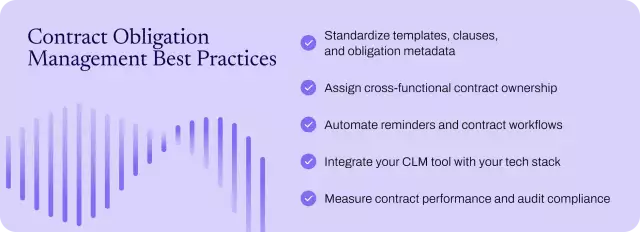
- Standardize templates, clauses, and obligation metadata: use pre-approved language for recurring obligations (payment terms, service levels, compliance requirements) and apply consistent tagging and metadata (financial, performance, regulatory) to ensure clarity, improve searchability, and enable accurate reporting.
- Assign cross-functional contract ownership: designate responsibility for each obligation type—legal ensures compliance, finance oversees payments, procurement tracks vendor performance, and operations manages deliverables—to improve accountability.
- Automate reminders and contract workflows: configure your CLM system to trigger alerts for deadlines, renewals, and reporting requirements, keeping teams proactive and reducing missed obligations.
- Integrate with other systems: connect contract data with CRM, ERP, and other platforms to sync performance and financial information automatically, minimizing manual handoffs and delays.
- Measure contract performance and audit compliance: track contract analytics such as cycle time, renewal success, and obligation fulfillment, and conduct regular audits to verify compliance, maintain accurate records, and mitigate risk.
10 must-have contract management software features
Conga: The Best Way for Enterprises to Track and Manage Large-Scale Contract Obligations
With the Conga Advantage Platform, you can manage and fulfill contracts with ease. Our solution connects every phase of the commerce lifecycle, from contract generation and signature collection to billing and obligation management.
When it comes to our contract obligation management software, you can:
- View the obligations list: a centralized, searchable view of all active commitments, showing due dates, responsible parties, and completion status
- Create an obligation: add new obligations and link them to specific contracts or clauses for transparent ownership
- Automate obligation tracking: link obligations to contract clauses for automatic inclusion in contracts and receive proactive alerts for upcoming deadlines to ensure nothing is missed
- Update an obligation: adjust owners, statuses, or deadlines as business needs evolve to keep records accurate and current
- Delete an obligation: remove outdated or invalid entries with administrative permissions to maintain clean, reliable data
Ready to optimize your contract obligation management process? Contact our sales team to learn how Conga can help.
Frequently Asked Questions
-
What is a contractual obligation?
A contractual obligation is a legally binding duty that one or more parties agree to perform as part of a contract. These obligations require one party to take a specific action (delivering goods or providing a service) or refrain from a particular action (not disclosing confidential information) by a stated deadline.
-
What is mutuality of obligation in a contract?
Mutuality of obligation in a contract is a legal principle that requires both parties to an agreement to be bound to perform their respective duties or render consideration. Suppose one party can choose to perform or withdraw without incurring legal consequences while the other remains bound. In that case, mutuality may be absent, which could render the contract unenforceable in some jurisdictions.
-
Contractual obligation vs. contractual right: what's the difference?
Obligations and rights represent two sides of a contract management process. An obligation is a duty you must fulfill, while a right is an entitlement you can enforce.
Here are the key differences:
Comparison criteria
Contractual obligation
Contractual right
Definition
A duty or action that a party is legally required to perform
A benefit or entitlement that a party can legally claim
Purpose
Ensuring performance and compliance
Protecting interests and guarantees value
Enforceability
Breach leads to liability or penalties
Breach allows the holder to seek remedies or compensation
-
How do contractual obligations differ from legal obligations?
Contractual obligations come from agreements between private parties, while legal obligations come from laws that impose duties regardless of any contract. Both are enforceable but differ in their source and scope.
Comparison criteria
Contractual obligation
Legal obligation
Source
Created by a written or verbal contract
Established by law or regulation
Parties Involved
Between two or more agreeing entities
Between individuals and the state or governing body
Consequences of breach
Governed by the terms of the contract
Governed by statutory penalties or legal sanctions
-
Can contract obligations change over time?
Yes, contract obligations can and often do change over time. Changes typically occur through formal, agreed-upon amendments, renewals, or documented change orders executed by both parties. Obligations can also change automatically in response to triggering events specified within the original contract.
-
Who should review contract obligations and how often?
A cross-functional team that includes representatives from operations, finance, legal, and management should review obligations in a contract. The frequency of review depends on the type of obligation:
- Financial/regulatory: in real-time or daily via contract obligation management software dashboards
- Compliance/renewal: quarterly to ensure they maintain regulatory standards and address future renewal dates on time
-
Why is it risky to manage contracts without dedicated software?
It is risky to manage contracts without dedicated contract lifecycle management software, because manual tracking through spreadsheets or emails can lead to missed deadlines, incomplete records, and compliance gaps. That's why enterprises need a contract obligations management software like Conga, which automates these processes and ensures accuracy at scale.
Related Resources
-
Connect and Learn With Peers in the Conga Customer Community BlogCLMConnect and Learn With Peers in the Conga Customer Community
Join 40,000+ peers in the Conga Customer Community—connect, learn, and grow with resources, training, and support to fuel smarter business outcomes.09/30/20266 min read -
The Contract Management Strategy You Might Be Overlooking BlogCLMThe Contract Management Strategy You Might Be Overlooking
Discover the contract management strategy that improves collaboration, clarity, and results—without overcomplicating your process.07/15/20257 min read -
The Quote to Cash Process in 10 Steps BlogCLMThe Quote to Cash Process in 10 Steps
Discover how to streamline your quote-to-cash (Q2C) process to accelerate sales cycles, improve customer experience, and boost revenue. This comprehensive guide covers every stage—from configuration and pricing to contract management, billing, and renewals—plus tips for finding the right automation solution. Learn how to eliminate silos, reduce errors, and drive efficiency across your CRM and ERP systems.12/01/20259 min read -
The Complexity Tax: How Manufacturers Can Stop Leaving Revenue on the Table BlogManufacturingThe Complexity Tax: How Manufacturers Can Stop Leaving Revenue on the Table
Product lines grow. Quoting slows. Contracts pile up. Learn how manufacturers are tackling commercial complexity with CPQ and CLM to recover lost revenue.07/13/20267 min read