Contract Approval Workflow: What It Is and How to Improve
12/15/2025
9 min read

Contract approval is often one of the most challenging parts of the contracting cycle. Lengthy review times and unclear responsibilities slow deals, increase risk, and cause delays across teams. An automated approval workflow ensures that every agreement moves efficiently through drafting, review, negotiation, and sign-off.
In this guide, we break down the contract approval process and show how a CLM solution streamlines workflows, enforces compliance, and delivers measurable business impact.
Key highlights:
- Contract approval workflow is a structured process that moves agreements from draft to signature with automated routing and clear oversight, ensuring compliance and speed.
- Optimizing the approval workflow with a CLM solution reduces bottlenecks by standardizing templates, enabling parallel reviews, and integrating systems.
- Implementing an automated platform such as Conga CLM delivers measurable impact, as AI and end-to-end automation accelerate approval times and support revenue growth.
What Is a Contract Approval Workflow?
A contract approval workflow is a process that enables legal teams to move agreements from draft to eSignature. It outlines steps, assigns reviewers, and sets conditions for stakeholders to approve or reject arrangement terms.
By automating routing, tracking, and notifications, this workflow accelerates approval and provides visibility into each contract stage, ensuring every agreed deal meets your organizational standards before execution.
Stages of the Contract Approval Process
An efficient approval process involves multiple contract stages, each designed to validate terms, manage risk, and ensure cross-functional alignment before execution:
- Agreement initial creation: sales or business teams draft their first version with approved templates and standard clauses.
- Cross-functional internal review: legal, finance, sales, and procurement review the agreement to validate terms, pricing, and contractual obligations.
- Contract redlining, negotiation, and version control: reviewers propose changes and track revisions.
- Automated approval routing based on rules and thresholds: the workflow routes agreements to the right reviewers based on value, risk, or contract type.
- Executive, legal, or risk-based escalated approvals: high-value or non-standard contract terms trigger additional review.
- Final approval and validation of contract terms: authorized stakeholders confirm that the agreement meets policy and business requirements.
- Signature and contract execution: parties eSign the document, making it legally binding.
- Post-approval obligation tracking and compliance setup: legal and contract management teams monitor deadlines and requirements.
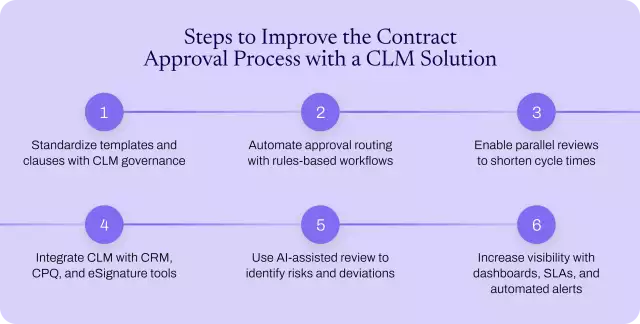
How to Improve the Contract Approval Process With a CLM Solution
Modernizing your contract approval process helps address time scarcity among legal teams. Thomson Reuters reports that corporate lawyers work 49 hours per week, yet 62% lack sufficient time for key tasks.
Fragmented workflows force teams to choose between strategic review and administrative tasks. A contract lifecycle management (CLM) solution, such as Conga CLM, reduces this friction by automating handoffs and providing structured guardrails.
1. Standardize templates and clauses with CLM governance
Standardizing templates and clauses reduces initial hurdles, helping teams start the contract with approved language. This approach keeps the process of approval focused on exceptions instead of routine terms. To implement standardization with a CLM software:
- Consolidate templates: audit existing agreements and eliminate redundant versions.
- Build a contract clause library: centralize legal-approved language to approve agreement terms.
- Support self-service: let non-legal teams create low-risk drafts with pre-approved building blocks.
2. Automate approval routing with rules-based workflows
Automated routing via a CLM solution ensures contracts reach the right approvers at the right time. Clear rules cut delays, avoid unnecessary reviews, and accelerate the process, keeping focus on contract risk and value instead of manual coordination.
To implement rules-based routing:
- Define routing rules: set approval paths based on contract value, risk level, or deviations from standard terms.
- Apply conditional approvals: require additional review only when thresholds trigger exceptions to approve agreement items.
- Enforce approval authority: ensure only authorized roles can advance agreements toward final approval.
- Track routing status: monitor where each agreement sits in the workflow to avoid stalled reviews.
3. Enable parallel reviews to shorten cycle times
Parallel reviews reduce delays caused by sequential handoffs, where an agreement stalls while waiting for a single reviewer. Allowing legal, finance, and other teams to review simultaneously shortens cycle times and keeps deals moving toward an approved contract.
You can implement parallel review by:
- Segmenting review scopes: assign non-overlapping sections to different teams so each group can review independently.
- Centralizing collaboration: manage all redlines and comments in a single workspace to avoid email-based revisions.
- Triggering critical reviews early: start time-intensive reviews, such as security or compliance, alongside legal.
4. Integrate CLM with CRM, CPQ, and eSignature tools
Disconnected systems require manual data transfer, causing errors and delays. Integrating your CLM with sales, pricing, and signature tools ensures a seamless process from quote to contract signing. Data auto-populates, approvers use familiar interfaces, and the agreement moves directly to signature without exports or re-entry.
Integrate your ecosystem by:
- Syncing with your CRM: map key fields so account and contact data flows into templates automatically.
- Leveraging CPQ for pricing: use tools such as Conga CPQ to validate pricing and discounts against financial guardrails before generation.
- Connecting eSignature for execution: embed secure signing with a tool, such as Conga Sign, once final internal authorization is complete.
- Automating document storage: return executed agreements to the CRM as the system of record for every approved contract.
5. Use AI-assisted review to identify risks and deviations
Manual contract review slows approval processes by forcing legal teams to examine every clause for risk and deviations. AI-powered analysis reduces review time from hours to seconds by flagging non-compliant language against approved templates. No wonder Gartner reports that procurement leaders expect a 21.7% productivity increase from GenAI.
To implement AI-assisted review:
- Automate data extraction: use a solution such as Conga CLM with AI to pull key obligations and dates from third-party documents, reducing manual entry.
- Flag high-risk deviations: scan redlines to identify clauses that require immediate executive review or approval.
- Apply playbook-driven redlines: suggest edits based on internal playbooks to speed agreement review.
- Score contract risk: assign scores to fast-track standard renewals and focus attention on complex deals.

6. Increase visibility with dashboards, SLAs, and automated alerts
Agreements disappear into approval black holes when you lack visibility into status and ownership. Teams waste hours asking who has this contract? while deals sit idle awaiting review. Real-time dashboards and automated alerts bring clarity to the workflow, ensuring every contract in process moves forward and accountability stays clear.
Increase your contract visibility with a CLM solution:
- Use real-time contract dashboards: track status, owner, and aging for every agreement under review.
- Set approval service level agreements (SLAs): define response timelines to keep reviews accountable and predictable.
- Trigger automated alerts: notify approvers when deadlines approach.
- Monitor exceptions: highlight stalled approvals or repeated delays that need intervention.
Automated Contract Approval Workflow Benefits
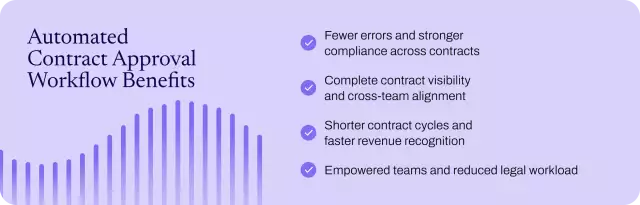
Automated contract approval processes deliver measurable improvements across speed, compliance, and visibility.
By leveraging tools for streamlining contract negotiation and approval, you benefit from:
Fewer errors and stronger compliance across contracts
Manual approvals introduce mistakes: misrouted documents, overlooked clauses, and version confusion that expose organizations to risk. Automated workflows enforce consistent review paths with complete audit trails documenting every approval decision, comment, and version change.
Complete contract visibility and cross-team alignment
Automated workflows provide complete visibility and control, transforming cross-team alignment. To streamline Veracode's approval workflows, Conga CLM replaced emails and spreadsheets with a central system that gives sales, legal, and procurement real-time insight into each approved contract’s status and stage duration. Dashboards and alerts streamline handoffs, reduce legal review to a single round, and cut renewal time from seven minutes to under one minute.
Shorter contract cycles and faster revenue recognition
Shorter cycles and faster revenue recognition result from intelligent routing that sends agreements to the right approvers. At Equinix, Conga CLM cut the contract lifecycle from 14 days to just 90 minutes by allowing low-risk agreements to bypass additional reviews and auto-escalating high-value deals. Connecting approvals, execution, and contract obligation management into a single workflow enabled timely pricing actions and faster revenue realization.
Empowered teams and reduced legal workload
AI contract review software and pre-approved clause libraries let teams draft low-risk agreements independently, while legal focuses on complex or high-value deals. This automation reduces repetitive manual review, accelerates approvals, and enables legal and finance teams to dedicate more time to strategic initiatives that drive business impact and support revenue growth.
Automate your approval workflow with Conga CLM
Contract Approval Workflow Checklist: Features to Look for in Automation
Selecting the right automation feature determines how effectively your contract approval process scales across the business.
This checklist highlights the capabilities that directly impact approval speed, control, and contract risk management:
| Automated contract approval workflow feature | What to look for | Why it matters for approval workflows |
| Dynamic approval routing engine | Configurable routing based on value, risk, or contract type | Faster handoffs and fewer manual approvals |
| Conditional risk-based approval rules | Thresholds that trigger escalations for non-standard terms | Reduced risk exposure and consistent enforcement |
| Collaborative review and redlining workspace | Shared environment for comments, edits, and version control | Less rework and clearer reviewer alignment |
| Integrated approval ecosystem | Native connections to CRM, CPQ, and electronic signature tools | End-to-end continuity across systems |
| Contract governance and template controls | Centralized templates and clause libraries with permissions | Stronger contract compliance and standardized language |
| Workflow visibility and contract performance analytics | Dashboards, SLAs, and approval metrics | Clear accountability and process hold-up tracking |
| AI-powered contract risk intelligence | Automated deviation detection and risk scoring | Earlier risk identification and focused review |
Leverage the Best Software for Contract Creation and Approval Workflows
Conga CLM brings contract creation, review, and approval into a governed workflow. With standardized templates, rules-based routing, AI-assisted review, and native CRM, CPQ, and eSignature integrations, Conga shortens review cycles and reduces contracting errors.
Designed for enterprise scale, our contract lifecycle management platform provides real-time visibility across approvals and the broader commerce chain, helping you to reduce risk, accelerate deals, and manage agreements from creation through renewal.
Streamline your contract approval process. Contact our sales team.
Frequently Asked Questions
-
Which CLM software helps automate contract creation and approvals?
A CLM software that helps automate contract creation and approvals is Conga CLM, an AI-enhanced platform natively integrated with Salesforce that combines rules-based approval workflows, governed templates and clauses, and intelligent agreement risk review.
Read more: what is Conga CLM?
-
What are the best practices for contract approval workflows?
The best practices for contract approval workflows balance speed with legal and financial risk control. Get started by:
- Defining approval policies and enforcing compliance standards
- Regularly reviewing and optimizing workflow efficiency
- Centralizing contract data for easier access and auditability
- Tracking approval metrics to identify delays
- Encouraging cross-functional collaboration and accountability
- Implementing change management to drive consistent adoption
-
How to streamline deal approvals with integrated CPQ and CLM?
To streamline deal approvals with integrated CPQ and CLM, connect pricing and contracting into a single automated flow. With platforms such as Conga CPQ and Conga CLM, approved quotes generate contracts automatically with terms carried over, triggering the correct approval workflow and accelerating the path from proposal to signature.
Download our ebook to explore the powerful integration of Conga CPQ and CLM.
-
The Quote to Cash Process in 10 Steps BlogCLMThe Quote to Cash Process in 10 Steps
Discover how to streamline your quote-to-cash (Q2C) process to accelerate sales cycles, improve customer experience, and boost revenue. This comprehensive guide covers every stage—from configuration and pricing to contract management, billing, and renewals—plus tips for finding the right automation solution. Learn how to eliminate silos, reduce errors, and drive efficiency across your CRM and ERP systems.12/01/20259 min read -
The Complexity Tax: How Manufacturers Can Stop Leaving Revenue on the Table BlogManufacturingThe Complexity Tax: How Manufacturers Can Stop Leaving Revenue on the Table
Product lines grow. Quoting slows. Contracts pile up. Learn how manufacturers are tackling commercial complexity with CPQ and CLM to recover lost revenue.07/13/20267 min read -
Conga Earns TrustRadius Top Rated Awards for CLM, CPQ & Composer BlogCLMConga Earns TrustRadius Top Rated Awards for CLM, CPQ & Composer
Conga earns #1 rankings in three categories for the 2026 TrustRadius Top Rated Awards, based entirely on feedback from verified customer reviews.07/16/20264 min read -
Selling and contracting in the age of regulated AI GuidesAISelling and contracting in the age of regulated AI
Explore strategies to manage AI compliance in sales, quoting, and contracting.11/19/20251 min read