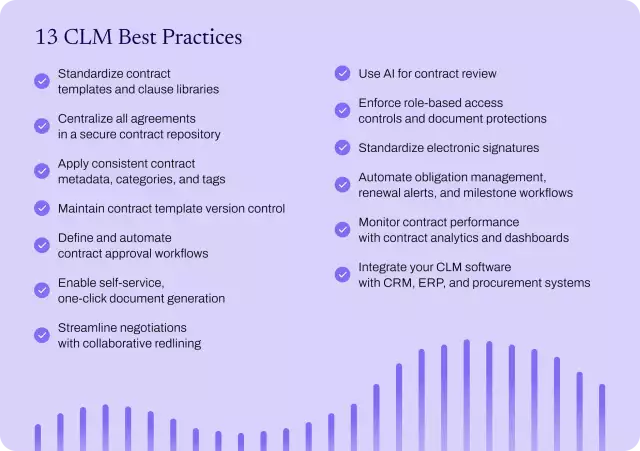
13 Contract Lifecycle Management Best Practices
04/23/2026
10 min read

Contract lifecycle management (CLM) best practices are systematic and often technology-driven methods—such as using a centralized repository, standardized templates, and automation—used to improve the entire contract process from initiation through execution, compliance, and renewal. This way, you reduce risks while maximizing the value of your agreements.
Key highlights:
- Contract lifecycle management best practices streamline workflows, enforce consistency, and optimize agreement outcomes.
- Standardizing contract templates accelerates approvals, reduces manual errors, and mitigates compliance risks, ensuring faster, more reliable contract execution.
- Tracking contract lifecycle performance through dashboards, monitoring obligations, and integrating your CLM with CRM/ERP systems gives you full visibility into agreements, operational efficiency, and data-driven insights.
- With Conga CLM, teams can implement contract management process best practices, improving compliance, efficiency, and decision-making.
We’ve compiled 13 contract management best practices you need to know. Find out which specific pain points you can solve with these CLM tips, and the key steps to implement them successfully.
1. Standardize Contract Templates and Clause Libraries
Creating multiple versions of contract templates across departments leads to inconsistent language, increased risk, and longer negotiation cycles. Legal must re-review variations in contractual clauses, definitions, and risk positions, while counterparties encounter conflicting or unclear terms in the agreement.
The solution: standardize your documents to keep them clear and compliant. Pre-approved templates maintain consistent formatting and language, while a clause library provides vetted, conditional, and alternative options.
To standardize your templates and clause libraries, you should:
- Identify your most common contract types and create approved templates for each.
- Replace outdated or department-specific files with a single source of truth for all your agreements.
Learn how to create customized, accurate templates with Conga CLM. Watch our video.
2. Centralize All Agreements in a Secure Contract Repository
To have an effective enterprise contract management process, you need a centralized system for all agreements. Storing deals across email, shared drives, and individual desktops limits visibility—resulting in your team wasting time searching for documents, struggling to identify the latest version, or missing key contractual obligations.
Consider our client QuintilesIMS (now IQVIA). Without a central repository, they experienced extended agreement lifecycles, frequent errors from outdated information, and limited cross-team visibility. By centralizing documents in Conga CLM, the company reduced duplicate data entry, accelerated approvals by 75%, and gained 100% faster contract processing time.
To properly centralize your contract repository:
- Make all agreements discoverable through a unified search and filtering experience.
- Track document and approval status to ensure teams access the correct, signed-off agreements.
Master Conga smart search: watch our webinar.
3. Apply Consistent Contract Metadata, Categories, and Tags
When teams use inconsistent naming conventions or skip fields, it might lead to missing or inaccurate contract information, resulting in poor reporting. For example, without standardized metadata, managers cannot quickly see which agreements expire this quarter, track contractual obligations tied to high-value deals, or identify documents with non-standard clauses—forcing legal and procurement teams to review everything manually to gather insights.
Eliminate contract data quality issues by creating a structured, predictable way to categorize every agreement. CLM software supports this best practice by enforcing mandatory fields and automating metadata tracking, keeping records up to date, and reducing the risk of missing or incorrect information.
Apply consistent contract metadata by:
- Defining a standard metadata model (for example, values, dates, parties, and key terms indicators).
- Requiring key fields during contract creation to prevent incomplete records.
- Leveraging consistent categories and tags to classify contracts by type, region, or business unit.
Keep learning: how to get cleaner data with Conga
4. Maintain Contract Version Control
Each agreement negotiation, redline, or amendment creates a new version, and without a governed system, that history disappears or becomes unreliable. By maintaining version control as a contract management best practice, you confirm which approved source produced each executed agreement and quickly revert if newly introduced terms create issues.
Conga CLM improves contract accuracy by breaking document versions into major (new generation/final), minor (negotiator check-in), and revision (reviewer feedback), maintaining a complete, auditable record of your contract lifecycle management.
Follow these tips to maintain your contract version control:
- Configure your CLM for document versioning to create automatic audit trails at the agreement record level.
- Distinguish major versions from minor and revision versions to support precise auditing.
- Enable template versioning to maintain a complete history of how your templates evolve over time.
5. Define and Optimize Contract Approval Workflows
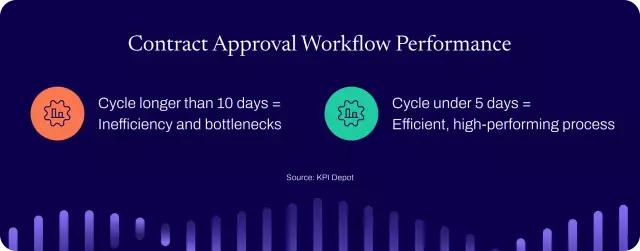
Clear workflows keep agreements moving and prevent delays caused by manual routing or email-based reviews. According to a benchmark report from KPI Depot, approvals lasting more than 10 days signal a process issue, while best-in-class teams keep turnarounds under 5 days.
Automated workflows ensure deals reach the right reviewers based on value, region, or clause changes. Following this CLM best practice reduces cycle time, improves compliance, and establishes predictable, repeatable processes across all contract types.
Automate your contract approval workflows by:
- Configuring approval flows with criteria such as contract value thresholds, discount levels, clause deviations, or region-specific rules.
- Setting up automatic routing so approvers receive tasks immediately when the contract meets predefined conditions.
- Enabling real-time status tracking so stakeholders can view pending approvals and eliminate follow-up emails.
6. Enable Self-Service, One-Click Document Generation
Legal teams become bottlenecks when they have to manually prepare every contract, consuming time they should dedicate to complex negotiations and strategic work. To improve efficiency and drive more predictable revenue, enable self-service, one-click document generation.
Effective contract management cuts document creation time from days to minutes, allowing legal to focus on higher-value tasks. Case in point: Equinix, one of our customers, reduced its agreements lifecycle from 14 days to 90 minutes by enabling teams to generate accurate, standardized deals through Conga CLM capabilities.
To accelerate document generation:
- Categorize contract risk and define which agreement types qualify for business-team self-service.
- Configure role-based access to ensure each team only selects the correct templates.
- Provide guided workflows so business users generate accurate documents without legal support.
7. Streamline Negotiations With Collaborative Redlining
When redlining contracts, relying on email chains and manual change tracking creates legal risk and slows deal closure. The solution: contract redlining software that consolidates negotiation by combining edits, comments, and approvals into one document. Stakeholders suggest, review, and approve changes in real time, with a clear history of all modifications.
With this best practice in contract management, you eliminate confusion over multiple versions and establish accountability for each user. With Conga CLM, for example, you can highlight edits, maintain a complete audit trail, and ensure all stakeholders work from the most current document.
Streamline your redlining process by:
- Centralizing negotiations so all parties work from a single, current document.
- Enabling real-time redlining to propose, review, and accept changes without manual tracking.
- Highlighting edits between versions to maintain a clear, auditable history.
8. Use AI for Contract Review
AI-driven solutions enhance agreement reviews and reduce hidden risk, especially when handling high-volume documents or third-party deals with inconsistent terms. Markets and Markets projects that the global legal AI software market will grow up to $10.82 billion by 2030, reflecting the increasing adoption of this technology for tasks such as drafting, review, and compliance.
AI contract review software automates the extraction of critical data points and compares deal language against pre-approved provision models, flagging non-compliant clauses, missing terms, or ambiguous language. Conga Discovery AI enhances this process by allowing reviewers to focus solely on validating and correcting results.
When applying AI to your contract review process, ensure to:
- Prioritize high-volume or third-party agreements to save legal team time.
- Configure provision models to flag non-compliant or missing clauses automatically.
- Dedicate human effort to verifying AI-extracted data and resolving exceptions.
Learn more about AI-powered contract management.
9. Enforce Role-Based Access Controls and Document Protections
A central repository organizes contracts, but you need to restrict access to protect sensitive information. This is a necessary CLM best practice that prevents data leakage and ensures regulatory compliance
Conga CLM allows you to specify a protection level tied to specific user profiles and actions, such as requiring track changes for a sales user when forwarding a document to a customer. You can manage access down to individual fields and clauses during parallel reviews. This granular control ensures maximum security throughout the collaboration process.
When configuring access controls and document protections, follow these steps:
- Define user profiles and roles with specific permissions for viewing, editing, and sharing documents.
- Enable field and clause-level permissions for documents shared with multiple reviewers.
- Use track changes to capture edits and maintain a complete, auditable history.
Master Conga roles and permissions: watch our video.
10. Standardize Electronic Signatures
Standardizing electronic signatures streamlines approvals and ensures compliance with legal and regulatory requirements, such as the ESIGN Act, UETA, and GDPR. With a unified eSignature platform such as Conga Sign, you eliminate delays from manual signatures, reduce errors, and create a secure, auditable signing process.
Conga Sign allows users to generate, route, and collect signatures directly within the workflow while maintaining document integrity and traceability.
Follow these steps to standardize your electronic signatures:
- Integrate eSignature solutions into your CLM workflows to remove manual handoffs.
- Enforce identity verification, including multi-factor authentication, for all signatories.
- Centralize signed documents in a secure repository for easy access, reporting, and compliance.
Learn how to sign a PDF with an eSignature.
11. Automate Obligation Management, Renewal Alerts, and Milestone Workflows
Manually managing contract obligations causes errors, delays in renewals, and missed revenue opportunities, forcing teams to spend excessive time on repetitive tasks rather than on strategic work.
Managing contract obligations with a platform like Conga CLM reduces the chance of missed deadlines and revenue loss. CLM software monitors milestones and sends renewal reminders to ensure compliance. This approach allows teams to focus on strategic tasks such as contract negotiations, risk management, and revenue growth.
Take a look at how to automate obligations, renewal alerts, and milestone workflows:
- Centralize contract data so your CLM solution automatically tracks obligations, renewal dates, and key milestones.
- Set rules and triggers so the system sends notifications, tracks tasks, and escalates actions when users miss deadlines.
- Activate notifications, assign tasks, and route approvals so stakeholders take action and complete deliverables without manual follow-ups.
12. Monitor Contract Performance With Contract Analytics and Dashboards
Without leveraging contract analytics as a CLM best practice, you struggle to track agreement performance, monitor key performance indicators (KPIs), and measure its impact. Relying on slow, manual reports makes it difficult to identify trends, assess compliance, or spot deals requiring attention.
With pre-built and custom contract management dashboards, you gain real-time visibility into agreement status, compliance, and business outcomes, allowing your team to monitor KPIs, streamline operations, and make data-driven decisions that maximize revenue and efficiency.
To streamline your contract performance monitoring, follow these tips:
- Build or clone dashboards that display metrics aligned with your business goals.
- Use datasets to define the metrics and business logic that drive your visualizations, ensuring consistency and accuracy across dashboards.
- Filter and group data to highlight contracts at risk, overdue obligations, or upcoming renewals for proactive management.
13. Integrate Your CLM Software With CRM, ERP, and Procurement Systems
Failing to integrate your contract management software with CRM, ERP, and procurement software results in disconnected information, duplicated efforts, and inefficient workflows. According to WorldCC, agreement-related data is scattered across an average of 24 different systems, making it nearly impossible to track commitments or make timely decisions.

Pre-built integrations, APIs, and custom connectors unify deal and revenue data, eliminating silos and improving accuracy. The result is a centralized information hub, enabling real-time insights, faster approvals, and more efficient renewal and procurement processes.
Here’s how you integrate your CLM software with other systems:
- Connect your CLM platform to your CRM system to synchronize customer and contract data.
- Integrate with ERP systems to streamline billing, invoicing, and financial reporting.
- Leverage APIs to create custom integrations tailored to your unique operational requirements.
Leverage contract management best practice across your organization with Conga CLM
Implement Contract Management Best Practices With Conga CLM
Adopt a solution built to enforce contract management best practices across every phase of the commerce chain. Conga CLM provides a unified data model, automated workflows, and intelligence to transform your contracts into strategic business assets.
Unlock revenue visibility, speed up deal closure, and maintain compliance with a platform designed to drive modern commercial success.
Ready to implement CLM best practices? Contact Conga’s sales team.
Frequently Asked Questions
-
Why should you follow best practices in contract management?
You should follow best practices in contract management because they standardize processes, minimize financial exposure, and accelerate deal velocity. Following proven CLM strategies helps your organization:
- Enforce compliance, control clause deviations, and protect sensitive data.
- Automate manual tasks such as document generation and approvals.
- Accelerate revenue cycle by shortening negotiation cycles and ensuring timely renewals.
- Centralize all agreements and leverage contract analytics.
-
How does maintaining contract management best practices impact vendor relationships?
Maintaining vendor contract management best practices strengthens relationships by ensuring clarity, consistency, and timely communication between all parties. When you systematically track agreement obligations, renewals, and approvals, you reduce delays, prevent disputes, and create a predictable collaboration process that builds trust and supports long-term business partnerships.
-
Why does contract standardization matter in CLM best practices?
Contract standardization is a key CLM best practice because it creates a compliant baseline for all agreements, allowing the company to accurately monitor deviations. By reducing deal variability, organizations move from manual, one-off reviews to quick, automated contracting.
-
Connect and Learn With Peers in the Conga Customer Community BlogCLMConnect and Learn With Peers in the Conga Customer Community
Join 40,000+ peers in the Conga Customer Community—connect, learn, and grow with resources, training, and support to fuel smarter business outcomes.09/30/20266 min read -
The Quote to Cash Process in 10 Steps BlogCLMThe Quote to Cash Process in 10 Steps
Discover how to streamline your quote-to-cash (Q2C) process to accelerate sales cycles, improve customer experience, and boost revenue. This comprehensive guide covers every stage—from configuration and pricing to contract management, billing, and renewals—plus tips for finding the right automation solution. Learn how to eliminate silos, reduce errors, and drive efficiency across your CRM and ERP systems.12/01/20259 min read -
The Complexity Tax: How Manufacturers Can Stop Leaving Revenue on the Table BlogManufacturingThe Complexity Tax: How Manufacturers Can Stop Leaving Revenue on the Table
Product lines grow. Quoting slows. Contracts pile up. Learn how manufacturers are tackling commercial complexity with CPQ and CLM to recover lost revenue.07/13/20267 min read -
Conga Earns TrustRadius Top Rated Awards for CLM, CPQ & Composer BlogCLMConga Earns TrustRadius Top Rated Awards for CLM, CPQ & Composer
Conga earns #1 rankings in three categories for the 2026 TrustRadius Top Rated Awards, based entirely on feedback from verified customer reviews.07/16/20264 min read