Why Document Automation in Manufacturing Is Important
08/25/2026
10 min read

A single production order spins off dozens of documents: work orders, bills of materials, certificates of conformance, quotes, and shipping records. When you build and reconcile those by hand, typos and version mismatches slip through. A quote stalls in approval while the customer shops elsewhere. An auditor flags a missing revision. A wrong manufactured component is shipped to the wrong dock. Each mistake lands in scrap, rework, and stalled lines.
Document automation in manufacturing closes that gap. It builds each file straight from your ERP, MES, CRM, and PLM data, routes it for approval, and keeps every plant working from one verified template. This guide covers what this technology does, where manual work costs you the most, the six benefits that lift throughput and margin, and how to choose a high-volume tool.
Document automation generates production documents from live ERP and MES.
Automation cuts manual work, boosts accuracy, and speeds plant-wide approvals.
Connected systems and standard templates deliver traceable, audit-ready records faster.
Conga handles generation, approvals, and eSignatures on one integrated platform
What Is Document Automation in Manufacturing?
Document automation in manufacturing is the use of software to generate, populate, route, approve, and store production and commercial paperwork such as:
- Work orders
- Bills of materials
- Batch records
- Certificates of conformance
- Quotes
- Purchase orders
Templates pull data straight from your ERP, MES, CRM, and PLM systems, so the system builds each file in seconds and applies conditional logic, giving everyone the right specifications for its product line without manual entry.
The manufacturing sector relies on this discipline more than most, and demand shows it. Manufacturing accounts for 10.1% of the document automation market, according to Marketing Intelo, a share that reflects how central documentation is to modern production. Every shipment, inspection, and supplier agreement generates records that must stay accurate, traceable, and audit-ready across plants.
Explore the latest document automation trends.
The High Cost of Manual Document Friction in Manufacturing
Manual document work rarely appears as a single line on a budget, which is exactly why it can be so damaging. The cost hides within slow approvals, reworked paperwork, and skilled staff pulled off high-value tasks to chase signatures. Document automation for the manufacturing industry removes that friction, often freeing more capacity than any line-item saving.
Here's where the cost shows up:
- Approval bottlenecks stall production: A work order waiting on an absent manager's signature holds up a line that could be running
- Manual data entry creates costly errors: Rekeyed part numbers, quantities, and pricing surface as wrong shipments or margin leaks caught only at quarter-end
- Disconnected ERP, MES, and CRM systems create data silos: When each platform holds its own version of a customer or price, files built from one contradict another
- Poor version control raises compliance risk: Plants working from different template revisions produce inconsistent records that slow every safety audit
- Fragmented procurement and vendor onboarding drag on: Supplier agreements and onboarding packets sent by email take days longer than they should
- Administrative overhead compounds quietly: Hours spent formatting, searching, and correcting paperwork add up across every team, every week
Learn how to overcome five documentation problems.
What Is the Importance of Document Automation for the Manufacturing Industry?
The importance of document automation for manufacturing comes down to protecting three assets a lean operation can’t afford to lose:
- Throughput: Approvals and work orders move without waiting on inboxes
- Document accuracy: Records generate straight from verified ERP and manufacturing execution systems (MES) data
- Skilled time: Engineers and operators build the product instead of formatting files
The document automation system pulls verified data straight from ERP and MES systems, so records generate cleanly, approvals move without waiting on email responses, and every plant works from the same standardized templates.
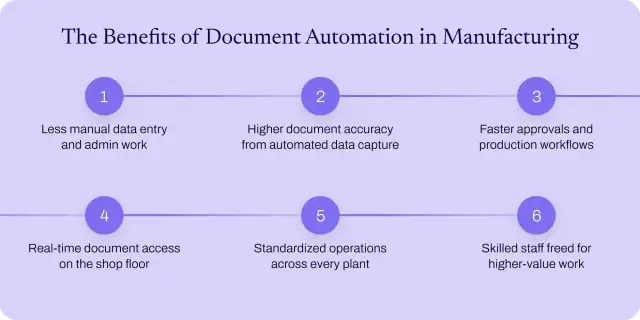
Let's break down six document automation benefits for manufacturers.
1. Less Manual Data Entry and Administrative Work
Left to manual workflows, staff retype the same part numbers, quantities, and pricing across work orders, invoices, quality records, and supplier agreements, then verify each one line by line. Manufacturing document automation removes that step: templates pull the data once from your ERP, MES, and CRM systems and populate every form automatically, cutting both the time spent and the errors hand-keying introduces.
That labor is what makes manual documentation so expensive, and the cost gap grows with every form you produce. According to Market Reports World, template systems drive generation costs below $0.10 per document, compared to $1.00 with manual processing for organizations issuing over 100,000 documents monthly. For a plant running that kind of volume, the tenfold difference hands hours and budget back to planning and production.

2. Higher Document Accuracy From Automated Data Capture
Every manual keystroke can transpose a part number or drop a decimal, and on a production line, one wrong figure scraps a batch or ships the wrong order. Automated data capture closes that gap. The system reads values straight from your ERP, MES, and PLM records, or extracts them from incoming PDFs with OCR, then validates and writes each into the correct field with no retyping.
Conditional logic adds the right specs and clauses for each product or region, so a certificate of conformance or shipping label holds up when a customer or auditor checks it. With automated document processing for manufacturing, every record draws from one verified source, and fewer manual touches leave fewer places for error.
3. Faster Approval and Production Workflows
A production line depends on documents moving as fast as the parts and materials it runs on, and approvals are where they usually stall. When a work order or engineering change travels by email and paper, it sits for days waiting on someone to return to their desk, holding up the line behind it.
Document automation for manufacturing routes each file to the right approver, triggers reminders, and captures a signature the moment a reviewer is ready, so quotes, purchase orders, and quality sign-offs clear in hours without printing or scanning. With an embedded eSignature tool like Conga Sign, approvers sign inside the systems they already use, so nothing waits on a separate app.
That process speed matters more as plants run leaner. In a Deloitte survey, 46% of manufacturers ranked process automation as a top-two investment priority to ease skilled labor shortages and lift productivity.

4. Real-Time Document Access on the Shop Floor
A technician working from last week's spec sheet can build the wrong part before anyone notices. Real-time access prevents that. Because every document pulls live data from your ERP and MES and syncs the moment those systems change, operators, inspectors, and supervisors open the current work order, batch record, or safety checklist on any tablet or terminal, whether at the machine, in the warehouse, or across a second plant.
The moment engineering revises a tolerance or work instruction, the change reaches the floor, so no one runs against a superseded file. Document automation replaces the binder and the shared drive with one live source, keeping lines moving and every build aligned to the latest approved record.
5. Standardized Operations Across Every Plant
When each plant builds its own work orders and quality forms, the same product ends up documented three different ways, and audits turn into detective work. Reusable templates fix that. A central library holds one approved format for every document type, so a batch record in Ohio matches the one in Monterrey down to the field.
Conditional logic adapts each template to the product, region, or regulation it serves, so you standardize without flattening real differences between lines. Tools like Conga Composer let central teams update the master template once and push the change to every site at the same time.
Standardize documents across plants with a single template library using Conga Composer.
6. Skilled Staff Freed for Higher-Value Work
You didn't hire a process engineer to format certificates or chase signatures, yet manual paperwork pulls exactly those people off the work that pays. Automation hands the routine back to the software: templates generate the documents, workflows route them, and integrations file them. Engineers return to design and root-cause analysis, quality teams focus on prevention over transcription, and planners get back to solving capacity problems.
Moving this administrative load off your people matters most where skilled labor runs short: every reclaimed hour feeds output, not overhead, and the gain grows as volumes climb. Manufacturing document automation clears the busywork so your experts spend their time where only they can add value.
How to Choose the Right Document Automation Tools for High-Volume Manufacturing and ERP
At the scale at which manufacturers operate, the wrong tool buckles the moment volumes spike or a second plant comes online. Choosing a document automation software for high-volume manufacturing and ERP comes down to a few capabilities that separate a platform built for enterprise production from one built for the occasional form.
| Document Automation Capability | What Manufacturers Should Look for | Why It Matters for High-Volume Manufacturing |
| ERP and MES Integration | Native integrations or APIs that connect with ERP, MES, CRM, and PLM systems, with real-time data synchronization. | Consistent production, inventory, and document data across business systems with less manual data entry. |
| High-Volume Document Generation | Batch processing, scheduled generation, and the ability to reliably produce large volumes of documents. | An automated document factory for work orders, batch records, certificates, and shipping records without bottlenecks. |
| Dynamic Templates and Version Control | Centralized templates, conditional logic, reusable content, and document version control. | Standardized documentation across facilities with fewer errors and greater consistency. |
| Compliance and Traceability | Audit trails, role-based access, document history, and support for industry standards such as ISO 9001, FDA 21 CFR Part 11, or AS9100, where applicable. | Improved audit readiness and document traceability to support regulatory compliance. |
| Embedded eSignature | Secure, integrated electronic signatures that fit into existing business systems. | Faster approvals for quotes, purchase orders, supplier agreements, and quality documentation within existing workflows. |
| Scalability and Performance | Cloud-based architecture, multi-site support, and reliable performance during peak production periods. | Reliable document throughput as production volumes, facilities, and users grow. |
| Security and Access Control | Encryption, role-based permissions, secure storage, and recognized security certifications, such as SOC 2. | Stronger protection for intellectual property, pricing information, supplier documents, and other sensitive manufacturing data. |
Power Manufacturing Document Automation with Conga
With document automation in manufacturing, you generate every work order, certificate, and purchase order from live data, route each one for embedded signature, and standardize it across every plant from a single template library. Conga's Document Automation solution brings all these capabilities together on one platform. You can also pair Conga Composer for high-volume generation with Conga Sign for approvals, embedded in the CRM, ERP, and MES systems your teams already use.
Our manufacturing solutions connect the front office to the shop floor, so a quote becomes a signed contract and a delivered document without manual rework. As volumes climb and plants multiply, the platform scales with you.
See what it does with your own work orders and certificates. Talk to the Conga team.
Automate every manufacturing document from quote to signed record with Conga.
Frequently Asked Questions
-
What types of documents can manufacturers automate?
The types of documents manufacturers can automate include:
- Shop-floor production documents: work orders, job travelers, routing sheets, and engineering change orders
- Engineering and design documents: bills of materials (BOMs), product specifications, and drawing packages
- Quality and inspection records: inspection reports, certificates of conformance, non-conformance reports, and batch or device history records
- Sales and procurement documents: quotes, proposals, purchase orders, and supplier agreements
- Shipping and logistics documents: commercial invoices, packing lists, and bills of lading
- Regulatory and safety documents: SOPs, material safety data sheets, and audit records
-
How does document automation support manufacturing compliance and quality control?
Document automation supports manufacturing compliance and quality control by pulling data straight from validated systems, so records stay accurate and consistent with no manual rekeying. Version control and conditional logic keep every plant on the current approved template. The system logs timestamps, revisions, and access history. That builds the audit trail standards like ISO 9001, FDA 21 CFR Part 11, and AS9100 require, so inspectors and auditors find complete, traceable records on demand.
-
How does a document automation system connect to ERP and MES systems in manufacturing?
A document automation system connects to ERP and MES systems in manufacturing through native integrations and APIs that read and write data in real time. Templates pull live values, such as part numbers, quantities, tolerances, and pricing, from those systems, generate the document, and sync any updates back so records and source data always match. That sync removes duplicate entries and keeps the shop floor and back office working from one set of numbers.
-
How does document automation speed up the quote-to-order process in manufacturing?
Document automation speeds up the quote-to-order process in manufacturing by generating accurate, on-brand quotes from live CRM and pricing data in one click, then routing them for embedded signature, so nothing waits on manual formatting or handoffs.
Manufacturer Despatch Industries shows the payoff: after adopting Conga Composer, its sales team cut detailed quotes from up to an hour to five minutes or less, producing them 12x faster while enforcing brand consistency and capturing 100% of opportunities in their CRM.
Related Resources
-
Checklist: 7 Essential Documents to Automate GuidesCLMChecklist: 7 Essential Documents to Automate
Today’s sales teams waste precious time and resources on repetitive, manual tasks when preparing quotes, proposals, and contracts. In fact, the average sales rep spends only 33% of their time each day actually selling.10/12/20263 min read -
The Million Document Moment: A Guide to Policy, Endorsement, and Renewal Accuracy at Scale GuidesDocument AutomationThe Million Document Moment: A Guide to Policy, Endorsement, and Renewal Accuracy at Scale
Learn how document automation supports large-scale businesses in the most regulated industries.10/05/20263 min read -
Connect and Learn With Peers in the Conga Customer Community BlogCLMConnect and Learn With Peers in the Conga Customer Community
Join 40,000+ peers in the Conga Customer Community—connect, learn, and grow with resources, training, and support to fuel smarter business outcomes.09/30/20266 min read -
The Quote to Cash Process in 10 Steps BlogCLMThe Quote to Cash Process in 10 Steps
Discover how to streamline your quote-to-cash (Q2C) process to accelerate sales cycles, improve customer experience, and boost revenue. This comprehensive guide covers every stage—from configuration and pricing to contract management, billing, and renewals—plus tips for finding the right automation solution. Learn how to eliminate silos, reduce errors, and drive efficiency across your CRM and ERP systems.08/12/20269 min read