What Is Contract Performance Management?
01/12/2026
10 min read

90%
of leaders call digital contract processes essential
63%
of executives say scattered data blocks contract monitoring
28
KPIs covered for tracking contract performance end-to-end
1M
saved in admin costs by Conga CLM customers
Contract performance management is the process of ensuring that parties meet their obligations and get the most financial and operational value from each agreement. Without real-time oversight, organizations risk losing revenue, missing deadlines, and facing compliance issues that hurt profits.
This guide explains the contract performance management framework, highlights key metrics to track, and shows how contract lifecycle management (CLM) software can automate the process.
Key highlights:
- Contract performance management involves tracking and enforcing contractual obligations, service levels, and financial outcomes to ensure that agreements achieve their intended business value.
- A contract performance management system replaces manual tracking with structured data and continuous monitoring, enabling early risk detection, better compliance, and informed renewal decisions.
- Conga CLM supports large-scale contract management and performance monitoring by consolidating agreement data, clarifying obligation ownership, and providing AI-driven insights to protect revenue and enforce commitments.
Why Do You Need to Manage Your Contract Performance?
Managing contract performance is important for reducing operational and financial risks. Teams should manage contract obligations, service levels, and milestones to avoid missed commitments and problems. If you rely on manual tracking or scattered systems, you may face delays, poor performance, and financial losses.
Because of these risks, many organizations are rethinking their workflows. McKinsey reports that 90% of leaders now view digital processes for agreements and compliance as essential. A structured approach to contract oversight turns agreements into measurable assets, making it easier to detect issues early, enforce accountability, and drive consistent outcomes.
The Contract Performance Management Process
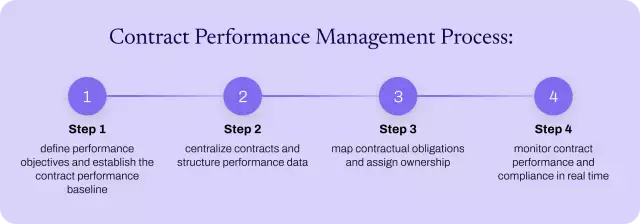
An effective contract performance management process relies on a structured, four-step framework.
Step 1: define objectives and establish the contract performance baseline
Before you start measuring performance, decide what success looks like for each agreement. Turn commercial, operational, and compliance terms into clear targets, so all teams know what is required from them. To establish a contract performance baseline:
- Identify critical deliverables: list specific products, services, financial thresholds, or milestones the counterparty must provide.
- Assign measurable standards: translate vague commitments into exact metrics.
- Formalize benchmarks in your CLM software: secure stakeholder agreement and lock these targets as reference points within structured data fields in the contract record before final signature.
Step 2: centralize contracts and structure performance data
To manage contracts and performance well, you need to see all obligations and service levels across every agreement. Here’s how to get started:
- Consolidate agreements from disparate silos into a single, secure repository, such as Conga CLM.
- Structure contract data by extracting SLAs, milestones, renewal dates, and financial thresholds into searchable fields rather than leaving them trapped in static text.
- Integrate operational systems (CRM, ERP, Finance) to ensure performance tracking relies on live execution data rather than manual inputs.
This way, you avoid missing information that could impact your ability to measure performance consistently. PwC found that 63% of executives say scattered data hinders contract monitoring and makes compliance harder. With centralized data, CLM users get real-time oversight, faster audits, and can spot risks sooner, helping agreements succeed.
Conga customers, for example, have reported saving up to $1M in contract administrative costs by centralizing agreements and structuring performance data within a single platform.
Step 3: map contractual obligations and assign ownership
When obligations are not assigned, agreements often fail. Effective contract lifecycle management means turning each deal into clear, trackable commitments with clear owners. Here’s how to do it:
- Break down clauses into specific obligations, such as payments, deliveries, reporting requirements, renewal actions, and compliance milestones.
- Record each contractual obligation as a structured record in your CLM system.
- Link obligations to the governing clause, due date, dependencies, and performance baseline.
- Assign a named individual owner with the authority to execute and escalate issues.
- Create automated alerts, real-time tracking, and reports for each owner across all contracts.
Step 4: monitor contract performance KPIs in real time and automate risk alerts
Track performance by comparing real-time data, such as service metrics, delivery confirmations, invoices, and audit results, to your baseline standards. Use contract management dashboards designed for each role to show key indicators such as SLA achievement, obligation status, milestones, and compliance.
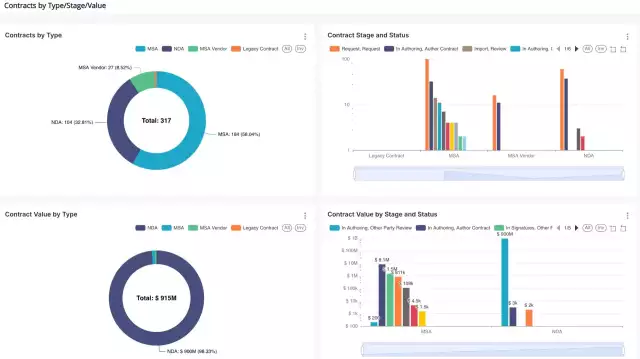
You can also set up automatic alerts for problems and use exception reports to flag contracts that need attention. Seeing information in real time makes it easier to act quickly, stay compliant, and make better choices about renewals and renegotiations.
28 Key Performance Indicators for Contract Management
Effective contract monitoring requires clear metrics across execution, finance, and compliance. Follow these KPIs to track obligations and close gaps throughout the agreement lifecycle:
| Contract management performance measurement area | Contract management key performance indicators | How it’s calculated | Why it matters |
| Performance baseline and execution | Contract performance baseline adherence | (Actual performance / Agreed baseline metric) x 100 | Confirm alignment with strategic goals and catch performance drift early |
| Service level agreement (SLA) achievement rate | (Total SLAs met / Total SLAs measured) x 100 | Verify vendor reliability and enforce quality standards to prevent disruption | |
| Milestone on-time completion rate | (Milestones completed on time / Total milestones) x 100 | Prevent downstream delays and ensure projects stay on schedule and budget | |
| Obligation fulfillment rate | (Obligations fulfilled / Total contractual obligations) x 100 | Guarantee parties fulfill all commitments to avoid breaches and reputation damage | |
| Contracting process efficiency | Contract cycle time | Average days from contract request to signature | Accelerate revenue recognition and improve overall operational excellence |
| Approval turnaround time | Average hours/days per approver | Eliminate internal bottlenecks that delay execution and frustrate stakeholders | |
| Signature velocity | Average time from final draft to eSignature | Close deals faster and reduce the risk of late-stage drop-offs | |
| Redline volume | Average number of redlines per contract type | Identify potential risks in negotiation to streamline future contract templates | |
| First-time acceptance rate | (% of contracts signed without redlines) | Validate template effectiveness and reduce time wasted on unnecessary negotiations | |
| Financial performance | Contract value realization | (Actual value delivered / Total contract value) x 100 | Ensure the business captures the full financial benefit intended by the agreement |
| Contract value leakage | (Lost value / Total contract value) x 100 | Stop silent revenue loss caused by billing errors or missed price uplifts | |
| Spend under management | (Spend governed by contracts / Total spend) x 100 | Maximize cost savings by enforcing purchasing through negotiated contracts | |
| Penalties and credits enforced | Total value of penalties/credits collected vs. eligible | Recover lost value and hold vendors financially accountable for underperformance | |
| Contract utilization rate | (Actual usage / Contracted capacity) x 100 | Optimize spend by identifying wasted resources or upsell opportunities | |
| Contract compliance and obligations | Contract compliance rate | (Compliant contracts / Total contracts) x 100 | Protect the organization from regulatory fines and policy violations |
| Missed obligations or breaches | Total count of missed contractual commitments | Detect risk early to prevent costly disputes and legal exposure | |
| Audit trail completeness | % of contracts with full activity logs | Secure defensibility during legal disputes and reduce the cost of external audits | |
| Contract risk management and governance | Contract risk score | Weighted score based on clause variance and attributes | Focus limited legal resources on agreements with the highest potential exposure. |
| Non-standard clause frequency | % of contracts containing modified standard clauses | Tighten governance to prevent unknown liabilities from entering the portfolio | |
| Audit findings per contract | Average number of issues flagged during audits | Identify systemic drafting weaknesses to improve future contract quality | |
| Contract lifecycle and renewal management | Renewal rate | (Contracts renewed / Contracts eligible for renewal) x 100 | Gauge customer satisfaction and the long-term health of recurring revenue |
| On-time renewal execution | % of renewals signed before expiration date | Avoid service interruptions and maintain pricing leverage during negotiations | |
| Contracts expiring soon | Count of contracts expiring in 30/60/90 days | Prevent unwanted auto-renewals and secure time for strategic renegotiation | |
| Ownership and accountability | Obligations with assigned owners | % of obligations mapped to a specific stakeholder | Ensure accountability so critical tasks don't slip through cracks |
| Performance issues by owner | Count of breaches/delays per internal owner | Spot skills gaps or resource constraints hindering successful execution | |
| Stakeholder and relationship effectiveness | Performance review cadence adherence | (Reviews completed / Reviews scheduled) x 100 | Maintain alignment with partners and address issues before they escalate |
| Stakeholder satisfaction score | Net promoter score (NPS) from internal/external partners | Assess relationship health to predict partnership longevity and cooperation | |
| Dispute frequency and resolution time | Average time to resolve contract disputes | Minimize business disruption and reduce legal costs associated with conflict |
Read more: 25 key contract analytics
Best Practices to Improve Your Contract Lifecycle Management Performance With CLM Software
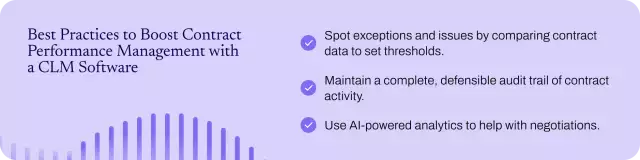
To improve contract lifecycle management performance with a CLM solution like Conga, configure the platform to automate monitoring, enforce accountability, and deliver decision-ready insights. Get started with these three best practices:
1. Spot exceptions and issues by comparing agreement data to set thresholds
With Conga CLM, you can trigger automated alerts for missed SLAs, delayed milestones, or contract values that deviate from approved terms, so owners can respond immediately.
2. Maintain a complete, defensible audit trail of contract activity
Use a CLM like Conga to capture approvals, amendments, communications, and performance events to support contract management performance audits and dispute resolution.
3. Use AI-powered analytics to help with negotiations.
Leverage Conga Contract AI to review past performance and contract risks, highlight delicate clauses, and spot underperforming suppliers before renewal.
Streamline Contract Management and Performance Monitoring With Conga CLM
Conga CLM supports contract performance management by bringing all lifecycle phases together in one scalable platform. Different teams can centralize agreements, organize performance data, and assign clear ownership for every obligation so execution matches set baselines.
Instead of relying on periodic reviews, you monitor performance and compliance in real time across all contracts. Automated alerts and AI-driven insights highlight execution risks, missed obligations, and value loss before they affect business outcomes.
For legal, procurement, and operations leaders, Conga Contract Lifecycle Management Platform replaces manual tracking with continuous performance control. You can enforce commitments, verify compliance, and base renewal decisions on real data rather than assumptions.
Optimize your contract performance management process. Contact our sales team.
Frequently Asked Questions
How does contract performance impact stakeholders and department managers?
Failure in contract performance forces department managers into reactive “firefighting” and constant resource shifts. It takes away the financial certainty stakeholders need to protect the bottom line. Missed SLAs disrupt procurement, while unfulfilled obligations expose legal teams to contract risk. Without reliable data, finance loses forecast accuracy. These gaps prevent leaders from planning effectively, managing supplier underperformance, or hitting revenue goals.
What are the best CLM vendors for improving contract performance and compliance?
The best CLM vendors for improving contract performance and compliance are those that centralize contracts, organize performance data, assign ownership of obligations, and support real-time monitoring. Top solutions like Conga CLM offer automated alerts, audit trails, system integrations, and AI insights to reduce risk and enforce accountability. Many enterprises choose Conga because we connect agreement execution with performance tracking, compliance, and renewal management at scale.
Learn more about Conga CLM.
Frequently Asked Questions
-
What is contract performance management and why does it matter?
Contract performance management is the process of tracking and enforcing contractual obligations, service levels, and financial outcomes to make sure agreements deliver their intended business value. Without structured oversight, organizations miss deadlines, lose revenue, and face compliance exposure. McKinsey reports that 90% of leaders now consider digital contract and compliance processes essential, which is why more organizations are moving away from manual tracking toward real-time monitoring.
-
What are the most important KPIs for contract performance management?
The 4 areas to track are execution, financial performance, compliance, and renewal management. Key metrics include SLA achievement rate, obligation fulfillment rate, contract value leakage, compliance rate, and on-time renewal execution. Each KPI connects to a specific business risk: missed SLAs signal vendor reliability issues, value leakage points to billing gaps, and low renewal rates reflect relationship health. A CLM platform like Conga CLM consolidates these metrics into role-specific dashboards so teams can act on live data.
-
How does CLM software improve contract performance monitoring?
CLM software replaces manual tracking with structured data, automated alerts, and continuous monitoring across every agreement. With Conga CLM, teams can extract obligations and SLAs into searchable fields, assign clear ownership, set automated alerts for missed milestones, and maintain a complete audit trail. The result is faster issue detection, better compliance, and renewal decisions based on real performance data rather than assumptions.
-
What causes contract performance failures and how can they be prevented?
Most failures come down to 3 things: obligations without named owners, performance data scattered across disconnected systems, and no real-time visibility into whether commitments are being met. PwC found that 63% of executives say fragmented data makes contract monitoring harder. Centralizing agreements in a single platform, structuring obligation data, integrating with CRM and ERP systems, and automating alerts are the most effective ways to prevent performance gaps before they become costly.
-
How does Conga CLM support contract performance management at scale?
Conga CLM brings all lifecycle phases into one platform, from request and authoring through obligation tracking and renewal. Teams can centralize agreements, structure performance data, assign obligation ownership, and monitor compliance in real time across their entire portfolio. AI-driven insights from Conga Contract AI flag underperforming suppliers, highlight risky clauses, and surface value leakage before renewal. Conga customers have reported up to $1M in administrative cost savings by centralizing and automating contract operations.
Related Resources
-
Connect and Learn With Peers in the Conga Customer Community BlogCLMConnect and Learn With Peers in the Conga Customer Community
Join 40,000+ peers in the Conga Customer Community—connect, learn, and grow with resources, training, and support to fuel smarter business outcomes.09/30/20266 min read -
The Contract Management Strategy You Might Be Overlooking BlogCLMThe Contract Management Strategy You Might Be Overlooking
Discover the contract management strategy that improves collaboration, clarity, and results—without overcomplicating your process.07/15/20257 min read -
The Quote to Cash Process in 10 Steps BlogCLMThe Quote to Cash Process in 10 Steps
Discover how to streamline your quote-to-cash (Q2C) process to accelerate sales cycles, improve customer experience, and boost revenue. This comprehensive guide covers every stage—from configuration and pricing to contract management, billing, and renewals—plus tips for finding the right automation solution. Learn how to eliminate silos, reduce errors, and drive efficiency across your CRM and ERP systems.12/01/20259 min read -
The Complexity Tax: How Manufacturers Can Stop Leaving Revenue on the Table BlogManufacturingThe Complexity Tax: How Manufacturers Can Stop Leaving Revenue on the Table
Product lines grow. Quoting slows. Contracts pile up. Learn how manufacturers are tackling commercial complexity with CPQ and CLM to recover lost revenue.07/13/20267 min read