What Is Contract Intelligence? How It Works and Its Benefits
07/23/2026
7 min read

AI extracts and transforms contract text into actionable data
Intelligent contract management eliminates manual work at scale
Evaluate solutions on extraction accuracy and CRM integration
Conga CLM saves up to 200 attorney hours per year
Contract intelligence is the use of artificial intelligence (AI) and machine learning (ML) to ingest, analyze, and transform unstructured agreement text into verified, actionable data. Unlike traditional contract management, which focuses on document storage, intelligent contracting software extracts governing terms, commercial obligations, and key dates from thousands of legal deals to protect stakeholders from breach risks.
In this guide, we broke down how contract intelligence works, how different teams leverage it to accelerate revenue cycles and reduce risk, and the key features to prioritize when selecting a solution.
How Does Contract Intelligence Work?
Intelligent contract management works by using AI and ML to extract, analyze, and manage key data from legal documents, streamlining compliance and decision-making.
Intelligent solutions follow a defined sequence that turns agreements into actionable insights:
- Contract ingestion: centralized capture of paper, PDF, and digital agreements from SharePoint, cloud storage, and legacy systems
- Data extraction: identification of key elements such as parties, effective dates, pricing terms, contractual obligations, and governing clauses
- Data verification: validation by legal domain experts to ensure accuracy and continuously improve AI models
- Data transformation: calculation of renewal windows, notice periods, and expiration dates to support automated alerts
- Contract analytics: population of searchable dashboards that reveal risk exposure, compliance status, and revenue impact
How Different Teams Use Intelligent Contract Management
Artificial intelligence contract management adds value across teams by automating agreement tasks and improving access to key information. With standardized, non-siloed data, you ensure enterprise-wide visibility and operational efficiency. Case in point: the Federal Reserve Bank of St. Louis reports that generative AI saves workers 5.4% of their time, about 2.2 hours per week. For contract-heavy teams, these savings enable faster execution, better compliance, and more predictable revenue.
| Team | Specific uses of artificial intelligence in contracts | Impact |
| Legal | Extraction of governing terms, obligations, and renewal conditions across thousands of agreements | Strategic time savings for attorneys and reduced manual contract analysis effort |
| Finance | Identification of price increases, caps, and specific notification requirements in legacy contracts | Enhanced forecasting for upcoming quarters and protection against revenue leakage |
| Procurement | Proactive monitoring of auto-renewals and due diligence on audit or assignability clauses | Elimination of surprise expenses and avoidance of unwanted contract rollovers |
| Sales | Real-time visibility into price escalation clauses and expiration dates during negotiation | Faster contract cycles and prevention of missed expansion opportunities |
Benefits of Implementing Contract Intelligence Solutions
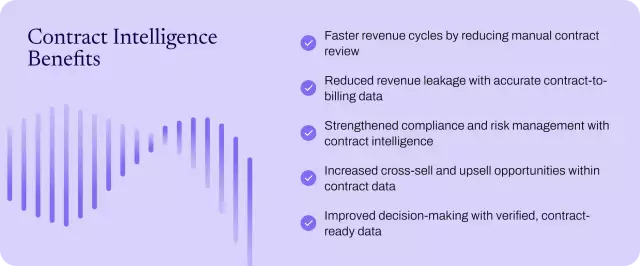
Implementing artificial intelligence in contracts scales deal analysis across thousands of agreements in a portfolio while reducing manual work. Key benefits include:
Faster revenue cycles by reducing manual contract review
Contract intelligence shortens revenue cycles by automating review and standardizing risk assessment. By reducing manual redlining and rework, legal teams move agreements forward without sacrificing accuracy, preventing slow cycles from costing sales teams critical deals.
Artificial intelligence routes standard agreements through automated workflows, helping sales close faster while avoiding costly oversights. With contract intelligence software such as Conga Contract AI, you can save up to 200 hours per attorney each year by cutting out manual review processes.

Reduced revenue leakage with accurate contract-to-billing data
Intelligent contracting extracts price escalators, caps, and notification requirements from unstructured contract text to prevent revenue loss. Automated extraction transforms commercial terms into structured, verified data so billing systems precisely reflect every negotiated deal.
Organizations leveraging Conga Contract Intelligence anticipate a 1% to 3% rise in annual recurring revenue. Our platform automatically identifies price increases and renewal opportunities that manual reviews often miss.
Read more: how to avoid revenue leakage
Strengthened compliance and risk management with contract intelligence
With intelligent contracting, you can track every contract obligation in real time, reducing liability and risk across your enterprise. WorldCC reports that poorly defined and managed risks account for significant financial losses across portfolios, often exceeding 10% of total agreement value.

An intelligent contract solution mitigates financial and compliance risk by identifying hidden clauses and highlighting ambiguous language for quick review, preventing legal, financial, and regulatory vulnerabilities.
Increased cross-sell and upsell opportunities within contract data
Intelligent contract management transforms static documents into searchable business assets by extracting growth triggers such as expansion rights, usage limits, and renewal dates. With clear visibility into obligations and customer lifetime value, revenue teams can identify cross-sell and upsell moments with greater accuracy than manual sifting. Conga CLM, for example, surfaces these opportunities directly within the system of record, enabling accurate forecasting and proactive engagement.
Improved decision-making with verified, contract-ready data
Verified, agreement-ready data provides a reliable foundation for confident decision-making. Intelligent contracts replace manual, error-prone review with high-accuracy extraction, transforming dense legal language into trusted, searchable insights. By eliminating small data errors that cause wasted time, lost revenue, increased risk, and customer churn, solutions such as Conga CLM provide a single source of truth for analyzing performance, modeling outcomes, and making fact-based decisions.
Key Features to Consider When Choosing Contract Intelligence Software
According to Verified Market Research, the contract intelligence market is projected to grow at a 19.6% CAGR, reaching $4,081.7 billion by 2032, as organizations seek to convert static agreements into operational data. As adoption scales, selecting the right platform requires prioritizing capabilities that turn legal documents into high-fidelity assets to drive the entire revenue lifecycle. Key features to consider:
| Contract intelligence software feature | What to look for | Why it matters |
| Contract data extraction accuracy | Precision in identifying metadata and complex clauses with specialized natural language processing (NLP) and legal-expert verification. | High accuracy eliminates minor errors that cause wasted time, revenue leakage, and increased customer churn. |
| Revenue lifecycle integration | Native synchronization with CRM, ERP, and billing systems such as Salesforce and SAP. | Seamless connectivity removes data silos and aligns sales, legal, and finance on a single source of truth. |
| Compliance automation | Automated tracking of every obligation and proactive alerts for key dates such as renewals. | Real-time monitoring prevents missed deadlines and regulatory penalties. |
| Custom AI models | Industry-specific training and adaptive learning that understand unique terminology. | Specialized models provide more valuable insights and adapt to an organization’s specific risk tolerance over time. |
| Search and contract analytics | Centralized, searchable contract repositories with dashboards for end-to-end portfolio visibility. | Instant data discovery identifies hidden trends and enables stakeholders to make fact-based strategic decisions. |
| Scalability and performance | Bulk upload capabilities and high-speed processing for thousands of existing agreements. | Robust architecture supports rapid organizational growth without requiring a proportional increase in administrative headcount. |
| AI transparency and decision traceability | Audit trails and explainable AI that link extracted data directly to the original contract text. | Transparent logic builds trust with legal teams and satisfies auditors by making every AI-driven decision auditable. |
Explore the best features to look for in CLM software.
Leverage Conga Contract Intelligence to Reduce Risk and Unlock Revenue
Conga Contract Intelligence moves beyond basic management by applying AI to analyze your entire agreement portfolio. Our solution extracts and verifies critical terms to provide the insights needed for proactive revenue management and risk control.
Conga Contract Lifecycle Management Platform delivers this intelligence by:
- Leveraging your existing agreements: AI transforms static contracts into a searchable, centralized repository of negotiated terms and clauses
- Eliminating manual data extraction: automated workflows identify obligations, dates, and financial terms, removing error-prone manual review
- Providing predictive insights: the system generates alerts for renewals and risks while highlighting revenue opportunities hidden in contract language
Ready to scale your business with contract intelligence software? Contact our sales team.

Frequently Asked Questions
-
How does contract intelligence differ from traditional contract management?
Contract intelligence differs from traditional contract management by applying artificial intelligence and machine learning to analyze contract language and extract structured insights at scale.
- Traditional contract management focuses on storing documents and handling simple workflows. People have to review contracts by hand to find terms, obligations, and risks.
- Contract intelligenceautomates data extraction, monitors compliance, and even predicts potential issues.
Read more: what is AI for contract management?
-
What is the difference between contract intelligence and smart contracts?
The difference between contract intelligence and smart contracts is that contract intelligence uses AI to analyze and extract data from written legal agreements, while smart contracts are self-executing programs that automatically trigger specific actions once predefined rules apply.
Category Contract intelligence Smart contracts Primary purpose Static contracts transformed into valuable, searchable business assets Automated execution of agreements based on predefined triggers Technology foundation Artificial intelligence (AI) combined with legal-expert verification Blockchain technology and coded logic Contract types supported Complex, dense legalese and standard business agreements Simple, programmatic transactions with binary outcomes Flexibility Adaptation to changing business models and unique complexities Rigid structure; the code is typically immutable once deployed Role in contract lifecycle End-to-end insights and visibility into post-signature obligations Immediate execution phase of a deal Typical users Legal, sales, and revenue operations teams Developers and automated systems Business value Accurate forecasting, reduced contract risk, and identified expansion opportunities Increased transaction speed and reduced need for intermediaries -
What are examples of contract intelligence?
Examples of contract intelligence include:
- Automated data extraction: AI finds dates, terms, and key clauses in existing documents.
- Centralized repositories: searchable databases collect all the extracted data, so you do not have to sort through contracts by hand.
- Contract performance dashboards: visual tools that help you track revenue cycles and spot risks using data.
-
Can contract intelligence tools handle agreements written in multiple languages?
Yes. Contract intelligence platforms use language models trained on local legal terms and verify the accuracy of the data they extract. This capability enables global organizations to review and manage contracts from anywhere, without manual translation.
-
How to Shorten Your Sales Cycle: Fix the Handoffs, Not the Hustle BlogAIHow to Shorten Your Sales Cycle: Fix the Handoffs, Not the Hustle
Learn how to shorten your sales cycle by removing the hidden friction between teams, pricing, approvals, contracting that stalls deals right when they should close.07/24/20269 min read -
Stop Guessing & Start Deciding: The Forrester Framework for Buy vs. Build Analyst ReportIndustry InsightsStop Guessing & Start Deciding: The Forrester Framework for Buy vs. Build
AI lowered the cost of building software. It didn't lower the cost of running it. Get the Forrester framework that helps you decide what to buy, build, or generate.07/22/20264 min read -
Only the Agile Thrive BlogIndustry InsightsOnly the Agile Thrive
Discover how business agility, AI, and connected data help companies respond faster to tariff disruptions, reduce risk, and make confident go‑to‑market decisions.07/22/20265 min read -
Why AI-Powered Pricing is Now a Business Necessity for Margin and Growth BlogAIWhy AI-Powered Pricing is Now a Business Necessity for Margin and Growth
Learn why AI pricing is becoming essential for businesses facing rising market volatility, increased pricing pressures, and growing need for agility.07/16/20267 min read