Healthcare Contract Lifecycle Management
09/27/2023
10 min read
Healthcare organizations manage some of the most complex contracts in any industry. These agreements include physician participation agreements, payer-provider contracts, business associate agreements (BAAs), and vendor deals governed by strict regulatory requirements. Yet many organizations still rely on manual, fragmented processes that slow contract cycles, create compliance gaps, and strain provider relationships.
This guide covers how payers and providers use healthcare contract lifecycle management software to automate key processes, reduce risk, and improve operational control. For a deeper look, download our eBook on automated healthcare processes.
Key highlights:
- Contract lifecycle management for healthcare is the end-to-end process of creating, negotiating, executing, tracking, and renewing contracts across payer and provider organizations within a centralized, automated system.
- Healthcare contract management reduces manual work, shortens cycles, and strengthens compliance by replacing disconnected tools with standardized workflows and real-time visibility.
- Healthcare contract lifecycle management software helps payers and providers manage distinct operational needs.
- Conga CLM helps healthcare organizations automate the full contract lifecycle with purpose-built workflows, centralized data, native Salesforce and eSignature integrations, and a secure cloud platform built for healthcare-scale complexity.
What Is Contract Lifecycle Management for Healthcare?
Contract lifecycle management (CLM) for healthcare is the end-to-end process of creating, negotiating, executing, tracking obligations, and renewing agreements across payer and provider organizations. It replaces disconnected tools with a centralized, cloud-based system that converts static documents into live metadata, giving legal and operations teams visibility into compliance terms, financial commitments, and high-volume workflows.
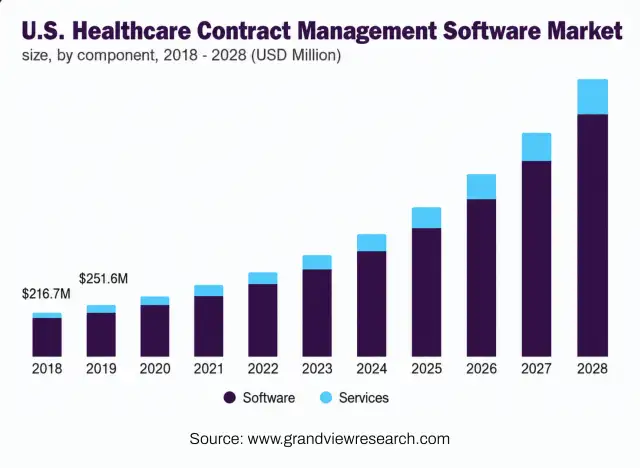
Investment in CLM is accelerating: according to Grand View Research, the global healthcare contract management software market is projected to grow from $906 million in 2020 to $4.6 billion by 2028, at a 22.8% CAGR. Organizations across the industry are replacing manual processes with automated infrastructure to reduce cycle times, close compliance gaps, and control administrative costs at scale.
Healthcare Contract Lifecycle Management for Payers vs. Providers
Payers and providers operate on opposite sides of the medical economic ecosystem. While both handle high volumes of agreements, their workflows, friction points, and system dependencies require separate operational strategies.
Conga unifies these complex requirements with specialized contract management for payers and providers. Our platform architecture delivers purpose-built workflows, centralized agreement data, and real-time visibility.
| Healthcare Operational Dimension | Healthcare Payers | Healthcare Providers |
| Primary Contract Types | Managed care agreements, provider network contracts, employer group plans, and network rate schedules | Physician participation agreements, clinical trial agreements (CTAs), BAAs, and vendor contracts |
| Core Operational Challenges | Fragmented data replication across systems, manual rate schedule updates, and complex claims processing delays | Slow credentialing processes, manual milestone tracking for clinical trials, and heavy administrative and legal overhead |
| Primary Compliance Exposure | Centers for Medicare & Medicaid Services (CMS) guidelines, Affordable Care Act (ACA) updates, and network adequacy standards | Stark Law regulations, Anti-Kickback Statute violations, and unauthorized deviations from approved legal playbooks |
| Key Contract Automation Priorities | Mass plan amendments, contract metadata extraction for rate tables, and integrated network onboarding workflows | Template standardization, clause validation against playbooks, and automated clinical trial obligation tracking |
| Strategic Business Outcomes | Financial margin protection, eliminated billing disputes, and real-time network visibility | Contract cycle velocity, eliminated compliance gaps, and stronger provider relationships |
Looking for a deep dive into insurance and managed care contract automation? Read the Ultimate Guide to CLM for Healthcare Payers.
Common Contract Management Challenges in Healthcare
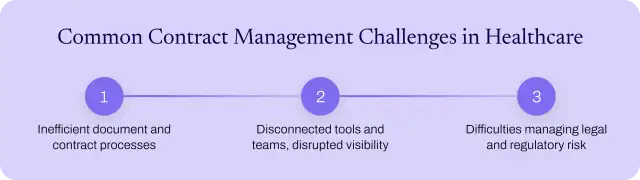
Even with the global push for greater efficiency across industries, many healthcare organizations lag in business process optimization. Without modern tools at hand, teams have to grapple with three key issues:
1. Inefficient document and contract processes
Manual processes require significant time and effort, especially when creating and managing complex, multifaceted contracts, such as those between payers and providers.
For example, physician participation agreements and BAAs contain a multitude of line items—such as provider and service details, credentialing requirements, fee and reimbursement terms, rate obligations, and participating locations—that should be filled in and updated.
A typical contract process also requires human intervention at every step. Usually, it involves someone in legal poring over every detail and revision before sending the document to the other party for scrutiny, approval, and possibly further revision. But there’s no easy way for an administrator or other team member to make a change and update the agreement in real time.
Instead, any change requires sending it back to legal and restarting the entire process. There’s also no way to make mass changes to a large number of deals or take similar bulk actions to improve efficiency.
Manually creating, amending, updating, approving, and managing these documents is not only time-consuming and error-prone but also costly.
2. Disconnected tools and teams, disrupted visibility
Nearly every organization has a contract creation and approval process, a procurement and ordering process, and an onboarding process. But it’s rare that these processes integrate and interconnect to synchronize and actually share information. This disorganization results in massive visibility gaps that increase the likelihood of errors, omissions, or delays.
For example, on the payer side, whenever an insurance company onboards a new practice, business, partner, or physician, they must manually replicate information by pulling data from multiple systems.
Even automation solutions can be disconnected from each other. An organization’s legal team may use a contract lifecycle management tool, while the procurement team uses its own software platform, and sales uses a CRM. But no team has visibility into the other team’s system, making it difficult to address friction or gaps in processes and reduce errors during the lifecycle.
Without a centralized contract management tool, there’s no way to store terms and details as metadata, making it more difficult to extract and report on the data as well as integrate it with connected systems. This decentralization prevents providers and payers from accurately accessing what they need, when they need it, and hurts their ability to serve customers of those connected systems, resulting in disputes, additional manual work, and compromised customer and vendor experiences.
3. Difficulties managing legal and regulatory risk
Contract risk management is a top priority in the healthcare industry, but how this translates to agreements and documents is often messy and confusing.
Healthcare organizations must strictly adhere to myriad laws, regulations, and industry standards, including HIPAA, the HITECH Act, the Affordable Care Act, JCAHO, GDPR, CCPA, the Sunshine Act, and the Stark Law. Compliance also requires a near-continuous process of ensuring that all clauses, terms, and obligations related to each law are standardized, updated, and included across all documentation and processes, and that this occurs within the allotted time to meet deadlines.
But if there’s no centralized and templated system for teams to intelligently search for, update, and reuse clauses and other legal language, it’s much harder to mitigate contract risk and reduce liability.
Benefits of Healthcare Contract Lifecycle Management Software
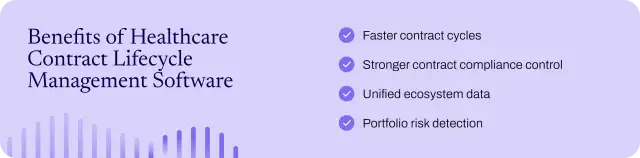
Healthcare contract lifecycle management software gives payers and providers operational control over processes that manual methods can’t scale. By replacing disconnected systems with a centralized platform, organizations standardize workflows, improve data accuracy, and accelerate high-volume processes such as provider onboarding, approvals, and renewals.
The best contract management software for healthcare allows organizations to:
- Accelerate agreement cycles: automated contract approval workflows and self-service templates cut cycle times and eliminate administrative bottlenecks that stall vendor deals
- Enforce compliance control: centralized clause libraries and contract obligation management help ensure that regulatory requirements such as HIPAA, the Stark Law, and CMS guidelines are applied consistently across all contracts
- Unify ecosystem data: integrated contract repositories connect agreement metadata with external claims, payments, and eligibility verification platforms to keep teams aligned on real-time data
- Detect portfolio risk: advanced contract search and provision detection capabilities surface hidden liabilities and problematic language before audits occur
Conga CLM brings these capabilities together on a secure, cloud-based platform. By integrating natively with eSignature tools and Salesforce customer relationship management, Conga removes operational friction. With this single source of truth, you transform static healthcare agreements into strategic operational assets.
Manage every healthcare contract from creation to renewal with Conga
Automating Healthcare Contract Management: 5 Ways to Improve Efficiency
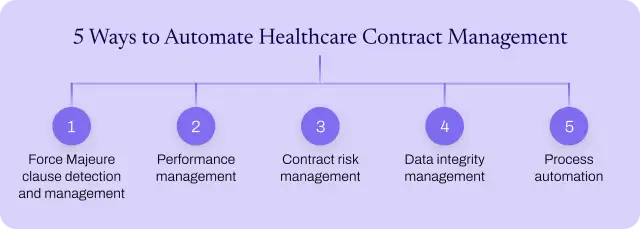
While every healthcare organization is different, they all share a similar need for efficiency, data integrity, and risk mitigation. Here are the five aspects of healthcare contract management that can be automated with CLM solutions to better meet these needs.
1. Force Majeure clause detection and management
In the wake of the pandemic, Force Majeure clauses have taken on new meaning. CLM software like Conga allows healthcare organizations to build and update these clauses within contracts to protect against sudden, unforeseen disruptions and loss of business, should another health crisis or similar widespread emergency appear again.
2. Performance management
Provider service agreements contain operational standards and milestones, which often trigger fee disbursements. Conga CLM provides greater visibility into and control over contract performance, driving providers to meet their contractual obligations and get reimbursed.
3. Contract risk management
Risk can live anywhere, especially when error-prone humans and manual effort are involved. Through template standardization and language detection. Conga’s automated solutions help organizations find, mitigate, and reduce risk across document processes and throughout the lifecycle, avoiding costly contract compliance and other business issues.
4. Data integrity management
With any number of software systems and technology tools in play at any given time, it’s difficult for teams to find and access the information they need, while also avoiding data duplication and corruption. Instead of hunting in multiple locations, Conga’s healthcare solutions help maintain a single source of truth, enabling healthcare organizations to integrate and access records across systems, making it easier for key teams to use and share essential information.
Learn how to automate data extraction from contracts.
5. Process automation
The demand to improve efficiency in healthcare will only continue to increase. By using an enterprise CLM like Conga, you automate processes and workflows to keep pace with the industry’s shift toward digital tools and reduce operational costs. Enabling mass creation and updating of provider agreements, for example, improves administrative efficiency and helps decrease spend.
Scale Smarter with Conga Healthcare Contract Management Software
Healthcare contract management touches every operation: provider onboarding, credentialing, rate management, compliance monitoring, and vendor relationships. When those processes run on disconnected, manual systems, costs accumulate in delayed cycles, compliance gaps, and administrative overhead that pulls resources away from patient care.
Organizations that centralize contract operations on a unified platform gain visibility across every agreement, reduce administrative burden, and free legal and operations teams to focus on higher-value work. Payers and providers that automate the full lifecycle also adapt faster to shifting market conditions and regulatory changes.
The Conga Contract Lifecycle Management platform brings agreement creation, negotiation, approvals, obligation tracking, and renewals into one connected system with:
- AI-powered contract analytics and risk detection
- Native integration with Salesforce and eSignature solutions
- A secure, cloud-based architecture built for the scale and complexity of healthcare organizations
Ready to automate your contracting workflows? Contact our sales team to optimize your healthcare contract operations.
Modernize healthcare contract management with Conga CLM for faster, more compliant workflows
Frequently Asked Questions
-
Why is healthcare contract management important?
Healthcare contract management is important because the average hospital manages 1,200+ contracts that govern reimbursement, compliance, and operational risk — and poor oversight triggers financial penalties and regulatory exposure.
-
What are the key types of healthcare contracts?
The key types of healthcare contracts are:
- Physician participation agreements: define the terms under which physicians join a provider network, including credentialing requirements, service obligations, and compensation structures
- Payer-provider agreements: govern reimbursement rates, covered services, and network participation rules between insurance companies and healthcare providers.
- Business associate agreements (BAAs): establish data privacy and security responsibilities for third-party vendors and partners that handle protected health information (PHI) under HIPAA
- Value-based care contracts: tie financial reimbursement directly to patient outcomes and quality performance metrics rather than traditional service volume
- Clinical trial agreements (CTAs): define the financial arrangements, milestone obligations, and intellectual property terms between research sponsors and healthcare organizations
- Vendor and procurement contracts: cover medical equipment leases, software subscriptions, and third-party services that support clinical and administrative operations
-
What contract lifecycle management solutions are recommended for healthcare providers?
The contract lifecycle management solutions recommended for healthcare providers are enterprise platform architectures that automate the full agreement lifecycle within a centralized, cloud-based system. Healthcare providers require platforms that integrate natively with electronic health records (EHRs), credentialing software, and eSignature tools to accelerate high-volume workflows such as physician onboarding.
Conga CLM is the ideal solution, using template standardization and automated clause validation to eliminate rogue contracting while maintaining compliance with the requirements of HIPAA, the Stark Law, and the Anti-Kickback Statute.
-
What is the best contract management software for healthcare?
The best contract management software for healthcare is Conga CLM. It unifies complex payer and provider operations on a single, secure platform. Our platform architecture connects creation, negotiation, automated approvals, obligation tracking, and renewals inside core workflows.
Native integrations allow teams to manage portfolios without switching applications. Conga CLM converts flat document text into live metadata, providing healthcare networks with purpose-built capabilities to handle credentialing, track milestones, and protect financial margins.
-
How does AI contract analytics for healthcare help providers and payers reduce contract risk?
AI contract analytics for healthcare help providers and payers identify and mitigate risk by automatically extracting and analyzing data across large agreement portfolios. The technology converts flat document text into searchable operational data to expose non-compliant clauses, flag missing obligations, and monitor upcoming renewal dates.
For payers, contract intelligence reduces exposure to network adequacy violations and costly billing disputes. For providers, it prevents missed milestones, unauthorized language deviations, and revenue-cycle gaps that manual review processes routinely overlook.
Review the best AI contract review software tools.
Related Resources
-
The Million Document Moment: A Guide to Navigating Document Complexity and Compliance at Scale GuidesDocument AutomationThe Million Document Moment: A Guide to Navigating Document Complexity and Compliance at Scale
Learn how document automation supports large-scale businesses in the most regulated industries.08/18/20262 min read -
A buyer’s guide to choosing the right document automation solution GuidesDocument AutomationA buyer’s guide to choosing the right document automation solution
No matter the industry, you’re likely wading through a constant deluge of documentation. Whether it’s physical paper, all electronic, or a mixture of both, the risk of getting lost in the stream is always present.08/28/20238 min read -
How finance teams can save 10+ hours a week GuidesDocument AutomationHow finance teams can save 10+ hours a week
Document automation is a critical tool for finance leaders looking to enhance operational efficiency and improve regulatory compliance. Read on to learn the ins and outs of document automation for finance teams.07/09/20257 min read -
Unlock the key to revenue growth in 2025 GuidesCLMUnlock the key to revenue growth in 2025
Read the full report, The revenue imperative: overcoming efficiencies to maximize growth03/14/20252 min read