
Medical Device Pricing Strategy for Quoting Optimization
09/10/2026
10 min read

Medical device pricing rarely comes down to one list price. You have to account for product configurations, contracts, bundles, discount limits, and margin targets while buyers push for account-specific terms. Yet many teams still manage these decisions through spreadsheets and disconnected quoting tools, leaving reps to interpret rules without a clear view of margin impact.
In this article, you’ll learn what a medical device pricing strategy covers, which approaches fit different products and contracts, and how AI-powered solutions support better quotes.
Pricing strategy defines list prices, discounts, bundles, terms, and approvals
Main approaches: value-based, bundled, tiered, AI-optimized, and CPQ-enabled
Conga POM sets the best price for every product
Conga CPQ carries pricing into quotes with built-in guardrails
What Is a Medical Device Pricing Strategy?
A medical device pricing strategy is the set of rules, methods, and data you use to decide how much to charge for each product in your catalog. The strategy covers aspects including:
- List prices
- Discount policies
- Bundling logic
- Approval limits that govern how far a rep flexes on a deal
According to Precedence Research, the global medical devices market was valued at $678.88 billion in 2025 and is projected to reach $1.2 trillion by 2035. But growth alone won’t translate into profitable revenue, which is why you need a pricing strategy that helps reps set the right price.
Why Medical Device Pricing Is So Complex
Medical device margins have faced sustained pressure throughout the 2020s. COVID-19 disrupted elective procedures, while inflation, higher interest rates, freight and fuel costs, supply constraints, and geopolitical instability raised costs. At the same time, healthcare affordability programs and tighter provider budgets limited room for price increases.
Pricing teams now manage high complexity:
- Thousands of SKUs: Product catalogs span equipment, implants, disposables, accessories, replacement parts, software, and services.
- Connected product portfolios: A discount on equipment may support years of consumable, software, and service revenue.
- GPO and IDN agreements: Group purchasing organizations (GPOs) and integrated delivery networks (IDNs) negotiate volume tiers, committed pricing, and account-specific terms on behalf of providers.
- Regulatory and contractual requirements: Different buyers often mean specific contracts, which obligate teams to constantly review deals.
- Regional variation: Competitive conditions, currencies, reimbursement models, healthcare systems, and buying behavior differ by market.
- Multi-party negotiations: Sales teams negotiate with procurement leaders, clinicians, finance teams, and hospital executives, often within the same deal.
- Reimbursement pressure: Buyers evaluate reimbursement levels, clinical outcomes, and total cost of care before approving a purchase.
Learn how to overcome the challenges of medtech pricing.
Why Traditional Medtech Pricing Strategy Fails in Execution
Most traditional medical device pricing strategies fail because of disconnected systems. Quoting teams often update price books in spreadsheets, while sales teams configure offers, interpret contracts, and request approvals in different tools, such as a medical equipment CPQ.
AI-powered pricing and CPQ tools replace static price books with account-specific recommendations. Rules apply as the rep builds the quote, exceptions route to the right approver, and margin impact shows before the deal moves.
That said, AI-powered medtech pricing is still early in its adoption journey. A Deloitte survey found that only 15% of surveyed executives operate AI at scale, while 53% plan to invest in AI-enabled platforms in 2026 and 47% would deploy AI tools to improve operational efficiency. Pricing is one possible application, including customized prices and contract structures, automated negotiation workflows, and alerts when a deal puts margin at risk.

See how AI pricing for medical devices makes your life easier:
| Commercial Dimension | Traditional MedTech Pricing Strategy | Modern AI-Powered CPQ and Pricing (The Conga Way) |
| Price setting | Static price books and spreadsheet-based updates | AI-powered, account-specific pricing recommendations for hospitals, GPOs, and IDNs for each deal |
| Quote execution | Manual configuration and inconsistent discounting | Automated CPQ software for medical equipment with pricing guardrails and guided quote generation |
| Approval workflows | Email-based reviews that delay deals | Automated approval workflows with rule-based exception routing |
| Real-Time transparency and reporting | Limited visibility into discounts and pricing leakage | Real-time margin visibility and controlled discounting at the line-item and deal level |
| Pricing governance | Inconsistent pricing across teams, regions, and channels | Centralized policies enforced across every quote and transaction |
| System connectivity | Disconnected pricing, CRM, ERP, and contracting systems | Integrated commerce chain from pricing and CPQ through contracting and billing |
| Continuous optimization | Static pricing decisions with limited feedback | Win/loss, quote, margin, and transaction data improve AI-driven pricing recommendations over time |
AI pricing for medical devices such as Conga Price Optimization and Management (POM) reads your quote, win/loss, and transaction history to return a recommended price and range for every deal like the ones in the table above.
See the drivers behind every price tag with Conga POM
How Medical Device Pricing Analysis Improves Quoting Decisions
Medical device pricing analysis reads your historical data to show which prices win profitable deals, then feeds that guidance to sellers. When pricing intelligence software compares deal data and adds guidance to each quote, turnaround and approval times drop and reps spend more time selling rather than hunting for the right price.
With CPQ software, you’re able to:
- Surface winning patterns: Study past quotes and win/loss data to find the price points that close profitable deals.
- Sharpen account-specific pricing: Read segments, contract terms, and buying behavior to set the right price for each account while pricing within the context of benchmark contracts (GPO, country, IDN).
- Rank profitable opportunities: Measure product and portfolio profitability, so reps prioritize deals that meet margin targets.
- Protect margin with guidance: Concessions stay inside policy thanks to embedded data-driven discount limits in the sales workflow.
- Hold contract terms steady: Apply approved GPO, IDN, and account-specific pricing across every quote.
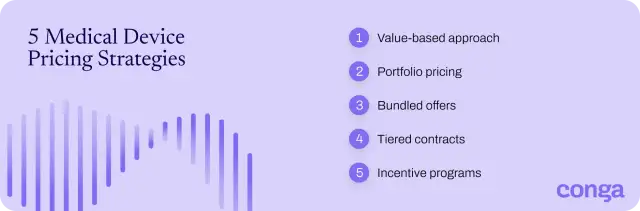
5 Medical Device Pricing Strategies for Profitable Quoting
The right pricing approach depends on the product, buyer, contract terms, and long-term value of the deal. Here are five strategies you can use to keep sales moving:
1. Value-Based Pricing for Clinically Differentiated Products
Value-based pricing sets the price against the clinical and economic value a medical device delivers rather than its build cost. Use evidence to support the price tag you put on your products, such as:
- Reduced procedure time
- Shorter hospital stays
- Improved outcomes
- Lower total cost of care
Back claims with validated clinical data or documented case studies so buyers trust the value behind the number.
2. Portfolio Pricing Across Complex Medical Product Categories
Portfolio pricing governs how you set prices across related products the buyer purchases separately, on different orders. Each item keeps its own price; what changes is that you manage margin across a group of SKUs instead of requiring every product to hit its own target.
This medical device pricing strategy suits complex categories because equipment, consumables, and service form one dependent system. The price you set on one determines the volume and margin of the next.
Examples of product categories that benefit from portfolio pricing include:
- Diagnostic analyzers and the reagents they consume
- Surgical robots and their instrument kits
- Imaging systems and their service contracts
- Implant families spanning dozens of sizes and trays
3. Bundled Pricing for Capital and Consumable Solutions, Including Software and Services
Bundled pricing combines durable equipment, recurring supplies, software, and services into one offer. A diagnostic bundle, for example, might include:
- An analyzer, which is the core instrument that processes patient samples and produces test results
- Reagents or test materials used with the analyzer for each procedure
- The operating software that controls the analyzer, manages workflows, and reports results
- Installation, including delivery, setup, calibration, and connection to the buyer’s existing systems
- Training, which includes instruction for laboratory staff on operation, maintenance, and standard procedures
- Maintenance for ongoing service, repairs, and parts replacement
Diagnostic companies can also use reagent rental models, placing equipment with the buyer in return for an agreed reagent purchase commitment. When software forms part of the offer, CPQ for SaaS helps manage subscriptions, renewals, and usage-based terms alongside the physical products.
4. Tiered Pricing for GPO and IDN Contract Management
GPO and IDN contracts cover buyers of different scale. A group purchasing organization negotiates for thousands of member hospitals at once, while an integrated delivery network signs once for dozens of facilities. One flat price would either overcharge a rural hospital or undercharge a large system.
Tiered pricing offers the same product at different price levels set by:
- Annual volume, reflecting how much the account buys in a year, in units or spend
- Contract commitment, offering a better rate for a signed multi-year term or minimum purchase
- Membership class, for an account’s assigned tier under its parent GPO or IDN agreement
5. Incentive Programs for Promotions and Rebates
Incentive programs use rebates and promotions to shape buyer behavior without touching your published list price. Instead of changing the price tag itself, you attach a reward to a specific action, such as hitting a volume threshold, renewing early, or adding a new product line to an existing agreement.
Common incentive structures include:
- Volume rebates paid back once an account crosses an agreed purchase threshold
- Growth rebates tied to year-over-year increases in spend or unit volume
- Promotional pricing on new product launches or seasonal campaigns
- Loyalty incentives that reward multi-year contract renewals
- Bundled promotions that discount a service or consumable when purchased alongside core equipment
Incentive programs only pay off when finance and sales work from the same numbers. Without a shared system, CFOs reconcile rebate accruals against sales commitments by hand after the deal closes, which delays revenue recognition and opens the door to billing errors.
Operationalize Strategic Pricing for Medical Technologies with Conga CPQ
Conga CPQ configures complex device portfolios, applies contract terms and discount limits, and routes approvals as the rep builds the quote, so pricing rules execute on every deal instead of living in spreadsheets.
Every medical device business runs differently, so Conga CPQ adapts to your specific configuration, contract, and billing needs rather than forcing you into a one-size-fits-all setup.
Conga CPQ suits companies across the medical industry, including life sciences partners, providing CPQ across capital equipment, consumables, software, and services, plus GPO and IDN contract standardization.
Talk to our sales team and spend less time reconciling tools and more time closing deals.
Turn your medical device pricing strategy into faster, controlled quote execution
Frequently Asked Questions
-
What are the common challenges in setting a medtech pricing strategy?
Setting medical device prices gets harder as product, customer, and contract complexity grows. Common challenges include:
- Large product catalogs: Teams may manage thousands of devices, accessories, consumables, software options, and service plans with different cost and margin profiles.
- Contract-specific terms: Group purchasing organizations (GPOs), integrated delivery networks (IDNs), and account agreements can carry different price levels, commitments, and eligibility rules.
- Regional differences: Currency, reimbursement models, competitive conditions, and purchasing behavior can change from one market to another.
- Reimbursement pressure: Providers may judge a purchase against reimbursement levels, clinical outcomes, and total cost of care.
- Discount control: Sales teams need room to negotiate without pushing deals below approved margin thresholds.
- Limited margin visibility: Disconnected tools can make it difficult to see how discounts, bundles, and contract terms affect profitability before approval.
Explore the main sales challenges solved by CPQ automation.
-
What factors drive medical device pricing optimization?
Medical device pricing optimization uses a mix of financial, customer, and deal data to determine what price makes sense for a specific opportunity. Key factors include:
- Product costs: Manufacturing, service, logistics, and support costs shape the margin available in a deal.
- Clinical value: Better outcomes, workflow improvements, or lower total cost of care can support a higher price.
- Buyer segment: Hospitals, health systems, laboratories, and other buyers may have different needs and purchasing power.
- Order volume: Larger commitments can support different discount levels or price tiers.
- Contract terms: Length, minimum purchases, service obligations, and negotiated agreements affect deal economics.
- Buying history: Past purchases and account behavior can help guide account-specific decisions.
- Competitive pressure: Alternative products and market conditions influence how much flexibility a seller may need.
- Win/loss data: Historical quote results show which price ranges have won profitable businesses.
See how an enterprise CPQ optimizes your quotes.
-
What innovative approaches exist for AI pricing for medical devices?
Innovative AI approaches in medical device pricing strategies include the comparison of similar deals, recommending account-specific price ranges, flagging risky discounts, and improving guidance as new quote and transaction data enters the system.
Conga POM brings these approaches together in one engine. Our neural network reads millions of data points across your quote, win/loss, and transaction history to set account-specific prices, then adapts in real time to shifts like inflation or new contract terms, so every recommendation gets sharper as more deals close.
-
How do surgical supplies manufacturers use CPQ to improve pricing?
Surgical supplies manufacturers use CPQ to apply contract prices and discount rules on every quote. Since disposables move in bulk under GPO terms, small inconsistencies compound fast. CPQ software for manufacturing like Conga Smart CPQ builds guardrails and AI pricing into each line, keeping high-volume quotes consistent and margins protected at scale.
Related Resources
-
Pricing Opportunity Framework: See What You’re Leaving on the Table GuidesAIPricing Opportunity Framework: See What You’re Leaving on the Table
Estimate how much revenue your pricing process is losing and what it would take to recover it.03/30/20262 min read -
Why AI-Powered Pricing is Now a Business Necessity for Margin and Growth BlogAIWhy AI-Powered Pricing is Now a Business Necessity for Margin and Growth
Learn why AI pricing is becoming essential for businesses facing rising market volatility, increased pricing pressures, and growing need for agility.06/30/20267 min read -
Conga Solutions Named to 2026 Constellation ShortListTM BlogCPQConga Solutions Named to 2026 Constellation ShortListTM
Conga Solutions has been named to the 2026 Constellation ShortList for Revenue Intelligence, Price Optimization, and CPQ, recognizing leadership in revenue optimization.09/08/202611 min read -
The Total Economic Impact™ Study of Conga Price Optimization and Management Analyst ReportPrice Optimization & ManagementThe Total Economic Impact™ Study of Conga Price Optimization and Management
A Forrester Total Economic Impact™ Study commissioned by Conga05/16/20231 min read