Contract Clause Library: Definition, Benefits, and Examples
09/15/2026
11 min read

This article is for informational purposes only and does not constitute legal advice.
You're asked to approve the same indemnification language for the fifth time this month, so you hunt through an old agreement for a paragraph you know is buried somewhere. Sales waits. Procurement waits. A junior colleague, tired of the delay, pastes in wording from a deal that closed two years ago and never crossed your desk. That's how nonstandard terms end up in signed agreements and quietly drain revenue.
A contract clause library addresses the root cause of nonstandard terms, giving drafts one approved source for language legal already trusts. This guide covers what it is, its benefits, seven clause examples, industry use cases, and best practices for building one that scales.
A contract clause library is a searchable, pre-approved set of standardized contract language that legal builds and business teams can reuse across agreements.
Clause libraries for contract drafting help support faster cycle times, fewer manual errors, lower compliance risk, and self-service drafting for non-legal teams.
Conga CLM solution turns your clause library into a part of drafting, so approved language provided by your legal team shows up where deals get done.
What Is a Contract Clause Library?
A contract clause library is a centralized, searchable repository of pre-approved clauses. Rather than reinventing the wheel with every contract, the legal team writes approved language and the business can reuse it across every agreement. Entries typically include:
- A standard clause plus vetted fallback options for terms, such as indemnification, termination, and confidentiality.
- Metadata that sorts entries by type, risk level, and jurisdiction, so contract authors can find the right language fast.
- Usage rules and permissions that decide who can edit a clause versus simply inserting it into contract documents.
Legal owns and maintains the clauses, while sales and procurement can pull approved wording without rewriting or hunting through past deals. The library is connected to dedicated clause management software and a contract lifecycle management (CLM) platform, so approved terms feed straight into drafting, redlining, and approval workflows. That can help cut cycle times, reduce legal risk, and support agreement consistency across the enterprise.
Clause Library Benefits for Contract Drafting
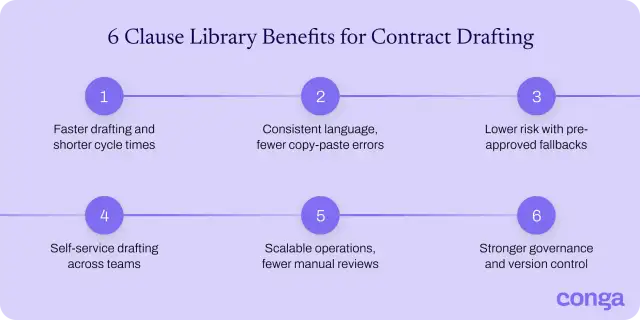
A clause library pays off the moment contract drafters stop rewriting agreements from scratch and start assembling them from approved parts. The benefits compound as volume grows, and they extend beyond legal to sales, procurement, and finance:
- Accelerated contract drafting and reduced cycle times: Assemble agreements from pre-approved clauses instead of hunting through old files. A first draft that once took hours now takes minutes, and deals reach signature faster.
- Consistent, standardized language that helps reduce manual copy-and-paste errors: Every agreement uses the same approved wording to help prevent a typo or an outdated liability cap traveling from one deal into the next.
- Support compliance and legal risk management through pre-approved fallback clauses: If a counterparty rejects the preferred term, negotiators simply pick a fallback that legal has already signed off on. That keeps talks within established guardrails and facilitates contract compliance without a fresh review.
- Easier cross-team collaboration with guided self-service contract creation: Sales and procurement draft their own agreements from approved content, freeing lawyers from routine requests. According to Gartner, self-service systems will handle roughly half of contract reviews by 2029 and escalate only one in 10 for human review.
- Strengthened clause governance, simplified search, and version control: One owner controls every clause in a single contract repository. A full history tracks who changed what, to help keep stale language from reaching a signature line.
- Scalable contract operations that minimize manual legal reviews: Routine agreements automatically include standard clauses that have been pre-approved by your legal team, so legal spends their time on the high-stakes, nonstandard terms that need human approval. Per the CLOC State of the Industry Report, 83% of legal departments face rising demand against limited resources, pushing more work onto internal teams.
Explore AI contract review software to automate your routine reviews.
7 Contract Clause Examples for Standardized Enterprise Agreements
A good library organizes the types of contract clauses by the job each does.
| Types of contract clauses | Purpose |
| Penalty | Financial consequences for missed timelines |
| Divisible | Independent obligations remain enforceable if one term fails |
| Suspension | Performance paused for specific non-compliance |
| Variation | Scope or pricing changes governed through formal approval |
| Cancellation | Exit criteria and required notice periods established upfront |
| Exclusion | Financial liability capped for defined risks |
| Insurance | Minimum third-party coverage requirements mandated |
Here’s a breakdown that defines each of these clause types in more detail, along with sample language you can adapt when you need it.
1. Example of a contract penalty clause
A penalty clause sets the financial consequence when one party misses an agreed obligation (usually a deadline), giving vendor and service contracts a clear deterrent and a ready remedy. Courts enforce these terms only when the penalty amount reasonably reflects the likely harm from the breach. A sum that punishes the other side excessively is likely to be struck down.
Example: “If the Supplier fails to deliver by the agreed date, the Customer may deduct 0.5% of the total contract value for each week of delay, capped at 10%. The parties agree this sum is a genuine pre-estimate of loss, not a penalty.”
2. Example of a divisible clause in a contract
A divisible clause splits a contract into separate, independent obligations, so the failure of one does not void the rest. Multi-part and phased service agreements rely on this clause type. For example, in a managed-services deal covering hosting, support, and training, a breach of the training terms never collapses the hosting commitment.
Example: “Each Statement of Work forms a separate, divisible obligation. The breach or termination of one does not impair any other, and the Customer pays for each completed deliverable independently.”
In the Conga CLM clause library, legal maintains approved divisible language and applies the same version across templates, contract types, and jurisdictions.
See how Conga CLM helps keep every clause consistent across teams and contracts
3. Example of a suspension clause in a contract
A suspension clause lets a party pause performance when the other side breaches a defined condition, such as non-payment or a regulatory hold, without ending the agreement. It offers a graduated alternative to termination, so pressure builds until the issue clears and work resumes.
Example: “If the Customer fails to pay an undisputed invoice within 30 days, the Supplier may suspend the Services on 10 days' written notice until payment clears. Suspension does not terminate this Agreement.”
4. Example of a variation clause in a contract
A variation clause governs how the parties change scope, pricing, or timelines after signing, usually requiring a written amendment signed by both sides. Construction and SaaS agreements use this clause type to route changes through formal approval, so an informal email promise never becomes a binding obligation.
Example: “No variation of this Agreement, including its scope or price, takes effect unless made in writing and signed by an authorized representative of each party.”
With Conga CLM, you can embed the approved variation clause into every template and enforce it through a governed contract approval workflow, so no change counts until the right people sign off.
5. Example of a cancellation clause in a contract
A cancellation clause sets how and when a party can end a contract before its term. It also defines permitted grounds, notice periods, and any exit fees upfront. Subscription and managed-service agreements use cancellation clauses to remove the ambiguity behind renewal disputes and auto-renewal surprises.
Example: “Either party may cancel this Agreement for convenience on 60 days' written notice. The Customer remains liable for fees accrued through the cancellation date.”
Conga CLM allows you to store the approved cancellation clause in the library and link its notice period to obligation management, so alerts fire before each deadline.
6. Example of an exclusion clause in a contract
An exclusion clause caps or removes a party's liability for defined risks, such as indirect or consequential loss. It draws a hard boundary around financial exposure, so software, professional services, and supply contracts tend to negotiate exclusion clauses hard. However, courts only enforce exclusions they find reasonable.
Example: “Neither party is liable for indirect or consequential loss, and total liability is capped at the fees paid in the 12 months before the claim.”
7. Example of an insurance clause in a contract
An insurance clause requires a party to carry minimum coverage for the term, name the other party as additional insured, and provide certificates on request. Construction, logistics, and vendor agreements use this clause type to shift defined risk onto a third-party insurer, giving you recourse if something goes wrong.
Example: “The Supplier shall maintain commercial general liability insurance of at least $2 million per occurrence, name the Customer as additional insured, and provide a certificate of insurance on request.”
With Conga CLM, you can store standard coverage tiers in the library, and our contract intelligence feature extracts each insurance requirement so you verify coverage across the portfolio.
Contract Clauses Examples by Industry
Different industries have different contracting priorities based on regulation, risk, and commercial model. These examples show which clauses companies typically prioritize across different industries and examples of their standard language.
| Industry | Priority Clauses | Contract Clauses Examples |
| Healthcare | HIPAA compliance, confidentiality, insurance | “Provider shall handle all protected health information in compliance with HIPAA.” |
| Life sciences | Clinical trial milestones, IP, regulatory compliance | “Sponsor shall pay each site fee on completion of the corresponding trial milestone.” |
| Technology | Subscription renewal, SLA, limitation of liability | “This subscription renews for successive 12-month terms unless either party gives 30 days' notice.” |
| Manufacturing | Warranty, delivery penalty, insurance | “Supplier shall pay 0.5% of order value for each week a delivery runs late.” |
| Financial services | Regulatory (DORA), data protection (GDPR), audit rights | “Vendor shall grant the Client audit rights over controls relevant to operational resilience.” |
5 Best Practices for Building a Contract Clause Library
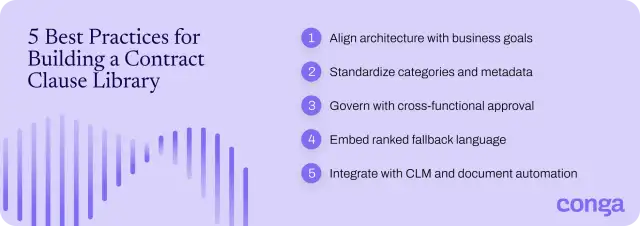
Building a clause library is among the most important steps in automating your contracting process, because the pre-approved language you include will be the foundation of every agreement going forward. Follow these five best practices to ensure your clause library meets the needs of your entire organization, both now and in the future.
1. Align clause architecture with core business goals
Map clauses to what the business protects, not to an alphabetical list of legal terms:
- Group clauses by risk, contract type, function, or jurisdiction.
- Set approved and fallback language for each category.
- Prioritize the clauses in your highest-volume agreements first.
A contract management dashboard shows which clause types create the most negotiation friction, so you know where to focus.
2. Define clear clause categories and metadata standards
The EY Law General Counsel Study found that legal’s top barriers include disorganized data (52%) and disconnected platforms (44%). That's why you should standardize how every clause is labeled:
- Tag each clause by type, jurisdiction, risk, and fallback status.
- Add owner, version, and approval status information.
- Enforce one naming convention across teams.
With that structure in place, contract authors can filter your library by type, category, or keyword to pull the right version.
3. Establish cross-functional governance and approval workflows
Give every clause category an owner across legal, compliance, procurement, and sales, so no team quietly saves its own version. A defined workflow controls how clauses get added, changed, and retired. In addition, sign-off should be required before any clause goes live, leaving an audit trail behind each version.
In Conga CLM, for example, permissions enforce that division of responsibility. A rep inserts an approved clause but can’t edit it, so only owners can change the language.
4. Embed fallback language preapproved by your legal team into negotiation playbooks
Pair every high-negotiation clause with fallback options ranked from preferred to least favorable, then tie them to the playbook. When a counterparty rejects the first position, the drafter moves to the next approved option without pausing for a fresh legal review.
Ranked fallbacks keep concessions inside boundaries legal already accepts. This results in faster contract redlining, because approved language alternatives are already in place before talks begin.
5. Integrate the clause library with CLM and document automation platforms
A clause library delivers full value only when it’s embedded inside the tools where drafting happens. When integrated with your CLM, approved clauses populate templates automatically during document assembly, and contract authors can pull current versions into Word instead of copying from old files.
Conga Document Automation builds a first draft from clauses that are pre-approved by your legal team, so legal keeps control of the language while contract automation reduces the manual copy work.
Explore the top contract management tools.
Standardize Enterprise Agreements with Conga Contract Clause Library Software
Conga Contract Lifecycle Management Platform builds the clause library into the work your teams do every day, so approved language shows up in drafting, negotiation, and approval instead of sitting in a document no one opens. Legal owns and governs every clause with version control and permissions, while sales and procurement draft from the standard and fallback clauses set by legal in Word through X-Author for Contracts.
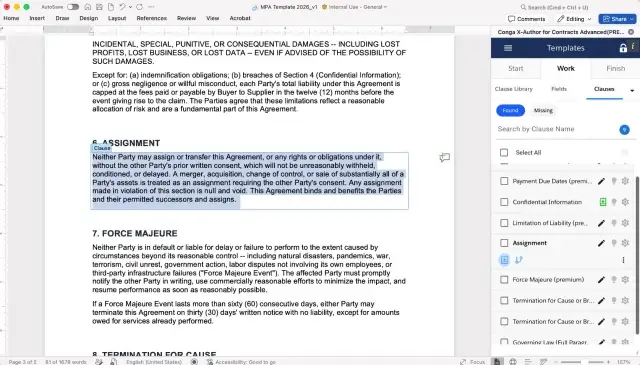
Getting started doesn't mean building from a blank page. The Conga CLM Clause Library Builder Agent turns your existing templates into a governed library:
- Document parsing: The tool reads uploaded Word templates and automatically identifies and extracts individual clauses, regardless of how each document is formatted.
- Metadata extraction: Each clause is tagged with details like type, topic, and applicable contract type, so it's searchable and governable the moment it's promoted.
- Admin review: Extracted clauses sit in a review queue, where admins refine and selectively promote only the language they approve.
- Self-improving accuracy: The system learns from admin corrections, sharpening extraction quality with every batch.
Approved language reaches the live library quickly, so legal can spend more of its time reviewing content instead of digging through old templates.
Conga CLM flags non-standard terms for legal while business users handle routine deals. Running on the Conga Advantage Platform and connected to your CRM and ERP, our solution gives every team one governed source of language, to help you standardize enterprise agreements, shorten cycle times, and hold risk in check.
Contact our sales team to put your clause library to work across every team and contract.
Turn your clause library into faster, lower-risk contracts with Conga
Related Resources
-
Connect and Learn With Peers in the Conga Customer Community BlogCLMConnect and Learn With Peers in the Conga Customer Community
Join 40,000+ peers in the Conga Customer Community—connect, learn, and grow with resources, training, and support to fuel smarter business outcomes.09/30/20266 min read -
The Contract Management Strategy You Might Be Overlooking BlogCLMThe Contract Management Strategy You Might Be Overlooking
Discover the contract management strategy that improves collaboration, clarity, and results—without overcomplicating your process.07/15/20257 min read -
The Quote to Cash Process in 10 Steps BlogCLMThe Quote to Cash Process in 10 Steps
Discover how to streamline your quote-to-cash (Q2C) process to accelerate sales cycles, improve customer experience, and boost revenue. This comprehensive guide covers every stage—from configuration and pricing to contract management, billing, and renewals—plus tips for finding the right automation solution. Learn how to eliminate silos, reduce errors, and drive efficiency across your CRM and ERP systems.12/01/20259 min read -
The Complexity Tax: How Manufacturers Can Stop Leaving Revenue on the Table BlogManufacturingThe Complexity Tax: How Manufacturers Can Stop Leaving Revenue on the Table
Product lines grow. Quoting slows. Contracts pile up. Learn how manufacturers are tackling commercial complexity with CPQ and CLM to recover lost revenue.07/13/20267 min read