Contract Redlining Software: a Buyer's Guide
08/12/2026
10 min read

An inefficient contract redline process stalls deals, introduces errors, and creates legal exposure. When sales, legal, and finance teams rely on email attachments, manually track changes, and compare versions across disconnected systems, negotiations become slow and risky.
Contract redlining software enables you to track every change, collaborate in real time, and maintain definitive version control. These tools transform negotiations by ensuring complete visibility and accountability.
In this guide, we'll break down what contract redlining is, the benefits of automated software, and best practices to accelerate your agreement reviews.
Key highlights:
- Contract redlining software is a digital solution that centralizes, tracks, and manages every contract change.
- Moving from manual redlining to automated tools eliminates version confusion, improves collaboration, and reduces legal and commercial risk during negotiations.
- Conga CLM automates the entire contract redlining process by integrating true-up of external edits and streamlined approvals.
What Is Contract Redlining Software?
Contract redlining software is a digital tool that helps teams identify, track, and manage changes to agreements during the drafting and negotiation process. Redlining highlights differences between document versions, making it easy to see updates, additions, or deletions.
By centralizing control and maintaining clear visibility, redlining contract management tools reduce errors, enhance collaboration, and help teams finalize agreements faster and with greater confidence. Yet despite these efficiency gains, adoption of this solution is still catching up.
Learn how to redline a contract before signing.
6 Signs Your Company Needs Automated Contract Redlining Software
The traditional contract redline process slows negotiations, creates confusion, and increases risk, especially when teams rely on disconnected tools and manual comparison. Automated contract redlining software replaces those manual steps with structured workflows, real-time collaboration, and AI-powered CLM features, cutting average review time.
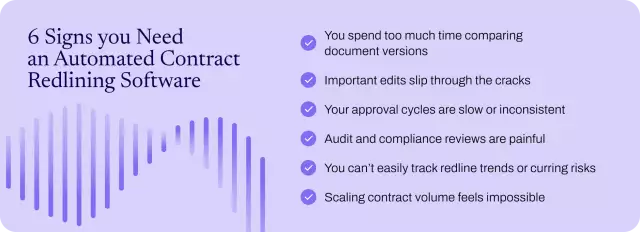
Let's review the signs that your manual redlining contract workflow is no longer working:
1. You spend too much time comparing document versions
Manual comparison of contract versions consumes resources across teams. According to Gartner, lawyers spend an average of 25-40% of their time on work that doesn’t require legal expertise—much of it tied to reconciling edits across multiple documents. Automated redlining software quickly highlights every change, shifting from administrative review to actual contract analysis.

2. Important edits slip through the cracks
Significant contract changes that disappear between review cycles or get overlooked can lead to financial consequences due to unfavorable terms. Platforms such as Conga CLM use automated tracking to ensure teams don’t miss anything and can confidently account for every revision.
3. Your approval cycles are slow or inconsistent
Without structured agreement management workflows, reviewers often join the process late or forget to approve entirely, which stalls deals. Leveraging automation features, contract redlining software routes deals to the right stakeholders, keeps deadlines visible, and accelerates the entire approval process.
4. Audit and compliance reviews are painful
Reviewing emails and outdated drafts to piece together the contract’s history consumes time and increases audit risk. Automated redlining tools preserve a complete, time-stamped history of all edits and comments, making compliance reviews faster, cleaner, and more defensible.
5. You can’t easily track redline trends or recurring risks
When you rely on manual contract review, you miss patterns, such as clauses that always trigger negotiations or terms that consistently introduce new risks. Automated redlining solutions highlight these trends, enabling legal teams to refine templates, reduce negotiation friction, and manage risk.
Watch our webinar to learn how CLM tools can complement your contract review processes.
6. Scaling contract volume feels impossible
As contract volume grows, manual redlining in contracts becomes a bottleneck that slows revenue and overwhelms legal teams. Automation solutions handle comparison, tracking, and risk detection at scale, enabling you to support business growth without sacrificing accuracy or adding headcount.
Explore everything Conga CLM can do for your contract redlining process.
Key Features to Look for in Redlining Tools for Contracts
The right redlining tool serves as a centralized negotiation hub, bringing structure, intelligence, and efficiency to contract management. Here's a quick feature overview.
| Contract redline software feature | What it does | Importance |
| Role-based access and permissions | Control over which users can view, edit, or approve specific contract sections and clauses | Protection for sensitive terms, with visibility limited to authorized personnel in legal, finance, and other key departments |
| Real-time collaboration and version control | Simultaneous editing, commenting, and negotiation by multiple stakeholders in a single, live document environment | Complete elimination of redline version contract confusion through a single source of truth, with full tracking of all changes and their authors |
| Document comparison | Automatic highlighting of all differences between document versions, with the ability to reconcile the final contract versionwith any source document through features such as Conga's True-Up All | Significant time savings over manual review, with guaranteed capture of every modification made during negotiations |
| AI-powered review and suggestions | Intelligent analysis of contract language against your playbook, with flagging of non-standard terms and pre-approved alternatives | Reduction of legal risk through consistent enforcement of standards, plus accelerated review cycles for all teams |
| Customizable approval workflows | Automated routing of contracts to appropriate stakeholders based on contract type, value, or risk level | Consistent enforcement of internal controls with eliminated bottlenecks and guaranteed compliance with company policies |
| Integration with CLM and eSignature tools | Direct connection between redlining functions, your contract lifecycle management (CLM) platform, and eSignature solutions | Seamless transition from negotiation to execution without manual handoffs or duplicate data entry across systems |
| Connection to standard writing tools | Native redlining capability within familiar environments, such as Microsoft Word | Minimal training requirements and smooth user adoption across business teams through interface familiarity |
| Direct clause library access | Immediate availability of pre-approved, company-standard clauses for insertion during the redlining process | Maximum contractual consistency and compliance assurance, with a reduction in manual drafting errors |
| Centralized storage and access control | Unified, secure repository for all contracts, redlines, and related communications | Instant document retrieval capability with enhanced security protocols and a single system of record for all agreements |
| Complete audit trail | Comprehensive logging of every view, edit, comment, approval, and decision throughout the negotiation lifecycle | Simplified compliance reporting with undeniable proof of the negotiation process for complete legal protection |
How to Choose Your Enterprise Contract Redlining Software
When choosing the right enterprise contract redlining software, look for a solution that improves accuracy, speeds negotiations, and supports your team’s existing agreement processes. The best platforms remove manual work, strengthen compliance, and streamline collaboration across legal and business teams. Prioritize redlining tools that:
- Minimize manual work: the right contract redlining platform reduces time spent reconciling versions, formatting documents, and managing edits via email, thanks to automated archive comparison and centralized collaboration features.
- Improve visibility and control: the best contract redlining tools provide a reliable version history, clear edit tracking, and assurance that everyone works from the correct document by serving as a single source of truth with permission-based access.
- Support cross-functional collaboration: your redlining software should enable all stakeholders, legal and non-legal, to review, comment, and track changes easily without confusion.
- Protect accuracy and compliance: your contracts software for the redlining process solution should have a clause library integration and role-based permissions to enforce standard terms, prevent unauthorized edits, and maintain a clear audit trail of changes.
- Connect to your broader contract lifecycle: the best tools are built into your CLM system and can plug into your CRMs and ERPs, so data stays consistent from draft to signature.
- Scale with your contract volume: as your business grows, your redlining solution should keep negotiations fast and manageable, not introduce new bottlenecks, by leveraging AI-powered review and automated workflows to handle increased volume.
How Using a CLM Platform Can Help You Maintain Contract Redlining Best Practices
With CLM software, you handle contract redlines within a single, controlled environment that makes every edit visible and traceable. This solution consolidates collaboration, allowing stakeholders to work from a single definitive version. Case in point: a Forrester’s Total Economic Impact™ (TEI) study found that contract artificial intelligence software cut manual work on average from 25 hours to 15 hours per contract for the composite company. These tools save time, for example, by automatically flagging redlined clauses that are slowing down deals.
Adopting a robust CLM helps you maintain these contract redlining best practices:
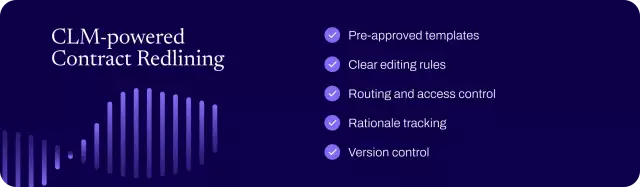
- Start every negotiation with standardized contract templates: pre-approved templates ensure consistent language, eliminate unnecessary deviations, and reduce the need for redlining. A CLM platform keeps templates governed, updated, and automatically applied based on contract type.
- Establish clear contract redlining etiquette guidelines: consistent rules for edits, comments, and suggested language keep contract negotiations organized. Built-in CLM markup tools enforce these standards, so stakeholders know exactly how to format changes and communicate revisions.
- Limit contract reviewers to essential stakeholders only: involving only the necessary reviewers keeps negotiations focused and prevents conflicting feedback. CLM-driven workflows route contracts to the right people based on value, risk, or deal stage, reducing delays and unnecessary rework.
- Document the rationale behind every contract decision: capturing the reasoning for each edit keeps negotiations transparent and defensible. CLM platforms store all comments, decisions, and exception notes directly on the contract record, creating a complete history for contract renewals, audits, and escalations.
- Maintain strict version control discipline throughout negotiations: a single source of truth prevents outdated drafts from circulating. Enterprise contract management systems capture full version history and reconcile offline edits back into the platform, ensuring accuracy and eliminating version confusion.
Keep learning: 10 must-have contract management software features
Simplify and Automate Your Contract Review and Redlining Process With Conga CLM
Conga's contract lifecycle management solution goes beyond standalone redlining by embedding it into a unified platform that automates every stage of the negotiation process.
By leveraging our integrated solution, companies like Equinix reduce their contract management cycle time from 14 days to just 90 minutes. How? Centralizing redlines, approvals, and document updates in a single, streamlined workflow.
Conga CLM simplifies the contract redlining process with features that include:
- Contract review: compare third-party contracts to your negotiation playbook, jump to high-risk clauses, and accept suggested redlines.
- Real-time collaboration: create, negotiate, and review contracts in Microsoft Word and Google Docs with version control that tracks every edit and comment.
- Seamless true-up: add the latest negotiated version of contracts back to Salesforce, ensuring your CRM data is always in sync with final agreements.
- Automated workflows: route contracts to the right people, ensuring necessary sign-offs happen before execution.
Contact our sales team to get started with the best contract redlining software.
Frequently Asked Questions
-
What are redlines in a contract?
Redlines in a contract are visual markups (additions, deletions, and edits) applied to a contract draft during the negotiation process. Redlining serves as the record of changes proposed by one party to the other, making it easy to see how the agreement has evolved from its original state.
-
Can you sign a redlined contract?
No. You should never sign a document that contains visible contract redlines. A redlined version is, by definition, a deal still under negotiation. Before the contract is executed, all marks must be formally accepted or rejected by both parties, and a "clean" final copy must be generated for signature.
-
What to look for when redlining a contract?
When conducting legal contract redlining, focus on deviations from your company's standard terms, specifically:
- Contract risk: clauses that increase liability
- Commercial impact: changes to pricing, payment terms, or scope of work
- Clarity: ambiguous or vague language that could lead to future disputes
- Compliance: terms that violate internal policy or regulatory requirements
-
When do you need contract redlining?
You need contract redlining whenever one party proposes a change—even a minor one—to the original contract draft. This step supports the contract negotiation process by capturing every modification and ensuring that all parties reach a full agreement on each clause before signing.
-
What is AI contract redlining software, and how does it differ from standard redlining tools?
AI contract redlining software is a specialized, intelligent solution that automates the review process with machine learning and natural language processing (NLP). While standard tools focus only on version control and visibility of changes, AI solutions enforce governance and provide intelligent analysis.
Feature Standard contract redlining tools AI contract redlining software Core function Tracking edits, managing versions, and showing differences (blacklines) Analyzing clause content, detecting risk against playbooks, and enforcing compliance checks Output A visual markup of what has been changed Contextual clause insights with pre-approved fallback language. Time savings Reducing time spent on manual version comparison Reducing time spent on substantive legal review and contract risk management -
What's the difference between redline and backline edits?
Both redlines and backlines edits show changes between contract versions, but they highlight them from different perspectives:
Type of edit What it shows When it’s useful Redline New insertions, deletions, or modifications made in the latest version Reviewing proposed changes and preparing responses Backline What changed from the perspective of the prior version Understanding how the document evolved and validating earlier edits
Related Resources
-
How to Shorten Your Sales Cycle: Fix the Handoffs, Not the Hustle BlogAIHow to Shorten Your Sales Cycle: Fix the Handoffs, Not the Hustle
Learn how to shorten your sales cycle by removing the hidden friction between teams, pricing, approvals, contracting that stalls deals right when they should close.07/24/20269 min read -
Stop Guessing & Start Deciding: The Forrester Framework for Buy vs. Build Analyst ReportIndustry InsightsStop Guessing & Start Deciding: The Forrester Framework for Buy vs. Build
AI lowered the cost of building software. It didn't lower the cost of running it. Get the Forrester framework that helps you decide what to buy, build, or generate.07/22/20264 min read -
Only the Agile Thrive BlogIndustry InsightsOnly the Agile Thrive
Discover how business agility, AI, and connected data help companies respond faster to tariff disruptions, reduce risk, and make confident go‑to‑market decisions.07/22/20265 min read -
Why AI-Powered Pricing is Now a Business Necessity for Margin and Growth BlogAIWhy AI-Powered Pricing is Now a Business Necessity for Margin and Growth
Learn why AI pricing is becoming essential for businesses facing rising market volatility, increased pricing pressures, and growing need for agility.07/16/20267 min read