CPQ for SaaS: 6 Ways to Automate Subscription Quotes
09/02/2026
11 min read

You’re not losing deals in the pitch or discovery call. You’re losing them while your team struggles to build a complex quote. Tiered subscriptions, usage-based overages, multi-year ramps, and contract add-ons all slow you down. By the time your proposal lands, the disconnected chaos behind your quoting process makes your buyer question your ability to deliver what you promised.
CPQ for SaaS cuts through the complexity of multiple pricing models, multi-year escalations, and layered approvals, so your team can generate accurate proposals in minutes, not days, and get back to selling.
In this guide, we break down what this technology does for your business, why the gap between quoting intent and execution is costing you revenue, and the six specific points where CPQ technology for SaaS removes the friction slowing your deals down.
Key highlights:
- CPQ for SaaS is software that handles all subscription complexities, including tiered pricing, usage-based billing, multi-year ramps, and automated approval workflows.
- The benefits of adopting CPQ tools for SaaS companies include faster quote turnaround, fewer configuration errors, more consistent offer management, higher renewal rates, and stronger revenue performance.
- Conga CPQ provides SaaS companies with a unified platform to automate the entire quote-to-cash process in a single tool.
What Is CPQ for SaaS?
Configure, price, and quote (CPQ) for SaaS is a purpose-built revenue system that manages the complexity of subscription-based sales. CPQ centralizes product catalogs, commercial rules, and contract terms into a single platform, enabling sales teams to generate accurate, compliant proposals in real time without relying on spreadsheets or disconnected tools.
For SaaS providers, this setup means handling tiered subscriptions, usage-based pricing, multi-year ramps, and renewals within a single system. CPQ technology for SaaS applies approved logic, enforces discount controls, and aligns sales, finance, and billing, so every deal is consistent, executable, and moves at the pace of opportunity.
Why CPQ Solutions for SaaS Companies Are No Longer Optional
Legacy tools fail to manage the structural complexity of usage-based billing and multi-year ramps, creating a gap between sales promises and financial execution. Accenture reports that only 16% of companies have automated the quote-to-order process, and just 6% have reached systemized revenue operations maturity, which explains why most software companies struggle to execute proposals consistently at scale.

CPQ solutions for SaaS companies replace manual workarounds with a unified logic that spans from configuration to contract execution. With this technology, CROs have the deal velocity needed to hit targets, and CFOs get the pricing accuracy required to protect margins. By aligning these systems, you can eliminate revenue leakage and maintain profitable growth at the pace of opportunity.
Benefits of Using CPQ Software for SaaS Businesses

Quoting solutions deliver measurable improvements across the deal cycle, from initial quote to renewal. See the key CPQ benefits that eliminate friction and protect your commerce chain:
- Faster quote turnaround: guided workflows apply current pricing rules and configurations, reducing the proposal generation times by more than 50% for 78% of the companies surveyed by Market Growth.
- Fewer configuration errors: selling logic blocks prevent representatives from generating proposals with invalid product combinations or out-of-parameter pricing before the quote leaves their screen.
- Consistent offer management: discount thresholds and approval triggers enforce margin guardrails on every deal, regardless of who builds the quote or which approver responds first.
- Higher renewal rates: asset-based ordering gives you full visibility into upcoming subscription end dates, delivering accurate upgrade pricing without manual quoting hassles.
- Stronger revenue performance: faster quoting lifts win rates, protects margin, and captures more upgrades and contract add-ons from existing customers, so more opportunities convert into profit.
How CPQ Technology for SaaS Simplifies Subscription Quotes
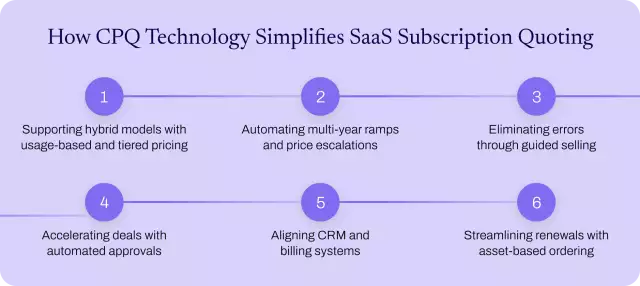
CPQ solutions simplify subscription quoting by embedding your quote rules, product logic, and approval thresholds directly into the configuration engine. Every proposal your reps generate automatically applies the correct tiered pricing, discount limits, and contract terms, without manual calculation or back-and-forth. Here's how:
1. Powering hybrid revenue models with usage-based and tiered pricing support
Your enterprise deals likely combine base fees, usage-based charges, tiered overages, and optional modules within a single quote. CPQ handles hybrid structures with configurable pricing models.
When a rep adds a usage-based tier, the CPQ system calculates charges based on contracted volume bands. For deals with annual minimums and quarterly true-ups, the platform enforces those terms during configuration rather than leaving them to the rep’s discretion.
2. Automating multi-year ramps and complex price escalations
Multi-year SaaS contracts often include annual price escalations, ramp schedules that start low and increase over time, or milestone-based adjustments tied to usage thresholds.
In the subscription scenario, manual configuration across your CRM fields, spreadsheets, and contract templates introduces errors that resurface at renewal. Conga CPQ, for example, eliminates the manual work that slows renewals and expansion revenue, replacing it with an automated new pricing process that happens in six steps:
- CPQ solutions build the complete schedule at quote creation and apply the correct escalation rates.
- The software then assigns the right escalation for each contract year.
- The system flags any deviations from approved contract structures or pricing terms.
- Non-standard structures go to the right approver before the quote moves forward.
- Finance receives a quote aligned with what billing will actually invoice.
- Sales avoids re-openings caused by contract inconsistencies discovered after signing.
3. Eliminating configuration errors through intelligent guided selling
Configuration errors happen when sales reps build product combinations that don’t exist, apply pricing to retired plans, or select add-ons that conflict with the base package. Those sales pain points delay deals, damage buyer confidence, and generate rework that consumes hours across sales and operations.
Conga CPQ cuts those mistakes off at the source with guided selling and quoting intelligence. Our neural-network AI can analyze 400+ million data points across your base to generate account-specific quotes with 90% prediction accuracy. This means that when a customer wants to move from a 50-seat starter plan to an enterprise tier with API overages, we guide the rep through only valid, currently available options—and estimate the upgrade price in seconds using pricing optimization software.
4. Accelerating deal velocity with automated approval and discounting workflows
Discounts require approvals, and approvals take time unless you automate the process. CPQ tools generate quotes instantly without manual oversight, as long as your reps apply discounts within the system's pre-approved thresholds.
If a deal exceeds standard limits, the CPQ technology stack routes the issue directly to the right decision-makers, with all the context they need. This way, you eliminate the mess of email chains and delays, replacing them with a clear, fast process.
5. Aligning the commerce chain with CRM and billing integration
When CPQ doesn’t sync with your commerce chain tools, such as your CRM, reps re-enter product, price, and term data, degrading your pipeline data. Contracts that don’t align with your financial workflows force your team to rebuild deals and revenue schedules, leading to invoice errors, disputes, and rework. These gaps are common in SaaS companies that assembled their revenue stack from separate tools.
A complete quote-to-cash process covers CPQ, contract management, and pricing. By using a platform like Conga CPQ, which has native CRM and billing integration, you close those handoff gaps. When a rep generates a quote, opportunity data updates automatically, so accepted contracts go to the financial system with the correct subscription terms, pricing, and start dates, eliminating a major source of downstream revenue leakage.
Align your commerce chain from CRM to billing with Conga CPQ
6. Optimizing the renewal flywheel through automated asset-based ordering
Renewal revenue slips away through lapsed subscriptions, pricing errors, missed upsell opportunities, and salespeople who lack a clear view of what each customer owns. Asset-based ordering (ABO) solves these issues by treating every active subscription, license, and entitlement a customer holds as a structured data record inside the CPQ platform.
CPQ tools flag when it’s time for renewals, pull the customer’s current subscription configuration, apply correct renewal pricing, and generate a pre-built quote ready for you to deliver.
How to Choose the Right CPQ Tool for SaaS
You need a CPQ tool that models SaaS pricing and updates any deal changes throughout your workflows. Follow these five criteria to choose the right solution for your SaaS:
- Prioritize a unified platform: a CPQ tool that natively integrates with contract lifecycle management (CLM), billing, and CRM provides a single data layer for the entire revenue process. This alignment matches sales quotes to finance bills and legal documents.
- Verify scalability for high-volume transactions: your platform should handle complex pricing rules and a high SKU count without performance degradation. Maintaining speed during concurrent quoting keeps your team moving through the sales cycle without interruption.
- Evaluate AI pricing intelligence: a quoting tool with built-in AI recommends optimal subscription values based on deal history, customer segments, and competitive signals. This intelligence identifies the exact amount an account is willing to pay. Mordor Intelligence reports that early adopters of AI-driven pricing in CPQ platforms see a 4.79% revenue uplift.
- Select a partner with a proven roadmap: successful CPQ implementation for SaaS requires a clear plan to map pricing logic, configure catalogs, and train teams. Your partner must understand the nuances of subscription lifecycles so every quote remains accurate and compliant.
- Require built-in analytics: a solution that natively surfaces CPQ KPIs, such as quote cycle time, error rate, discount frequency, and win rate, gives you the visibility to measure whether your investment is delivering results and where your revenue process still breaks down.

Optimize Your Quoting Workflows with Conga CPQ SaaS
Conga CPQ transforms your revenue process into a continuous flow by aligning complex pricing variables with strategic execution. Our Advantage Platform connects your sales data and rules behind every deal, so your team quotes faster with fewer errors and less margin leakage.
With Conga CPQ, you can:
- Manage the full lifecycle of customer subscriptions, including complex mid-term amendments and coterminous renewals.
- Leverage neural network AI to analyze 400 million data points, delivering account-specific pricing recommendations that maximize win probabilities and price realization.
- Handle swap and upgrade scenarios instantly by automating the logic for prorated credits and net-new subscription additions within a single quote.
- Maintain financial integrity with a platform architecture that synchronizes quote data across Salesforce, Microsoft Dynamics, or SAP, preventing downstream errors.
Contact our sales team to receive a tailored look at how our platform handles your specific SaaS pricing model.
Streamline the management of your SaaS subscription quotes with Conga CPQ
Frequently Asked Questions
-
What are the leading CPQ solutions for SaaS providers?
The leading CPQ solutions for SaaS providers are those that handle subscription complexity without workarounds and keep deal data consistent from quote to contract to invoice. The Conga CPQ platform is the best option for companies with complex SaaS offers that demand:
- Deep pricing flexibility to offer list, cost-plus, volume, and attribute-based pricing, beyond promotions and bundles
- Guided selling that helps reps build the right quote the first time and blocks configurations that can lead to rework later
- Support and integration to major CRM environments, including Salesforce and Microsoft Dynamics 365
- Composable, high-performance architecture that runs on AWS, Microsoft Azure, and IBM Cloud
-
What features should SaaS companies look for in a CPQ solution?
SaaS companies should look for a CPQ solution that combines:
- Subscription-specific configuration logic, automating the full asset-based ordering (ABO) lifecycle, including complex amendments, renewals, and upgrades, to eliminate manual workarounds and keep your commerce lined up.
- Native CRM and billing integration, connecting CPQ with CRMs and software like Salesforce through APIs.
- AI-assisted pricing optimization in a single platform, offering you neural-network AI to provide real-time, account-specific price guidance that empowers you to close deals faster and protect margins.
-
How long does CPQ implementation for SaaS typically take?
Most CPQ implementations for SaaS companies take three to six months, but the range swings based on how much subscription complexity you need to model (ramps, usage, amendments), how messy your product catalog is, and how many systems you need to connect (CRM, contracts, billing).
With Conga, you speed up the process because our CPQ sits on a unified revenue platform and doesn’t rely on fragile handoffs between separate tools for quoting, contracts, and downstream processes. You still need to do the work, cleaning your CRM data, locking your pricing logic, and defining approval rules, but you spend less time rebuilding the same deal data in multiple places.
-
How to create quote templates for SaaS products?
To create quote templates for SaaS products in a CPQ platform, follow these four steps:
- Map each product tier, its associated pricing rules, and any usage-based components that need to appear on the proposal.
- Use a CPQ platform like Conga, which includes a template builder to define line-item structure, pricing display logic, and approval thresholds tied to specific discount levels.
- Choose a template that separates base subscription from contract add-ons and professional services, so buyers see a clear cost breakdown for each commitment.
- Set up automated templates that connect to CRM opportunity data, so your reps don’t have to enter customer or deal details into each new quote.
For companies with multiple product tiers, starting with a small set of core templates and expanding over time yields faster adoption than trying to build every possible configuration at launch.
-
Can CPQ support usage‑based, hybrid, and tiered pricing models in SaaS?
Yes. Enterprise CPQ platforms built for SaaS handle usage-based billing, tiered pricing, hybrid models that combine flat and consumption-based fees, and multi-year contracts with escalation schedules.
-
Connect and Learn With Peers in the Conga Customer Community BlogCLMConnect and Learn With Peers in the Conga Customer Community
Join 40,000+ peers in the Conga Customer Community—connect, learn, and grow with resources, training, and support to fuel smarter business outcomes.09/30/20266 min read -
5 B2B Buying Behaviors You Can’t Ignore BlogCPQ5 B2B Buying Behaviors You Can’t Ignore
Discover the 5 B2B buyer behaviors redefining sales and learn how companies can adapt their sales strategies to win in a buyer-led world.09/18/202611 min read -
Conga Recognized in the 2026 Gartner Peer Insights™ Voice of the Customer for Configure, Price, and Quote Applications BlogCPQConga Recognized in the 2026 Gartner Peer Insights™ Voice of the Customer for Configure, Price, and Quote Applications
Learn more about how customers rate Conga CPQ and our position in the Gartner Peer Insights™ Voice of the Customer: Configure, Price, and Quote Applications report.09/16/20264 min read -
The Future of SteelBrick Salesforce CPQ: Are You Ready? BlogCPQThe Future of SteelBrick Salesforce CPQ: Are You Ready?
SteelBrick Salesforce CPQ is changing. Learn what’s next, why it matters, and how to choose a modern CPQ that fits your business now and in the future.09/15/20266 min read