
How to Build an AI-Powered B2B Pricing Strategy
09/17/2026
14 min read

B2B pricing differs significantly from consumer sales. Each deal relies on negotiated contracts, volume tiers, and account-specific discounts, making accuracy important. Even minor errors can reduce margins or delay revenue.
Still, many sales teams use outdated models, manual discounts, and systems that fail to adapt to changing costs, competition, demand, or buying behavior. This gap leads to slow and inconsistent pricing decisions that reduce profits and become harder to manage as things get more complex.
This guide explains how to build a pricing strategy using AI to address those gaps. You’ll learn how to unify commercial data, uncover price elasticity and market trends, apply neural networks for account-level decisions, and enforce governance across every deal.
Key highlights:
- A B2B pricing strategy is the ability to set, optimize, and execute prices at scale across accounts, products, and channels while responding in real time to market, cost, and competitive changes.
- AI-powered B2B price optimization replaces static, spreadsheet-driven approaches with dynamic, account-specific pricing that continuously adapts to demand, costs, and buyer behavior.
- A centralized pricing system provides consistent execution across quoting, commerce, and contracts, reducing fragmentation and margin leakage.
- Conga Price Optimization and Management combines AI-driven optimization with governed execution to improve margins, win rates, and pricing consistency across the quote-to-cash process.
What Is B2B Pricing?
B2B pricing is how you set and manage charges for your products or services to other businesses. Unlike consumer transactions, there’s no single price on a shelf. You handle complex contracts, volume tiers, negotiated terms, relationship-specific discounts, and long sales cycles that vary by account.
According to Grand View Research, the B2B eCommerce market will grow from $24.08 trillion in 2025 to $105.85 trillion by 2033. The decisions you make today will determine how much of that growth your business captures. Rigid pricing models can’t keep up with this pace. You need flexible logic that adjusts to cost and demand shifts, competitive pressure, deal size, customer segment, and real-time market signals while protecting margins across your entire commerce chain.

Three traditional models form the foundation of most B2B pricing strategies, each serving a distinct commercial purpose.
| B2B pricing models | How it works | When to use it |
| Competition-based pricing | Benchmark rates against rival prices to position offers based on a specific value proposition | High-competition markets with visible pricing, where market share takes priority over margin-per-deal |
| Cost-plus pricing | Add a fixed markup to total production or delivery costs to secure consistent margins | Stable cost environments requiring a defensible, repeatable baseline—common in manufacturing and distribution |
| Volume-based pricing | Scale unit rates downward as purchase quantities grow via structured tiered discounts | High-volume accounts where deepening relationships and securing long-term commitments drive commercial priority |
Why Traditional B2B Pricing Strategies Fall Short
Traditional static pricing locks you into yesterday's market conditions while costs shift, competitors move, and deals stall in approval chains. Your sales reps apply discounts manually and arbitrarily, teams work in silos, and different stakeholders reach different conclusions on the same deal.
Without real-time data and centralized governance, pricing turns reactive, and margins erode quietly, deal by deal.
| Pricing capability | Manual B2B pricing | AI-powered B2B pricing |
| Speed | Approval chains and manual updates slow quote turnaround and delay market response | Pricing automation, streamlined approvals, and real-time execution accelerate quoting and reduce time-to-market for price changes |
| Accuracy | Fragmented data and human error produce inconsistent, margin-blind pricing | Unified data and AI-driven optimization models factor in historical transactions, price elasticity, and market signals to generate precise, margin-optimized pricing |
| Optimization | Generic discounting ignores account behavior, history, and price elasticity | Account-level pricing adapts to buyer preferences, elasticity, and demand signals to deliver tailored prices and win rate insights for every account and deal |
| Scalability | Manual processes break under growing SKU complexity and transaction volume | Algorithmic pricing logic, automation, and mass price change capabilities handle growing SKU complexity and transaction volume without added headcount |
| Margin impact | Uncontrolled discounting and slow cost updates compress margins over time | Optimization enforces margin guardrails and quickly aligns prices with changing market reality and demand |
| Consistency and governance | Decentralized decisions create pricing drift and limited visibility across teams | Centralized and omnichannel price list management and multi-tier approval workflows enforce consistent, auditable pricing across all channels, customers, and regions |
Learn how companies use smarter pricing at scale.
What AI Can Do for Your B2B Dynamic Pricing Strategy
AI turns pricing from a one-time decision into an ongoing process that adapts to every deal and market change. When you give your machine learning models information such as historical data, costs, and buying behavior, they can:
- Estimate the price elasticity of demand before you send a quote
- Suggest prices that balance profit and the chance of winning the deal
- Adjust prices right away as costs, demand, or competition shift
- Alert you to deals that might fall below your target profit before they close
- Use the results of every deal to improve future pricing suggestions
According to a Bain & Company survey, an AI-driven pricing program delivered 4% to 8% revenue growth. With a price optimization solution like Conga, your sales team gets data-driven answers for every account, channel, and deal before negotiations even start.

How to Use AI to Create Dynamic Pricing Strategies for B2B Customers: Step by Step
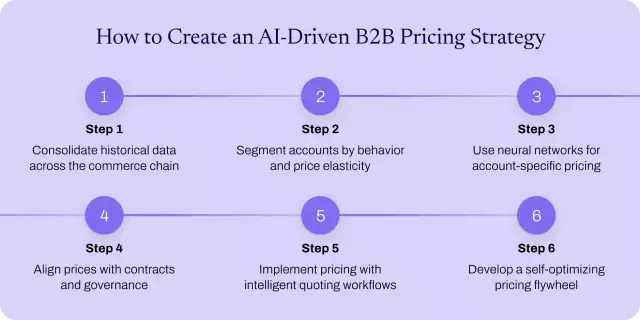
To build an AI-powered pricing strategy, you need a clear plan that connects your data, models, and processes. Follow these six steps to turn scattered information into a system that gives account-specific prices, protects margins, and works for every deal.
1. Aggregate historical data across the commerce chain
Disconnected data creates a pricing blind spot before negotiations even start. Your transaction history lives in CRM, costs sit in ERP, contracts stay in CLM, and quote data stays in CPQ—none of which align in real time. You cannot train AI on fragmented inputs.
To strengthen your business strategy, bring these important data points together into your commerce chain:
- Historical deal data, including won and lost quotes and final selling prices
- Cost variables such as raw materials, logistics, tariffs, and supplier pricing
- Legal and commercial terms found in contracts, rebate agreements, and price protections
- Account behavior signals like purchase frequency, order volume, and churn patterns
Clean, organize, and consolidate this data across your business. This solid base helps you spot where you’re losing margin, avoid repeated pricing mistakes, and give your AI models the full picture to make accurate, specific suggestions from the start.
2. Segment accounts by behavioral value and price sensitivity
If you treat every account the same, you end up competing only on price. You might give too many discounts to your loyal, high-value customers and miss out on deals with price-sensitive clients because you didn’t tailor pricing to their needs.
Start by sorting your accounts based on your data and clear signs of their behavior:
- Purchase frequency, order volume, and product mix
- Discount history, negotiation intensity, and win/loss patterns
- Price elasticity and response to past adjustments
- Lifetime value, churn risk, and growth potential
These customer groups help your AI models understand who is truly sensitive to price. Determine price elasticity, stay competitive where price is key, and avoid giving extra discounts to less loyal customers while rewarding your best ones.
3. Use AI neural networks to optimize prices for each account
Spreadsheets and rule-based models can’t efficiently manage thousands of SKUs, account segments, and market variables. Manual pricing often overlooks subtle patterns in price, volume, and account behavior, which can reduce margins.
According to McKinsey, commercial teams that integrate AI with optimized account experiences are 1.7 times more likely to increase market share than their peers. That edge comes from account-level precision: knowing each buyer's specific needs and price elasticity at the exact moment of decision.

When you train neural networks on your organized, grouped data, they learn how price flexibility changes across products, regions, and deal types. For example, Conga's real-time delivery capabilities and AI-powered price optimization using neural networks provide account-specific recommendations for each item in just 300 milliseconds, with proven margin gains of 200 to 500 basis points.
Explore how neural networks revolutionize AI price optimization.
4. Align pricing logic with contract terms and governance
AI recommendations break down when they ignore contract terms. When your pricing engine runs separately from your agreements, you might see unauthorized discounts, missed rebates, or prices that don’t match negotiated terms. This gap often forces teams to review quotes by hand, slowing things down and hurting your margins.
Make sure your pricing logic integrates with your contract and governance systems so that all prices stay within approved limits:
- Link your AI recommendations to your contract lifecycle management (CLM) data, including negotiated discounts, rebates, and pricing agreements
- Set margin floors, discount limits, and approval rules for each line item
- Flag or block any quotes that don’t meet contract terms before sending them to the customer
By connecting your systems, you keep pricing decisions aligned with your agreements, reduce manual work, protect your margins, and keep deals moving forward.
5. Operationalize pricing through intelligent quoting workflows
Optimized prices deliver no value if your quoting process can’t execute them accurately and quickly. Manual quoting for thousands of items increases errors, delays deals, and prevents sales teams from seeing AI-driven recommendations.
Integrate your pricing engine with your quoting workflow to ensure recommendations are available at the point of decision. An intelligent quoting solution, such as Conga Smart CPQ, addresses this need by:
- Handling large-scale quotes with up to 10,000 line items in one fast, easy-to-use layout, without slowing down your system
- Automatically filling in specific prices and checking margin limits as sales reps build deals
- Showing win-rate chances and deal profitability with built-in quote analytics
- Using automated approval steps to catch margin issues before quotes go out
- Letting customers buy on their own through direct, partner, or online channels, all from one unified catalog
Read more: quote to cash process
6. Establish a self-optimizing pricing flywheel
Your pricing model becomes less effective the moment it stops learning from real results. If you don’t track and consider what happens in each deal, you risk repeating discounting mistakes and falling behind as the market changes.
Close the loop by feeding real transaction data to update your pricing models:
- Record the results of every deal, such as wins, losses, final prices, and margins
- Check how your recommended prices compare to the actual ones to spot any differences
- Keep your models updated by regularly using the newest deal data and market trends
- Monitor your performance across win rate, price realization, and margin for each segment
With this feedback loop, your pricing turns into a self-improving system. Each deal helps make the next recommendation better. You can adjust quickly, fix problems, and get more value over time without constant manual work.
Power a self-improving pricing flywheel with Conga POM
Best Practices for Developing Modern B2B Pricing Strategies
Follow these best practices to keep your pricing strategy accurate, defensible, and continuously improving as market conditions shift and your business scales.
| Best practice | Why it matters for B2B pricing | How to implement it |
| Start with clean, unified pricing data | Poor-quality data produces inaccurate AI recommendations and hides margin performance. You cannot build a reliable strategy on duplicate or siloed transaction records. | Consolidate CRM, ERP, CPQ, and CLM data into a single source of truth. Normalize transaction history and maintain consistent product and customer hierarchies across all global regions. |
| Use real-time market and cost signals | Static inputs cause your prices to lag behind inflation, supply chain shifts, and competitor moves. Real-time B2B price optimization protects your margins during rapid market changes. | Integrate live feeds for raw materials, market indices, and competitive signals into your pricing engine. Set automated triggers to adjust prices when cost thresholds or market conditions shift. |
| Apply segmentation before dynamic pricing | Generic pricing ignores differences in price elasticity and treats loyalists like one-time bargain hunters. Segmentation helps your AI understand the account context before deciding the price. | Use clustering algorithms to group accounts by purchase behavior, price sensitivity, and lifetime value. Apply differentiated pricing logic and margin thresholds for each specific segment. |
| Establish pricing guardrails | Unrestricted AI models or decentralized decision-making can produce rates that violate brand positioning or legal floors. Robust technical guardrails prevent rogue discounting and reduce enterprise audit risk. | Configure hard margin floors and automated approval triggers directly within your POM software. Embed these guardrails into your CPQ and selling workflows, ensuring every transaction adheres to commercial policies by default. |
| Make AI pricing recommendations explainable | Sales reps reject black-box suggestions they don’t trust or understand. Transparency drives internal adoption and empowers your team to defend prices during tough negotiations. | Deploy neural networks that provide clear, defensible insights. Show sellers the specific factors, such as specific attributes used or win-rate probability, behind each recommendation. |
| Continuously monitor pricing performance | Markets evolve, and models drift over time, eroding accuracy and margin capture. Robust B2B pricing analytics identify where your strategy succeeds and where you are leaving money on the table. | Build dashboards to track performance, price realization, and margin trends by segment. Review these metrics regularly to retrain your models and recalibrate your pricing logic. |
How to Choose the Right Pricing Software for B2B Strategies
Manual processes and disconnected tools can’t keep up with modern B2B commerce. Pricing software centralizes data, automates price adjustments and AI-powered recommendations, and enforces governance across all deals and channels.
Evaluate platforms with four steps to find a solution that delivers the speed, accuracy, and governed intelligence your commercial team needs to compete.

1. Look for explainable AI and neural networks
Black-box pricing destroys team trust. When your sales reps can't explain why the system recommended a price, they override it or discount to close, breaking consistency, eroding margin, and eliminating the ROI your AI investment was supposed to deliver.
Choose software with explainable AI and neural networks that can handle millions of data points and spot complex patterns across products, account groups, and deals. The system should clearly show what affects each price, like elasticity, costs, and win chances, and give account-level recommendations in milliseconds.
Read more: why are neural networks the future of B2B pricing?
2. Require unified quote-to-contract governance
If your pricing tools operate independently of legal agreements, you can easily miss negotiated discounts or rebate triggers. This gap can lead to compliance problems, lost revenue, and slow manual reviews that delay deals and cut profits.
Pick a platform that unifies pricing, configure-price-quote (CPQ), and enterprise contract management. The software should use real-time contract terms during quoting so that you meet margin and volume goals.
3. Prioritize a high-performance omnichannel pricing engine
Choose B2B omnichannel pricing software, like Conga, that can give account-specific prices in under 300 milliseconds, even for quotes with over 10,000 items and large product catalogs. The software should be your single source of truth, keeping pricing rules in sync across direct sales, partner portals, and e-commerce in real time.
This unified setup stops conflicting offers that hurt buyer trust and margins. You cut delays, keep pricing consistent everywhere, and give buyers a smooth experience that grows with your business without extra work.
4. Demand constraints-based configuration and waterfall analytics
Waterfall analytics track price erosion from list price to net margin, showing exactly where discounts, rebates, and freight costs drain profitability at the line-item level. Each layer of the waterfall reveals the specific commercial decisions that compress your margin at every deal stage, giving your team the visibility needed to adjust before the quote leaves the building.
Pair this with a powerful constraints-based configuration engine in your CPQ that enforces pricing rules and commercial boundaries at the point of decision. You automatically apply the right pricing logic to the right product combination, protecting margin integrity across every transaction without adding manual review cycles.
Grow Your Profits Faster with Conga's B2B Pricing Software
Conga Price Optimization and Management (POM) turns your price strategy into real, scalable decisions. By bringing together data from across your B2B business, POM creates one place to manage pricing, so every quote meets your standards and helps you stay competitive and earn more. It gives your sales team quick, account-specific recommendations, so they can negotiate confidently with clear, data-driven guidance instead of relying on manual discounts.
POM enforces margin guardrails and compliance and consistency across every channel, whether direct, through partners, or online. Our platform keeps everything in sync when you create quotes, and its neural network model improves with every completed deal, refining future recommendations automatically.
Talk to our team and start scaling profitable growth today.
Drive growth with Conga
Frequently Asked Questions
-
What are the common types of B2B pricing strategies?
The common types of B2B pricing strategies include:
- Value-based: prices tied to the economic value or ROI delivered to the customer, capturing true price elasticity
- Dynamic: real-time price adjustments based on demand, cost changes, and market signals to protect margins and competitiveness
- Segmented: differentiated pricing by account segment, behavior, and price elasticity to improve win rates and realization
- Contract-based: pre-negotiated terms, rebates, and agreements embedded into pricing for compliance and consistency
- Performance-based: pricing tied to measurable outcomes or milestones, aligning commercial terms with delivered results
-
How do you measure the success of a pricing strategy in B2B?
To check if your B2B pricing strategy works, look at more than just total revenue. Use these steps to track how well it is performing:
- Track price realization: estimate the specific gap between your target list and final pocket margin to expose hidden revenue leakage
- Analyze win rates: maintain healthy conversion rates while simultaneously increasing average selling prices across high-value account segments
- Monitor margin erosion: use B2B pricing analytics to identify when discounting exceeds predefined guardrails and adjust the logic accordingly
- Evaluate the impact of pricing on quote velocity with CPQ: count operational efficiency by tracking turnaround times; faster, data-backed quotes lead to superior competitive positioning
-
How does B2B pricing software help enterprises achieve profitable growth?
B2B pricing software helps companies grow profitably by replacing manual spreadsheets with automated, data-driven tools. It lets you adjust prices in real time to protect margins when costs change and stops revenue loss by keeping rules in one place.
By pushing AI-powered prices to quoting tools, the software also gives sales teams clear, account-specific recommendations, which help them close deals faster and get better prices. It also keeps pricing consistent across all channels, so you can handle many products and complex contracts without needing more staff or losing accuracy.
-
What factors influence B2B pricing decisions?
Many factors influence B2B pricing decisions, including your own data and changing market signals:
- Cost volatility: fluctuations in raw materials, logistics, and labor impact your baseline margin requirements and markup strategies
- Customer sensitivity: purchase history, order volume, and behavior-based elasticity vary significantly between different account segments and tiers
- Market dynamics: competitive positioning and real-time demand signals dictate your relative value and influence your commercial landscape
- Contractual governance: Pre-negotiated discounts, rebates, and price protections set the hard boundaries for every deal and renewal
- Strategic goals: objectives like market share acquisition or inventory clearance often override standard profit targets
-
Why AI-Powered Pricing is Now a Business Necessity for Margin and Growth BlogAIWhy AI-Powered Pricing is Now a Business Necessity for Margin and Growth
Learn why AI pricing is becoming essential for businesses facing rising market volatility, increased pricing pressures, and growing need for agility.07/16/20267 min read -
From Pricing to Profitability: How AI is Reshaping B2B Decision-Making BlogAIFrom Pricing to Profitability: How AI is Reshaping B2B Decision-Making
Discover how AI pricing is reshaping B2B decision-making—from improving speed and margin consistency to building trust and smarter commercial strategies.06/16/20266 min read -
Building CFO Buy-in for Pricing Transformation BlogAIBuilding CFO Buy-in for Pricing Transformation
Under pressure to deliver growth, CFOs are turning to AI pricing. Discover how modern pricing improves margins, forecasts, and governance.06/16/20268 min read -
Pricing Opportunity Framework: See What You’re Leaving on the Table GuidesAIPricing Opportunity Framework: See What You’re Leaving on the Table
Estimate how much revenue your pricing process is losing and what it would take to recover it.04/06/20262 min read