Enterprise Document Automation: Benefits and Use Cases
08/20/2026
10 min read

You probably send thousands of documents a month, and each one carries risk. A quote with the wrong discount, a contract missing an approved clause, an invoice that doesn't match the order. Each mistake slows a deal, drains your team, or invites an audit. Create them manually across disconnected tools at scale, and those small errors pile up across sales, legal, and finance until they cost you real revenue.
Enterprise document automation reduces that friction. It pulls verified data straight from your CRM and ERP, applies your rules, and produces accurate files in seconds. This guide breaks down what document automation is, the benefits it delivers, the use cases where it reduces risk, and the features that separate enterprise-grade platforms from basic tools.
Enterprise document automation uses software to generate, route, sign, and deliver business content.
Automated documents pull real-time data from connected systems, replacing manual, rules-based workflows.
Automated documents cut manual entry, speed signing, and boost accuracy and revenue.
Conga's Document Automation solution unifies generation and eSignature to simplify workflows and scale confidently.
What Is Enterprise Document Automation?
Enterprise document automation is the use of software to generate, route, sign, and deliver business paperwork at scale by pulling live data from the systems where work happens, including CRMs, ERPs, and finance platforms. It replaces manual entry and copy-paste with rules-driven templates, so teams produce accurate quotes, contracts, and invoices in seconds.
Unlike lightweight tools built for one-off files, enterprise platforms handle high-volume generation across departments while enforcing branding, approved language, and governance on every output.
Companies now treat business document automation as core infrastructure. As volumes outgrow manual workflows, organizations embed generation and eSignature into one process that drives speed, accuracy, and revenue.
6 Benefits of Business Document Automation
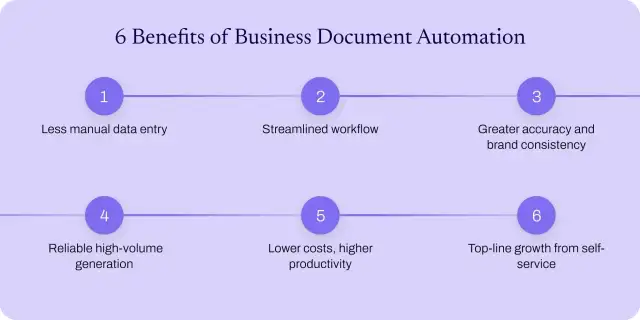
Business document automation drives value at every stage of the commerce chain. By embedding document generation and eSignature into core CRM and ERP systems, you remove the disconnected tools and copy-paste bottlenecks that stall operations.
At enterprise scale, where volume runs across sales, legal, and finance, every output has to follow the same governance. These six document automation benefits compound from the first quote to the signed agreement.
1. Less manual data entry with one-click CRM and ERP data merges
Manual data entry is where most errors begin. Document automation pulls fields from CRM, ERP, HRIS, and finance systems, so a rep never has to retype an account name, a price, or a contract term. One click merges data from multiple sources into a template:
- Sales generates a quote.
- Finance populates an invoice.
- Legal drafts a contract.
Accurate records replace rekeying and the rework it causes. When you move creation into a document generation solution, you reclaim the hours once lost to transcription and spend them with customers.
2. Streamlined workflow with generation and eSignature in one place
Every handoff between a drafting tool and a separate signing app delays a deal and the cash behind it. Conga closes that gap by pairing Conga Composer for document generation with Conga Sign for electronic signature in one continuous workflow.
A rep builds the agreement from live CRM data, the buyer signs, and finance bills, all without switching platforms or chasing manual steps. Deals that once took days to move from draft to signature now close in minutes, shortening the sales cycle and pulling revenue forward when quarter-end pressure peaks.
Close deals faster with generation and signing in one place.
3. Greater accuracy and brand consistency across every document
Manual document creation invites two problems: wrong data and off-brand formatting. Enterprise document automation software solves both by locking approved templates, logos, fonts, and legal language into every output.
Conditional rules select content by deal size, region, or product, so a quote from Chicago matches one from New York. Verified data flows from source systems into fixed fields, reducing the risk of manual entry errors and outdated pricing. Whether a team sends 10 agreements or 10,000, the system helps support consistent figures and branding.
4. Reliable high-volume document generation at scale
Think monthly billing, mass contract renewals, quarterly statements, and onboarding waves. These are the moments when you need thousands of files, fast and accurate. High-volume document generation takes it in stride with batch jobs, overnight scheduled runs, and triggers that fire the second a record changes in your CRM or ERP.
With the Conga Composer high-volume generation API, you can send up to 600,000 PDF documents per day by email, secure file transfer protocol (SFTP), or directly through Conga Sign. That means a 50,000-invoice cycle runs as smoothly as a single quote, no overtime needed.
5. Lower operational costs and increase team productivity
Repetitive paperwork drains budgets in ways that never hit a line item. The costs of manual document creation pile up fast:
- Hours of copy-paste
- Chased approvals
- Errors that need fixing every week
Business document automation can help clear that busywork in two ways, cutting the labor behind repetitive drafting and the rework that bad data triggers. Finance closes billing sooner, sales sends more quotes, and legal stops touching every routine agreement. You handle more volume with the same team. Productivity climbs, costs drop, and skilled people spend their time on work that moves the business.
6. Top-line growth potential from embedded, self-service document experiences
Give customers a way to buy on their own schedule, and revenue follows. Embed Conga Composer and Conga Sign into your portal or app, and a buyer can configure an order, generate the agreement, and sign it without waiting on a rep. Self-service buying lines up with how people want to buy: Gartner found 75% of B2B buyers prefer a rep-free sales experience.

Automated documents give enterprises exactly that rep-free experience, turning self-service into a revenue channel that runs around the clock and captures deals a slower, manual process would lose.
How Enterprises Reduce Risk in Automated Document Processing: 4 Use Cases
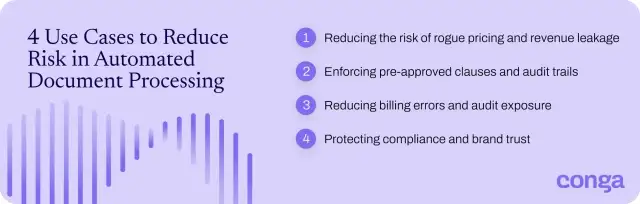
Automation speeds up documents. Without the appropriate governance built in, it scales mistakes just as fast as output. That's why automated document processing solutions for enterprises earn their keep on control. These systems build checkpoints into every step to help catch rogue pricing, unapproved clauses, billing errors, and compliance gaps before they reach a customer.
These four use cases demonstrate how enterprise doc automation closes the gaps that put revenue and trust at risk across quotes, contracts, invoices, and customer communications.
1. Reducing the risk of rogue pricing and revenue leakage in automated quote and proposal generation
Every manual quote is a chance for margin to slip. A rep grabs an old price, approves a discount they shouldn't, or mistypes a line item, and the company eats the difference across thousands of deals. Document automation helps reduce that risk at the source. Instead of a rep drafting in a spreadsheet, the platform builds each quote and proposal from approved data, pulling current pricing and product rules from your CRM or configure, price, quote (CPQ) solution.
Reps still shape the deal, choosing products and terms within the approved guardrails, and anything off-policy can be caught before it goes out. Connect that document to the wider quote-to-cash process, and the number stays consistent from proposal to invoice.
Learn how to avoid revenue leakage with Conga.
2. Enforcing pre-approved clauses and audit trails in contract and NDA execution
Contract risk lives in the clauses. One edited term or dropped condition and an NDA that looked routine becomes a liability. Document automation relies on a pre-approved clause library, so every agreement pulls vetted language and flags any deviation before it reaches signature. Each version, edit, and approval generates a full audit trail that shows legal who changed what and when.
That governance is what the market wants. Per Global Growth Insights, 61% of enterprises prioritize solutions with advanced audit trails and signature capabilities. Pair those controls with embedded eSignature, and contracts execute fast without breaking policy.

3. Helping to reduce billing discrepancies and audit exposure with triggered invoice distribution
A single wrong invoice can cost revenue today and become an audit problem tomorrow. Manual invoicing invites both, with wrong amounts, missed sends, and figures that don't match the signed contract. Document automation removes the manual work. The moment a billing event fires in your ERP, triggered invoice generation pulls from the order and pricing that closed the deal, so the amount billed matches the amount agreed.
Scheduled distribution keeps recurring and subscription billing on time, and each invoice logs a timestamped record tied to its order. The result is cleaner cash flow and a trail that stands up to scrutiny.
4. Protecting regulatory compliance and brand trust in customer communications
In regulated industries, late or off-message customer communications can quickly turn into a compliance problem. Every notice, statement, and renewal must reach the right person on time, with approved content and consistent branding. Document automation helps make that repeatable at scale.
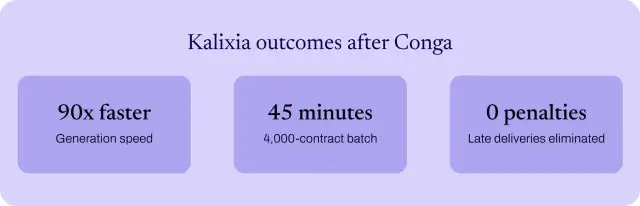
Take the example of Kalixia, France's largest healthcare network. This brand renews thousands of provider contracts each year. The renewal process once took five days to generate 7,000 contracts manually, risking missed deadlines and penalties. Running Conga Composer on the Conga Advantage Platform, Kalixia now produces a 4,000-document batch in 45 minutes, 90 times faster. Automating the process helped reduce the risk of compliance penalties while keeping every communication on brand and compliant.
Key Features of Enterprise Document Automation Software to Look for
Not every tool that claims to automate documents can handle enterprise reality. The key features of enterprise document automation software separate platforms built for scale from lightweight utilities that stall under volume, complex templates, or strict compliance.
| Enterprise Document Automation Software Capability | What to Look for | Why It Matters for Enterprises |
| Enterprise system integration | Native integrations or APIs that connect with CRM, ERP, HRIS, finance platforms, and other business systems | Connected business data across systems with fewer manual data entry errors and less duplicate work |
| High-volume enterprise document generation | Batch processing, scheduled generation, and event-triggered document creation at enterprise scale | Reliable document processing during billing cycles, contract renewals, and other high-volume business events |
| Dynamic templates and content rules | Reusable templates, conditional logic, centralized template management, and automated content selection | Accurate, consistent business documents that follow approved language, branding, and business rules |
| Document routing and eSignature | Configurable document routing, embedded eSignature, secure delivery, and status tracking | Faster document execution with fewer manual handoffs and greater visibility into status |
| Security, compliance, and governance | Role-based access, encryption, audit trails, version history, and support for industry and regulatory requirements | Stronger document governance, improved audit readiness, and protection of sensitive business information |
| Scalability and performance | Cloud-based architecture supporting enterprise users, workflows, and document volumes | Consistent performance as document volumes, business processes, and organizational complexity grow |
Simplify Your Processes with Conga's Enterprise Document Automation Software
Speed, accuracy, and control improve when doc generation, signing, and governance run as one connected system. Conga Document Automation delivers that. Conga Composer builds documents at high volume from your CRM, ERP and CPQ data, and Conga Sign executes them.
Our platform ties document generation, contract lifecycle management (CLM) solution, and CPQ tools to a single source of truth. A quote flows into a contract, and an agreement into an invoice, with no re-entry and no drift. The payoff is the potential for faster revenue, cleaner compliance, and less manual work across every team.
Talk to our sales team to see how Conga can handle enterprise volumes and governance requirements.
Scale your documents without multiplying the busywork.
Frequently Asked Questions
-
What are the best ways to automate document creation and management?
The best ways to automate document creation and management are:
- Connecting your CRM, ERP, CPQ and finance systems so legal documents pull live, verified data instead of manual entry
- Building approved, rules-driven templates that apply the right content, language, and branding automatically
- Combining generation and eSignature in one workflow so a document moves from draft to signed without handoffs
- Automating routing, delivery, and storage, with version history and audit trails for governance
- Using batch and event-triggered generation to handle high-volume runs like billing cycles and renewals
-
How do I know if a document automation platform is built for enterprise?
You know if a document automation platform is built for enterprise by testing it against scale and control. Look for native CRM and ERP integrations, high-volume batch generation, role-based security, audit trails, and cloud performance that holds under load.
Enterprise-grade tools like Conga Document Automation also handle complex, conditional templates and regulatory requirements, not just simple one-off files.
Automate the document creation of your enterprise. Watch our video.
-
How does automation support the integrity of business documents?
Automation supports the integrity of business documents by pulling data from verified source systems and locking content into approved templates. Conditional rules control what appears, so every file uses correct pricing, clauses, and branding. Version history and audit trails record each change, giving teams a defensible record from creation through signature.
-
How does enterprise document automation integrate with existing systems?
Enterprise document automation integrates with existing systems by using RESTful APIs, web applications, and pre-built connectors inside your core business platforms. Conga connects natively with environments like Salesforce, Microsoft Dynamics, and SAP, pulling real-time data straight from your records without custom code. Once it generates and signs documents, it routes the finished files downstream to storage like SharePoint, Box, OneDrive, or Amazon S3.
Explore Conga integrations.
Related Resources
-
The Million Document Moment: A Guide to Navigating Document Complexity and Compliance at Scale GuidesDocument AutomationThe Million Document Moment: A Guide to Navigating Document Complexity and Compliance at Scale
Learn how document automation supports large-scale businesses in the most regulated industries.08/18/20262 min read -
Checklist: 7 Essential Documents to Automate GuidesCLMChecklist: 7 Essential Documents to Automate
Today’s sales teams waste precious time and resources on repetitive, manual tasks when preparing quotes, proposals, and contracts. In fact, the average sales rep spends only 33% of their time each day actually selling.06/23/20263 min read -
Connect and Learn With Peers in the Conga Customer Community BlogCLMConnect and Learn With Peers in the Conga Customer Community
Join 40,000+ peers in the Conga Customer Community—connect, learn, and grow with resources, training, and support to fuel smarter business outcomes.09/30/20266 min read -
The Quote to Cash Process in 10 Steps BlogCLMThe Quote to Cash Process in 10 Steps
Discover how to streamline your quote-to-cash (Q2C) process to accelerate sales cycles, improve customer experience, and boost revenue. This comprehensive guide covers every stage—from configuration and pricing to contract management, billing, and renewals—plus tips for finding the right automation solution. Learn how to eliminate silos, reduce errors, and drive efficiency across your CRM and ERP systems.12/01/20259 min read