Configure Faster with Sales Quote Automation
07/27/2026
9 min read

You have probably seen this scenario: the buyer's ready to talk about prices, and your reps are stuck rebuilding the proposals in spreadsheets. Suddenly, a quick negotiation turns into a week of back-and-forth. In fact, according to recent research by Conga, nearly half of respondents (45%) lost a deal due to slow quote approval in the last six months.
Sales quote automation helps solve this problem by pulling product, pricing, and approval rules into one system, so a clean deal lands in your hands in minutes.
Key highlights:
- Sales quote automation runs on software that builds proposals from your catalog and pricing rules, so your reps don't have to enter data or do spreadsheet math.
- The benefits of automated quotes include faster sales turnaround, reduced errors, cleaner approvals, and better control over pricing.
- Conga's CPQ solution connects configuration, pricing, approvals, and proposal generation in one flow, lining up your commerce chain.
What Is Sales Quote Automation?
Sales quote automation is the use of software in the configure, price, quote process to generate proposals for products and services without manual data entry, spreadsheet math, or document copy-paste. The system, often a CPQ platform, reads the product catalog, applies pricing and discount rules, runs configuration checks, routes approvals, and produces ready-to-send quotes in a single pass.
More and more companies are starting to adopt enterprise CPQ. According to Grand View Research, the CPQ software market is projected to hit $10.89 billion by 2033 (15.6% CAGR). The reason adoption is climbing so fast: every quote built by hand costs hours, invites pricing errors, and slows the deal, so the longer you stay manual, the more revenue and margin you leave on the table.
How CPQ Quote Automation Works
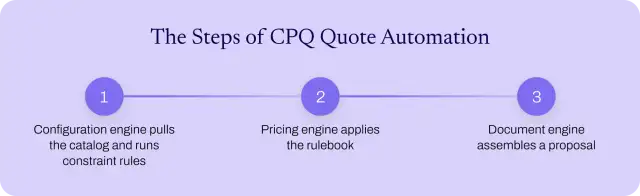
CPQ quote automation tools run on three connected engines: configuration, pricing, and document generation. Here's how the process works:
- The configuration engine pulls the catalog and applies constraint rules. When a rep selects a product, the CPQ tool validates compatible options, prevents invalid bundles, and flags missing dependencies in real time. The seller can't quote a product mix that engineering can't build or that procurement won't approve.
- The pricing engine applies the rulebook. List prices, account-specific contracts, volume discounts, and promotional offers all come from a single source. AI-powered CPQ solutions take this further by analyzing historical win rates and price elasticity at the account level.
- The document engine assembles the proposal. Your CPQ tool merges the configured quote with the right template, legal language, and approval routing. The output is a branded proposal ready to send, sign, and convert into a contract.
Key Automated Quoting Benefits
Your quoting demand might be scaling faster than manual work can keep up with.
Conga's State of Commercial Operations 2026 report found that 45% of organizations surveyed lost a deal in the last six months due to slow quote approvals. Quote automation removes that friction by routing approvals and generating compliant quotes automatically, so deals keep moving instead of stalling.

Time isn't the only quoting benefit you get from a CPQ technology stack. Compare a manual workflow side by side with an automated one. See where the money and margin go in each model:
| Automated quoting benefits | Manual process | Automated sales quotes |
| Quote turnaround | Days to weeks, often delayed by spreadsheet math and manual lookup | Minutes, with end-to-end automation across catalog, pricing, and document assembly |
| Pricing accuracy | Errors caused by stale price sheets, copy-paste mistakes, and inconsistent discounts | Rules-based pricing pulled from a single source, validated against active contracts |
| Configuration control | Reps build invalid product combinations that get caught downstream in operations | Constraint engine blocks invalid configurations at the point of quote creation |
| Approval speed | Sequential email chains across the deal desk, finance, and legal | Parallel routing based on deal size, discount level, and contract terms |
| Document compliance | Outdated templates and inconsistent legal language across reps | Pre-approved templates that lock in branding and contract language |
| System alignment | Disconnected CRM, ERP, and contracting tools that require rekeying | Native integration with Salesforce, Microsoft Dynamics, SAP, and Oracle |
| Rep productivity | Hours per quote, leaving less time for active selling | Creating a quote takes minutes, freeing reps to focus on the deal itself |
| Margin protection | Rogue discounting and uncontrolled exceptions erode profitability | Real-time margin guardrails and approval triggers when discounts threaten profit |
Explore all the CPQ benefits you get from automation.
5 Steps to Configure Quotes Faster with Automation
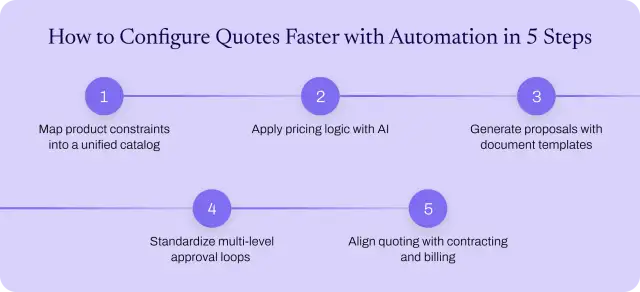
Enterprise CPQ helps sellers configure quotes faster by removing blockers such as invalid configurations, pricing exceptions, clause debates, approval queues, and downstream clean-up. Follow these five steps to automate your quoting process:
1. Map complex product constraints into a unified guided-selling catalog
Start with your catalog. Every product, option, attribute, and dependency needs to live in a single rule set that the CPQ engine can read. Consolidate item-specific data from all your sources, including:
- Spreadsheets
- PDFs
- Engineering specs
- Tribal knowledge
Once you have a structured catalog with constraint logic attached, guided selling sits on top of that. The rep answers a short series of questions about the account, use case, and deal scope, and the CPQ system narrows the configuration to valid options only.
2. Apply account-specific pricing logic through neural network optimization
Pricing is where most quote automation projects either deliver margin or leak it. The goal in this step is to apply list prices, contract pricing, volume tiers, and promotional adjustments without the rep having to remember which one applies to each account.
AI-driven pricing solutions, such as Conga Price Optimization, use neural networks to take this a step further by recommending the right price for a specific account based on historical win rates, price elasticity of demand, and the account's own purchase history. These capabilities justify the enthusiasm for adoption: a McKinsey survey of more than 400 B2B decision-makers found that 65% to 85% of enterprises expect to adopt generative or agentic AI over the next one to three years.

Conga Price Optimization uses AI to adapt your pricing strategy to each account. Boost your win rates and margins with automated adjustments to market shifts in real time, centralize your data, and track profitability in a single tool.
Optimize your pricing strategy with AI logic applied to every account-specific quote
3. Generate compliant proposals with dynamic document templates
The proposal is the buyer's first, and often only, impression of your commercial process, which is why it has to be accurate and compliant. Document automation makes compliance easier through each quote by pulling the pricing breakdown, contract language, and visual branding from your CPQ tool into one ready-to-send file.
Thanks to automated documentation with templates in the best CPQ tools, you speed the quoting process without sacrificing accuracy. The legal team controls the contract clauses, the deal desk handles the pricing structure, and the rep takes over the cover letter and narrative.
Conga Composer generates error-free documents for your commerce chain with templates your teams can use anywhere, anytime.
4. Standardize multi-level approval loops to remove execution friction
Approval bottlenecks are where deals go to stall. A discount above the threshold needs a CFO sign-off. A non-standard contract term needs legal review. In most teams, those reviews happen one after another, adding friction to the quoting process and slowing down negotiations.
Automated approval workflows change the sequence. Instead of routing a quote to the CFO, waiting, then routing it to legal, both reviewers get it at the same time. The deal desk sees what's in the queue, the rep tracks where the deal stands, and the buyer gets a proposal in hours.
5. Align quoting with contracting and billing to secure the commerce chain
A quote is only useful if it converts cleanly into a contract and a bill. Most CPQ rollouts skip this part, and that's where downstream revenue leakage builds up. Proposals live in one system, contracts in another, and billing is somewhere in a third workflow. Someone has to manually move data between them—and every handoff is a chance for numbers to drift, terms to change, or revenue to slip through the cracks.
The Conga Advantage Platform connects every step of your quote process in one solution. The price and terms flow directly into the contract. Once signed, that same data drives the invoice. Nothing gets rekeyed or lost. What the account agreed to is exactly what they get billed for.
Power Quote Automation for Enterprise Sales with Conga CPQ
You need a quoting tool that scales with your commerce, which is why Conga offers you two options: the Advantage CPQ that runs on the Conga Advantage Platform, unifying configuration, pricing, and subscriptions on one catalog, and the Smart CPQ, which brings AI to your workflows on Conga or any other system through APIs, delivering optimized, error-free proposals that protect your margins and boost your revenue.
With Conga CPQ solutions, you:
- Handle quotes with more than 10,000 line items.
- Validate configurations against catalogs without latency.
- Get neural-network pricing to deliver account-specific recommendations.
- Connect quotes, contracts, and billing in one tool.
Talk to our sales team to see how our enterprise CPQ engine cuts deal turnaround times, protects margins, and aligns your full quote-to-cash flow.
Line up your commerce chain with Conga AI-powered CPQ
Frequently Asked Questions
-
How to automate the quoting process?
Automating quoting means replacing spreadsheets, email threads, and manual pricing math with a CPQ engine that does the work for you. The rollout breaks into four steps:
- Load your products, pricing rules, and constraints into a CPQ system
- Set up guided questions that walk reps through building the right quote for each account
- Create approval rules so the system routes discounts and exceptions
- Connect CPQ to your contract and billing systems so the same data flows all the way through without rekeying
Download our guide on CPQ implementation to make your quote automation process easier, step by step.
-
How does automating the quoting process reduce manual errors?
Automating the quoting process reduces manual errors by removing the manual steps where mistakes happen: rekeying data, copying prices between systems, and building configurations by hand.
A CPQ solution pulls pricing from a single source, validates every configuration against the catalog, and applies approval thresholds that stop a rep from using an outdated price sheet or quoting a product bundle that can't be sold together.
-
What's the connection between CPQ and automated sales cycles?
CPQ is the operational backbone of an automated sales cycle. A CPQ tool connects the upstream catalog and pricing data to the downstream contract and billing systems, enabling a deal to move from initial configuration to a signed agreement without manual handoffs.
Without this technology, the sales cycle stalls at the stages of quote generation, approval routing, and document sharing. With CPQ, those steps run in parallel or disappear entirely.
See all challenges that CPQ solves, from delays in quote turnarounds to limited collaboration between departments.
-
What are the most frequent errors encountered in quote automation?
The most frequent errors in quote automation trace back to incomplete data migration during CPQ setup or to product changes that didn't make it into the catalog, such as:
- Misconfigured constraints that let invalid product combinations through
- Stale pricing data produces quotes that don't match the active contract
- Broken approval workflows that route deals to the wrong reviewers or skip required sign-offs
The fix to all of these issues is governance: a clear owner for the catalog, the pricing rulebook, and the approval matrix. Our predictable revenue eBook covers the governance model that keeps these errors out of the system long-term.
-
What tools help automate vendor quote data entry?
The best tools to automate data entry in vendor quotes are the ones that pull product, pricing, and term information directly from supplier catalogs into your CPQ or procurement system without manual rekeying, such as:
- Catalog ingestion engines
- OCR-based document parsers
- Direct API integrations with vendor systems
Check Conga’s integrations and see why our CPQ tool lines up your whole commerce chain.
Related Resources
-
Connect and Learn With Peers in the Conga Customer Community BlogCLMConnect and Learn With Peers in the Conga Customer Community
Join 40,000+ peers in the Conga Customer Community—connect, learn, and grow with resources, training, and support to fuel smarter business outcomes.09/30/20266 min read -
5 B2B Buying Behaviors You Can’t Ignore BlogCPQ5 B2B Buying Behaviors You Can’t Ignore
Discover the 5 B2B buyer behaviors redefining sales and learn how companies can adapt their sales strategies to win in a buyer-led world.09/18/202611 min read -
Conga Recognized in the 2026 Gartner Peer Insights™ Voice of the Customer for Configure, Price, and Quote Applications BlogCPQConga Recognized in the 2026 Gartner Peer Insights™ Voice of the Customer for Configure, Price, and Quote Applications
Learn more about how customers rate Conga CPQ and our position in the Gartner Peer Insights™ Voice of the Customer: Configure, Price, and Quote Applications report.09/16/20264 min read -
The Future of SteelBrick Salesforce CPQ: Are You Ready? BlogCPQThe Future of SteelBrick Salesforce CPQ: Are You Ready?
SteelBrick Salesforce CPQ is changing. Learn what’s next, why it matters, and how to choose a modern CPQ that fits your business now and in the future.09/15/20266 min read