What Is Contract Compliance? Process and Checklist
01/07/2026
13 min read

8.6%
of contract value lost to poor management
Only 7% of companies see themselves as compliance leaders
6
steps to build a contract compliance process
AXA signed 20% more contracts with Conga CLM
Contract compliance is all obligations, terms, and legal requirements set out in an agreement. This process helps you stay on track with important milestones, service-level agreements (SLAs), and pricing, protecting your business from financial loss and legal issues.
This guide gives you a contract compliance checklist you can use right away. Following this framework helps your business avoid audit issues and stops revenue from slipping through the cracks.
Why Is Contract Compliance Important?
Contract compliance protects the commercial and risk value negotiated into every agreement, including revenue, cost controls, service levels, and regulatory safeguards. When companies fail to enforce contractual terms, they lose an average of 8.6% in value, a loss that Deloitte attributes to poor management.
Taking a careful approach to contract risk and compliance lowers your business’s exposure to problems such as:
- Financial leakage: if you don’t track pricing tiers, rebates, or auto-renewals, your revenue and profit margins can drop.
- Legal and regulatory exposure: not meeting standards such as HIPAA or DORA can result in more audit issues, fines, and extra costs to address violations.
- Reputational damage: missing contract commitments can hurt your reputation with customers and suppliers, making future negotiations harder.
Who Is Responsible for Contract Compliance?
Effective contract compliance relies on shared responsibility. Legal sets the standards, while sales, procurement, and finance teams handle their own obligations. By letting specialized teams manage commitments within clear compliance rules, organizations can lower risk.
| Role | Primary responsibilities | Example of contractual compliance activities |
| Legal | Enforce regulatory requirements, manage risk language, and maintain contract approval workflows. | Review master service agreements (MSAs) for indemnification caps, track termination notice periods, and maintain audit trails for amendments. |
| Procurement | Monitor supplier performance, manage vendor relationships, and enforce contracted terms. | Verify delivery schedules match purchase orders, track certificate of insurance expirations, and escalate quality failures. |
| Finance | Reconcile invoices with contracted pricing and track payment obligations. | Audit invoices against rate cards and volume discounts, accrue rebates, and flag unauthorized price increases. |
| Sales | Align customer commitments with delivery capabilities and track revenue triggers. | Monitor implementation milestones tied to payment schedules, calculate service level credits, and issue renewal notifications. |
| Business owners | Own post-signature obligations for their function and coordinate cross-team execution. | Assign resources to contractual deliverables, approve scope changes, and escalate performance gaps to stakeholders. |
| Operations manager | Track operational SLAs, coordinate deliverable execution, and document performance. | Monitor system uptime guarantees, verify acceptance criteria, and log service failures and remediation efforts. |
| Internal audit | Validate compliance controls, test governance processes, and identify gaps. | Conduct periodic contract audits, review exception approvals, and assess alert configuration effectiveness. |
| Executive leadership | Set compliance priorities, allocate resources, and oversee enterprise risk exposure. | Approve high-risk agreement exceptions, review portfolio compliance scorecards, and authorize investments in contract lifecycle management (CLM) systems. |
Steps of the Contract Compliance Process
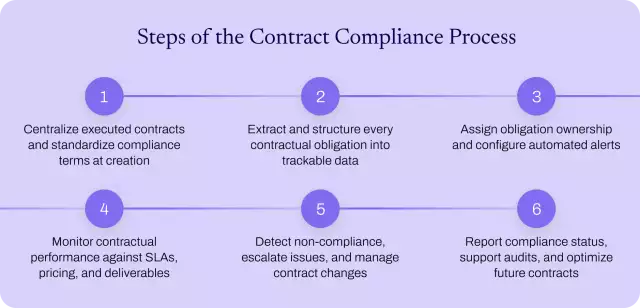
A reliable compliance framework requires clear ownership, structured data, and continuous oversight. To get better visibility into contract compliance tracking and reporting at scale, follow these steps:
Step 1: Centralize Executed Contracts and Standardize Compliance Terms at Creation
When agreements are scattered in emails or on local drives, it’s easy to lose track of them. This lack of visibility can mask unusual terms and expose the company to legal or financial risks. Keeping contracts in a searchable repository helps you manage them more effectively.
Following a standardized language from the start helps ensure every agreement aligns with company policies before anyone signs. Here’s how you can do this:
- Use approved clause libraries and templates to maintain consistency in regulatory and financial terms.
- Save all signed agreements in a central place right after they are signed.
- Add consistent tags and version controls to help track compliance over time.
This step reduces the risk of misunderstandings, makes it easier for teams to work together, and enables reliable contract audits without requiring legal review for every standard agreement.
Step 2: Extract and Structure Every Contractual Obligation Into Trackable Data
Static documents hide commitments, often leading to missed deadlines or financial penalties. By turning unstructured text into trackable data, you can stay on top of every requirement. Tools like Conga CLM powered by AI help you see and manage your contract portfolio more effectively by:
- Finding key dates, milestones, and financial commitments in your agreements.
- Turning the information you extract into structured data fields so you can track and report on it in real time.
- Looking for unusual wording in your contracts to spot hidden risks or missing obligations.
This way, you can avoid manual-entry mistakes and make your contract compliance management more transparent. With a clear view of all your commitments, your team can focus on strategy instead of just fixing problems as they come up.
Read more: how to manage your contractual obligations
Step 3: Assign Obligation Ownership and Configure Automated Alerts
Contract compliance fails when tasks lack a clear owner. Unclear ownership can cause missed deadlines, delays, and even financial losses. Assigning each requirement to a specific stakeholder helps keep sales, finance, and procurement accountable.
You should also set automated alerts for important dates, such as contract terminations, renewal periods, and key performance milestones. By following this step, you can prevent missed deadlines that lead to revenue leakage or supply chain disruptions, while freeing teams from manual tracking so they can focus on more strategic work.
Step 4: Monitor Contractual Performance Against SLAs, Pricing, and Deliverables
Manual tracking leads to missed commitments and overspending. Regular monitoring helps keep delivery, pricing, and performance in line with contract terms. Checking real results against agreements protects your margins and keeps partner relationships strong.
To monitor contracts well, you need to:
- Connect contract data to your operational systems so you can track service levels and milestones as they happen.
- Build dashboards to compare vendor performance with the quality standards you agreed on.
- Check invoices to make sure they match the pricing tiers and discounts in your contract.
With this level of visibility, you can enforce contracts more easily, have stronger renewal conversations, and avoid having to run manual audits all the time.
Step 5: Detect Non-Compliance, Escalate Issues, and Manage Contract Changes
Spotting missed obligations and pricing issues early helps limit their impact and lowers the risk of financial or legal problems. When you catch these gaps earlier, you can fix performance or adjust terms before small issues turn into bigger disputes. Having a clear response process facilitates a workflow in which every change or identified deviation adheres to your company’s rules.
Take these steps into account when managing contract deviations and changes:
- Apply risk scoring to flag non-standard clauses and deviations from approved playbooks.
- Trigger automated approval paths for identified exceptions so functional experts review high-risk changes.
- Document all amendments, waivers, and root causes in your central system to maintain a single, current version of the truth.
Read more: why legal compliance is so important?
Step 6: Report Compliance Status, Support Audits, and Strengthen Contract Standards
Comprehensive contract compliance reporting provides leadership with the visibility needed to assess portfolio health and audit readiness. Follow these steps:
- Create audit-ready reports with version history and supporting evidence to speed up regulatory reviews.
- Keep track of repeated non-compliance issues to spot ongoing problems or unclear contract language in your playbooks.
- Use what you learn from compliance to update your templates, improve negotiation strategies, and make future contracts better.
When you connect execution and reporting, you set up a cycle that keeps improving itself, reduces contract risk, and raises contract standards throughout your enterprise.
Power every step of contract compliance management with Conga CLM
Key Contract Compliance Metrics to Track
When reporting on agreement compliance, track these performance indicators to evaluate execution, risk exposure, and financial impact.
| Contract compliance metric | What it measures | Why it matters |
| Obligation ownership percentage | The proportion of agreements where every post-signature commitment has a named internal stakeholder. | Elimination of organizational blind spots where unassigned obligations lead to missed milestones or unclaimed entitlements. |
| Total audit recovery value | The cumulative dollar amount reclaimed from pricing errors, missed rebates, and unapplied SLA credits. | Documentation of the direct financial return on governance activities to justify continued investment in monitoring resources. |
| SLA breach frequency per supplier | The count of service level violations over a defined period, segmented by vendor and breach severity. | Identification of underperforming partners who require performance improvement plans or replacement during the next renewal cycle. |
| Data-driven renewal rate | The percentage of contract renewals or terminations where documented performance data directly influenced the outcome. | Transformation of compliance tracking into strategic negotiation intelligence that secures firmer terms and better pricing. |
| Audit response lead time | The total hours or days required to compile evidence for internal audits, regulatory exams, or disputes. | A clear benchmark for audit readiness; long lead times signal fragmented data silos and inefficient manual processes. |
How to Support Contract Compliance: Checklist
A-LIGN reports that 35% of enterprises see compliance as a means to boost revenue and attract clients, not just reduce risk. Reaching these growth goals requires shifting from manual checks to a standardized framework.
Use this contract compliance checklist to unify your governance and help every agreement deliver its full intended value.
| Contract compliance category | Actionable checklist item | Why it matters |
| Contract governance and standardization | Standardize contracts with approved clause libraries and templates. | Faster negotiations and consistent enforcement of regulatory, legal, and commercial requirements. |
| Centralize all executed contracts in a searchable repository. | Immediate access to current agreements and elimination of version control risk. | |
| Contract data extraction and ownership | Extract SLAs, milestones, pricing triggers, and penalties into structured fields. | Structured visibility that turns buried contract language into trackable, enforceable data. |
| Assign a named internal owner to every post-signature obligation. | Clear accountability for execution, deadlines, and entitlement realization. | |
| Compliance monitoring and alerts | Configure automated alerts for notice periods, expirations, and performance thresholds. | Early awareness of risk events without dependence on manual tracking. |
| Monitor vendor performance against contractual KPIs and acceptance criteria. | Documented evidence of performance gaps to support escalation or renegotiation. | |
| Financial compliance and auditability | Reconcile invoices with contracted pricing, discounts, and rebate structures. | Protection against billing errors, unauthorized rate increases, and margin erosion. |
| Maintain a complete audit trail for exceptions, waivers, and amendments. | Defensible documentation for audits, disputes, and regulatory reviews. | |
| Contract lifecycle and renewal governance | Generate portfolio-level compliance scorecards for stakeholders. | Executive visibility into risk concentration and performance trends. |
| Conduct pre-renewal compliance reviews at least 90 days before termination windows. | Sufficient runway for remediation, renegotiation, or supplier transition. |
Contract Compliance Management Best Practices
Enterprises often struggle to put compliance into practice at scale. PwC reports that just 7% of companies see themselves as leaders in compliance, mostly because there are gaps across policy, ownership, and monitoring. The most successful companies treat compliance as an ongoing, structured process rather than something they review only occasionally.
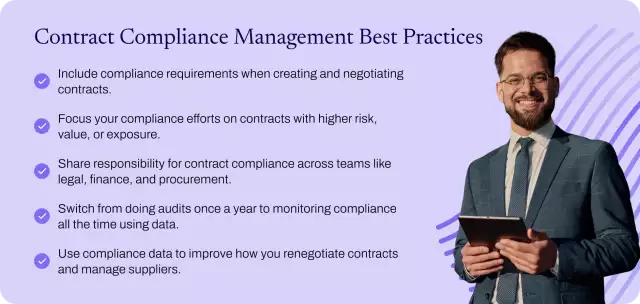
To achieve consistent management across your contracts, try these five best practices:
- Include compliance requirements when creating and negotiating contracts. Setting clear expectations from the beginning makes compliance easier. Using standard clauses helps promote the enforceability of rights without needing to fix things after signing.
- Focus your compliance efforts on contracts with higher risk, value, or exposure. Not every agreement needs the same level of attention. Let the risk and financial impact guide how closely you monitor each contract.
- Share responsibility for contract compliance across teams like legal, finance, and procurement. When everyone knows their role, it’s easier to avoid gaps that a single team might miss.
- Go from conducting audits once a year to continuously monitoring compliance. Annual reviews often find problems too late, but ongoing checks help you catch and fix issues early.
- Use compliance data to improve how you renegotiate contracts and manage suppliers. Knowing past performance can change how you negotiate. Having records of results helps you set stronger terms and make better renewal choices.
Industry-Specific Contract Compliance Use Cases
Highly regulated organizations rarely struggle to define compliance policies. The breakdown occurs when teams cannot translate contract terms into enforceable, auditable execution at scale.
These examples of how enterprises facing complex compliance challenges used Conga CLM to stay in control of high-volume, high-risk deals:
Enforcing Compliance Across Research Pipelines at Charles River Laboratories
Charles River Laboratories had important contract clauses scattered across shared drives and file cabinets, making it hard to find what they needed. Without a clear view of their agreements, the team found it difficult to maintain the right level of oversight for sensitive medical research.
By consolidating all its agreements in Conga CLM, Charles River eliminated scattered documents and gained a clear understanding of its contractual obligations.
Specific outcomes included:
- Self-service with built-in controls: sales reps use pre-approved templates to generate confidentiality and customer agreements, ensuring only authorized clauses are included from the start—reducing the need for ongoing manual review by legal.
- Accurate contract obligation management: with a custom tool, the team automatically links deals to the correct legal entities across a complex hierarchy, ensuring commitments are assigned to the right accounts.
- Audit-ready visibility: real-time dashboards and automated alerts provide stakeholders with immediate insight into clause-level details, replacing manual research with a clear, defensible record of compliance.
Managing Multi-Tiered Risk and Clause Compliance at AXA
For AXA, a global reinsurance provider, compliance is key to managing risk. Their business depends on layered contracts that need to match up to avoid financial problems. Without a clause library and with too many manual steps, it was hard to grow safely.
To address these challenges, AXA implemented Conga CLM, gaining the structure it needed to handle complex contracts and speed up its deal process. Direct agreement compliance benefits included:
- Precision in financial and risk data: AXA increased the number of merge fields in its contracts, pulling data directly from Salesforce. This integration helps ensure that financial triggers and asset verification are accurate, reducing the risk of manual errors.
- Governance for thousands of clauses: during renewals, AXA manages a large library of standardized language. Review workflows create a complete activity trail for each clause, supporting ISO compliance without slowing business operations.
- Documented internal control: tracked changes and structured review steps create a clear record for audits. In one month, AXA signed 20% more contracts than the previous year, demonstrating that strong compliance processes can also accelerate business.
Leverage Contract Compliance Management at Scale With Conga CLM
To move from reactive agreement compliance monitoring to strategic oversight, you need a solution that automates obligation tracking and risk management across every deal. Conga Contract Lifecycle Management Platform transforms static deal text into actionable data, helping you ensure you never miss a milestone or leave revenue on the table.
With Conga’s suite of contract solutions, you get:
- Intelligent data extraction: identify critical obligations and extract metadata automatically to eliminate the risks of manual data entry.
- Audit-ready compliance: speed up performance reviews and deliver validated, transparent information that legal and audit teams can rely on.
- Scalable contract governance: handle growing agreement volumes and complex global portfolios without increasing your administrative headcount.
- Unified lifecycle management: create, store, and manage every agreement on a trusted platform to maintain oversight of your contractual commitments.
Ready to automate your contract compliance process? Contact our sales team to see how Conga can help.
Strengthen contract compliance with Conga CLM
Frequently Asked Questions
-
What is a contract compliance audit?
Contract compliance audit is a structured evaluation of whether contractual obligations, pricing terms, and performance commitments align with actual execution. Auditors review agreements against invoices, service reports, delivery logs, and internal controls to identify gaps, overcharges, or unmet obligations. The goal is to recover lost value, validate governance controls, and improve future contract standards.
-
How does contract compliance auditing work?
Contract compliance auditing works by comparing actual business activities and financial transactions against the specific terms documented in a signed agreement. The process involves:
- Pulling out key obligations like pricing tables, SLAs, notice periods, and delivery schedules.
- Checking these terms against invoices, shipping records, or service reports.
- Recording any gaps, overcharges, or missed commitments.
By identifying differences between the contract and what actually happened, businesses can recover lost revenue, claim service credits, and strengthen controls to prevent future problems.
-
How do I report on contract compliance using analytics dashboards?
When using analytics dashboards to report on agreement compliance, combine obligation data, performance metrics, and financial differences into clear, standard views. Dashboards show SLA performance while highlighting renewal risks, pricing changes, and exception trends. This visibility supports audits, surfaces broader risks, and helps leaders focus on resolving issues and improving processes.
-
How to track vendor compliance through contract management?
You can track vendor compliance by converting contract commitments into structured data linked to operational systems. Automated alerts flag missed milestones, SLA breaches, or notice deadlines, while dashboards compare expected versus actual performance. This method provides documented evidence for escalation, dispute resolution, and renegotiation without relying on manual tracking.
Read more: What is contract management?
-
How does technology help ensure contract compliance with company standards?
Technology helps ensure contract compliance with company standards by controlling how agreements are created, reviewed, and approved within contract management software. By using this solution, you can limit users to approved language, flag or block non-standard terms, and route exceptions through defined approval workflows. Automated monitoring helps keep negotiated terms enforceable and applied consistently across all contracts.
Related Resources
-
Connect and Learn With Peers in the Conga Customer Community BlogCLMConnect and Learn With Peers in the Conga Customer Community
Join 40,000+ peers in the Conga Customer Community—connect, learn, and grow with resources, training, and support to fuel smarter business outcomes.09/30/20266 min read -
The Quote to Cash Process in 10 Steps BlogCLMThe Quote to Cash Process in 10 Steps
Discover how to streamline your quote-to-cash (Q2C) process to accelerate sales cycles, improve customer experience, and boost revenue. This comprehensive guide covers every stage—from configuration and pricing to contract management, billing, and renewals—plus tips for finding the right automation solution. Learn how to eliminate silos, reduce errors, and drive efficiency across your CRM and ERP systems.12/01/20259 min read -
The Complexity Tax: How Manufacturers Can Stop Leaving Revenue on the Table BlogManufacturingThe Complexity Tax: How Manufacturers Can Stop Leaving Revenue on the Table
Product lines grow. Quoting slows. Contracts pile up. Learn how manufacturers are tackling commercial complexity with CPQ and CLM to recover lost revenue.07/13/20267 min read -
Conga Earns TrustRadius Top Rated Awards for CLM, CPQ & Composer BlogCLMConga Earns TrustRadius Top Rated Awards for CLM, CPQ & Composer
Conga earns #1 rankings in three categories for the 2026 TrustRadius Top Rated Awards, based entirely on feedback from verified customer reviews.07/16/20264 min read