
How to Automate Data Extraction From Contracts
01/28/2026
8 min read

59%
of accountants make multiple financial errors monthly
40%
of law firms are increasing technology spend in 2026
60–80% of business transactions are governed by contracts
Conga CLM turns unstructured contract text into actionable data
Contracts contain your most critical business information—commercial terms, financial commitments, and compliance obligations. Yet manual extraction locks this data in unstructured documents, creating a revenue friction zone where disconnected systems and slow reviews stall deal velocity and increase risk. Without a way to automate data extraction from contracts, you lack the visibility required to track commitments, manage renewals, and act on data with confidence.
In this guide, we explain what contract data extraction is, why it matters, and how you can use AI to turn agreements into operational data without adding workflow complexity.
What Is Contract Data Extraction?
Contract data extraction is the process of identifying and capturing specific information from legal agreements. It converts unstructured text into structured, searchable data, including dates, financial terms, clauses, parties, and obligations.
According to WorldCC, agreements govern 60%–80% of business transactions, and large enterprises maintain tens of thousands of active deals at any given time. In environments of this scale, data extraction establishes a consistent method for identifying the same information across large, complex contract portfolios.
Why Do You Need Automated Contract Data Extraction?
You need automated contract data extraction because manual processes introduce risk as agreement information flows into finance, compliance, and operational reporting. Relying only on human-led reviews to capture financial terms and obligations makes it harder to control inconsistencies and errors.
Gartner reports that 59% of accountants make multiple financial errors each month, often due to capacity constraints. This type of risk increases when contract data enters downstream systems through manual processes.
Automated data extraction from contracts reduces this exposure by delivering consistent, accurate data at scale. The result:
- Lower organizational risk by making contract obligations and compliance requirements easy to see and understand
- Faster business cycles by eliminating manual contract review bottlenecks
- Improved revenue protection through proactive monitoring of contract terms and obligations
- Actionable business insight by converting unstructured contract data into structured, reliable information
How to Automate Contract Extraction: 4 steps
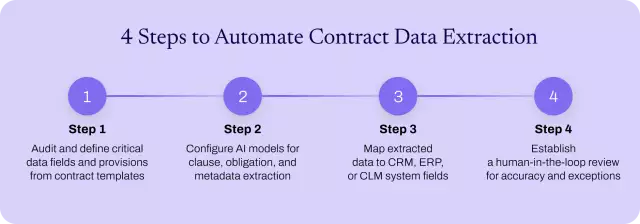
To automate contract extraction, you need a straightforward process that defines required data, applies AI-based extraction, and validates results for accuracy. Follow these four steps to get started:
1. Audit and define critical data fields and provisions from contract templates
Review your existing contract templates to identify the data fields that support business operations. Align legal, finance, and procurement teams on key elements such as effective dates, termination clauses, payment terms, and contract risk indicators. Document these fields in a standardized taxonomy, so AI models recognize and extract information consistently across your contract portfolio.
This audit prevents unnecessary data capture while ensuring visibility into provisions critical to compliance and obligation management. A clear taxonomy also supports accurate reporting and analytics by enforcing consistent naming and structure, turning unstructured contract text into reliable, decision-ready data.
2. Configure AI models for clause, obligation, and metadata extraction
Set up AI models to identify and extract the data fields listed in your audit. With the Discovery AI feature in Conga CLM, for example, you can scan agreement files and turn unstructured contract text into organized, ready-to-use data. Administrators set extraction rules in the platform to focus on specific clauses, obligations, and metadata. Users then run Intelligent Discovery with X-Author for Contracts to review third-party and older agreements.
To configure accurate extraction through Conga CLM, follow these steps:
- Choose the clauses, metadata fields, and obligation language you want the AI to find and capture.
- Start a discovery scan with X-Author for Contracts to review documents, highlight key terms, and link the extracted values to CLM fields.
- Decide when the system should extract data from contracts on its own and when it should send exceptions to people for review.
With these data extraction steps, you can replace manual contract review with reliable, automated recognition. You save time, keep accuracy across different formats and contract types, and fill your CLM software with checked, searchable data for compliance and reporting.

3. Map extracted data to CRM, ERP, or CLM system fields
Assign extracted contract data to the appropriate system fields to support your workflows and decisions. For example, link parties to CRM accounts, payment terms to ERP billing schedules, and obligations to CLM tracking. Keep your mappings consistent with your current data models, use standard formats, and watch for any differences from approved clauses.
Follow these steps for mapping extracted data:
- Match data fields such as payment terms, renewal dates, and termination clauses to the right fields in your CRM, ERP, or CLM to keep your data schemas aligned.
- Set up workflow automation, so validated data goes straight into your downstream systems, removing the need for manual entry.
- Connect your clause libraries by matching extracted text to standard clauses to help you spot any differences from approved legal positions.
Accurate mapping removes data silos, synchronizes systems, and ensures that finance, legal, and sales teams act on the same verified information, reducing contract errors and financial risk.
4. Establish a human-in-the-loop review for accuracy and exceptions
Create a validation process where AI manages routine data extraction, and people review exceptions and important contracts. Set confidence levels so that low-confidence or unusual results go to legal or compliance teams, while high-confidence data moves straight into your CLM.
As Jason Smith, global director, CLM product launch and legaltech evangelist at Conga, explains: “The real challenge isn’t choosing humans versus machines; it’s designing systems where each covers for the other’s weaknesses.” AI helps reduce fatigue and keeps results consistent, while people catch context, make judgment calls, and spot unusual contract terms that AI might miss. This way, you balance speed with reliability. Your teams get accurate, organized contract data, reduce risk, and stay compliant.
See how AI-powered contract review in Conga CLM accelerates accuracy and speed. Watch our video.
Best Practices for Extracting Data From Contracts
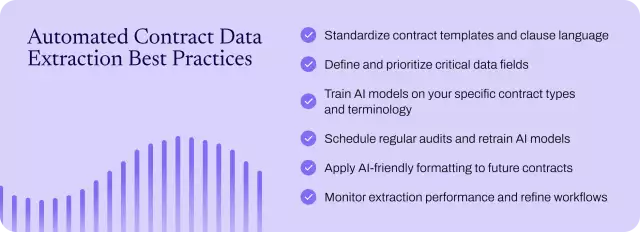
U.S. Legal Support reports that 40% of law firms plan to boost technology spending in 2026, especially for data management. This shift toward a tech-first approach requires rigorous standards for extracting, governing, and scaling contract intelligence across the enterprise.
These six practices help maintain accurate data extraction, ensure AI models stay up to date with changing contract language, and support processes that turn data into a dependable asset for the whole company.
| Automated contract data extraction best practices | Why it matters | How to implement |
| Standardize contract templates and clause language | Consistent language and structure improve AI accuracy and reduce interpretation errors across agreements | Build and enforce approved templates and clause libraries within your CLM to limit variation and free-text edits |
| Define and prioritize critical data fields | Focused data extraction ensures teams capture the terms that drive compliance, revenue, and operational decisions | Collaborate with legal, finance, and procurement teams to define a shared taxonomy of high-impact fields by contract type |
| Schedule regular audits and retrain AI models | Contract language, regulations, and business needs change over time, reducing accuracy without retraining | Review data extraction results on a set cadence and feed verified corrections back into the AI configuration |
| Apply AI-friendly formatting to future contracts | Clear, machine-readable contract layouts increase confidence scores and reduce exception handling | Apply consistent headings, numbering, and clause placement, and avoid complex tables or text embedded in images in your agreements |
| Monitor extraction performance and refine workflows | Ongoing visibility into contract performance helps maintain accuracy and scale without added manual effort | Track confidence thresholds, exception rates, and correction patterns to enhance contract review workflows and extraction rules |
Streamline Your Agreement Lifecycle With Conga’s Contract Metadata Extraction
Conga CLM transforms static agreements into strategic assets by operationalizing contract metadata across the enterprise. Through AI-powered extraction, our contract lifecycle management platform captures key dates, financial terms, and complex clauses directly from agreements, eliminating manual data entry. This intelligence flows through the full lifecycle.
Embedding metadata into workflows provides real-time visibility into contract commitments and risks. Legal teams handle obligations confidently, finance supports accurate billing, and leaders trust a single agreement source. Integrating metadata extraction into Conga CLM powered by AI scales deal operations, keeping provisions searchable, governed, and actionable.
Ready to improve your contract metadata extraction process with Conga CLM? Contact our sales team.

Frequently Asked Questions
-
Which systems offer AI-based clause extraction and playbook enforcement?
Systems like Conga CLM offer AI-based clause extraction and playbook enforcement. Our platform uses pre-trained artificial intelligence to scan third-party agreements automatically, recognize key clauses and metadata, and map them into the CLM. This extraction process—powered by Conga CLM's Discovery AI feature—enables playbook enforcement by surfacing the contractual terms that your business rules and negotiation standards evaluate.
-
How does AI-based contract data extraction work?
AI-based contract data extraction works through the use of natural language processing and machine learning to read and extract unstructured text from legal documents. The AI looks for patterns, keywords, and language associated with key details such as dates, parties, and clauses. The system turns this information into structured metadata fields in your contract management system.
-
How can I automate financial data extraction from contracts?
You can automate financial data extraction from contracts by configuring an AI-powered CLM platform such as Conga CLM to identify key commercial fields, including payment amounts, schedules, renewal fees, discount terms, currency codes, and liability caps. Our CLM software extracts these values and maps them directly to ERP, billing, or finance systems.
Contract automation delivers accurate, auditable data at execution, supports revenue recognition under standards such as ASC 606 and IFRS 15, and eliminates manual data entry from downstream financial workflows.
-
What are the benefits of automated data extraction for finance teams?
The benefits of automated data extraction for finance teams center on delivering accurate, timely contract data that directly improves billing, compliance, and financial decision-making. Results include:
- Reduced manual entry errors in payment terms, renewal dates, and financial obligations
- Improved billing accuracy and faster invoice and revenue recognition cycles
- Stronger legal compliance with accounting standards through auditable, structured data
- Real-time visibility into total contract value, cash flow, and financial exposure
A single source of truth shared with legal and sales for audits and reporting
Related Resources
-
Pricing Opportunity Framework: See What You’re Leaving on the Table GuidesAIPricing Opportunity Framework: See What You’re Leaving on the Table
Estimate how much revenue your pricing process is losing and what it would take to recover it.03/30/20263 min read -
Why AI-Powered Pricing is Now a Business Necessity for Margin and Growth BlogAIWhy AI-Powered Pricing is Now a Business Necessity for Margin and Growth
Learn why AI pricing is becoming essential for businesses facing rising market volatility, increased pricing pressures, and growing need for agility.06/30/20267 min read -
How to Shorten Your Sales Cycle: Fix the Handoffs, Not the Hustle BlogAIHow to Shorten Your Sales Cycle: Fix the Handoffs, Not the Hustle
Learn how to shorten your sales cycle by removing the hidden friction between teams, pricing, approvals, contracting that stalls deals right when they should close.04/29/20269 min read -
Stop Guessing & Start Deciding: The Forrester Framework for Buy vs. Build Analyst ReportIndustry InsightsStop Guessing & Start Deciding: The Forrester Framework for Buy vs. Build
AI lowered the cost of building software. It didn't lower the cost of running it. Get the Forrester framework that helps you decide what to buy, build, or generate.07/22/20264 min read