Considering a Move from Conga Contracts? Lessons from BakerHostetler’s CLM Journey
08/24/2026
8 min read

Conga Contracts has a devoted customer base. Many Conga customers have been using the solution for 10 years or more. BakerHostetler, one of the world’s 100 largest law firms, was one of them.
During a recent conversation, the company’s Legal Process Engineer, Nat Croumer, joked, “I’ve had the shoes I’m wearing for 10 years. I’m a loyal person.” That loyalty made the firm’s eventual decision to migrate from Conga Contracts to Conga CLM especially meaningful.
The move wasn’t about replacing a platform they knew and trusted. Instead, the team recognized an opportunity to unlock more value from their contract data, automate key processes, and support the firm’s evolving business needs.
We’re not losing anything we love about Conga Contracts. We’re just taking it to the next level.
Why Consider a Migration to Conga CLM?
BakerHostetler’s story is one many growing organizations will recognize: a contract management foundation that served them well, until the business started to outgrow it. As Lindsey Carpino, Senior Manager, Legal Content Services, explained, “What we had with Conga Contracts was great, but it really was a fancy repository.”
Over time, the firm accumulated a rich history of contract data. The next step was putting that data to use and extracting meaningful insights on renewals, spending commitments, risk assessments, and budgeting information in ways that could actively inform decisions rather than just store records. In other words, they wanted to spend less time tracking information and more time using it to drive decisions.
That progression is increasingly common. Storing contract data in a centralized repository is a strong starting point, and for most organizations, it’s where the contract management journey begins. But as legal and business teams mature, expectations naturally expand. Today’s business and legal leaders expect contract management solutions to answer questions about risk, renewals, obligations, and spending while helping to reduce manual work and accelerate contract cycles.
At BakerHostetler, that need started to show up in everyday contract processes. Croumer shared a familiar example: the latest version of a statement of work (SOW) might live in a SharePoint folder, only to be accidentally overwritten by another user. What starts as a simple version-control issue can quickly create confusion, delays, and unnecessary risk.
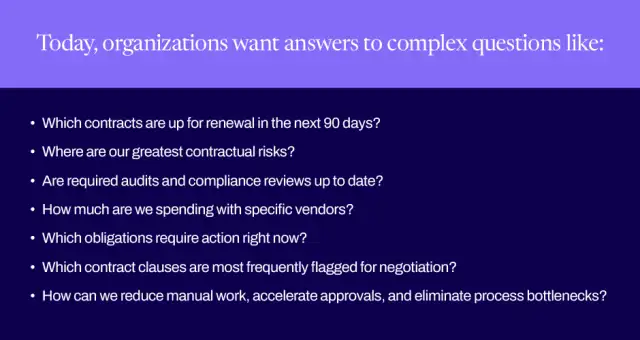
Today, organizations want answers to complex questions like:
- Which contracts are up for renewal in the next 90 days?
- Where are our greatest contractual risks?
- Are required audits and compliance reviews up to date?
- How much are we spending with specific vendors?
- Which obligations require action right now?
- Which contract clauses are most frequently flagged for negotiation?
- How can we reduce manual work, accelerate approvals, and eliminate process bottlenecks?
These aren’t repository questions. They’re complex business questions that can only be answered with a higher level of transparency and insight. And these questions led BakerHostetler to ask an even bigger one: could a different solution make this possible?
Making the Business Case: Visibility, Efficiency, and Strategic Insight
For BakerHostetler, the strongest argument for migration wasn’t access to new technology. It was the opportunity to solve real business challenges and provide leadership with better information. These four benefits provide a compelling business case for CLM migration:
Better visibility into risk, renewals, and spending
When BakerHostetler built its business case, leadership wasn’t focused on software features. They wanted better visibility into renewals, contract obligations, spending commitments, and risk assessment.
As contract reviews became more complex, leadership needed better access to the data points driving business decisions. Modern CLM solutions provide that visibility, helping organizations move beyond reactive contract management and toward more proactive planning and forecasting.
Reduced human error
Croumer shared a story of a common mistake: accidentally sending a SOW to one client that referenced another client because a name change was missed during manual editing.
It’s a simple human error, but the consequences can be significant. For organizations relying on manual document creation, shared folders, and email-based reviews, automation can increase consistency and reduce those risks.
Faster approvals and contract cycle times
Inefficient, manual contract processes frequently lead to contract delays. BakerHostetler’s experience highlighted one way that challenge commonly plays out: approvals that get stuck in a busy stakeholder’s email inbox.
Automated workflows help ensure contracts move through the appropriate review path without constant follow-up or manual intervention. As contract volumes grow, these efficiencies can significantly reduce bottlenecks and improve productivity across legal, procurement, finance, and business teams.
More strategic use of contract data
Perhaps the most significant shift with a CLM migration is the ability to turn contract data into actionable business intelligence. For BakerHostetler, that included better visibility into upcoming renewals, automated reminders for contracts that require action, and easier identification of contracts containing AI-related licensing restrictions and risk considerations.
The team also saw opportunities to identify unnecessary spend tied to auto-renewing agreements that no longer provided value. Instead of simply storing contract documents, CLM technology can help leverage contract data to make smarter business decisions and uncover meaningful cost savings.
Preparing for a Successful CLM Migration
One of the most valuable takeaways from BakerHostetler’s experience is that migration success starts long before the CLM implementation begins. The technology matters, but preparation matters just as much.
Start with your desired outcomes
Before they started evaluating platforms, BakerHostetler took the time to define what success would look like. They started by asking questions like:
- What business challenges are we trying to solve?
- Which processes create the most friction today?
- What information does leadership need access to?
- Which metrics would demonstrate success?
They carefully assessed options against business requirements, rather than simply comparing feature lists. At the same time, Croumer said he challenged the team to think beyond current processes and consider capabilities the organization may want to support.
Having clear goals helps guide technology decisions and ensure the migration will support long-term business priorities.
The more work you put in up front, the better the output is going to be.

Treat migration as a chance to clean house
CLM migration provides an opportunity to evaluate what still matters. Croumer suggested approaching the process like moving into a new house: keep what’s valuable and leave behind anything that no longer serves a purpose. For BakerHostetler, that meant reviewing years’ worth of templates, workflows, contract categories, and data fields.
Carpino shared that the migration readiness workbook provided by Conga initially felt overwhelming. But after walking through it together, the process felt much more manageable and ultimately led to better prioritization and decision-making.
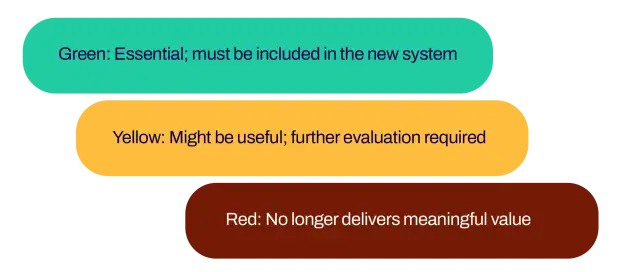
One technique that proved especially useful was a simple color-coding exercise. As the team reviewed templates, fields, reports, and requirements, they assigned each item a color:
- Green: Essential; must be included in the new system
- Yellow: Might be useful; further evaluation required
- Red: No longer delivers meaningful value
That kind of discipline becomes even more important as you prepare for more advanced reporting, automation, and AI capabilities.
Get stakeholders involved in the process
Technology projects rarely succeed in isolation; they require a coordinated group effort. When members of the BakerHostetler team were slow to provide assets needed for the migration, Croumer took five minutes during a team meeting to explain why the project mattered and how it would make their jobs easier.
The results were immediate; templates and other materials were completed right away. And the lesson is simple: people are far more likely to support change when they understand how it benefits them.
The same principle applies across the organization. BakerHostetler sees Conga as a foundation for broader enterprise reporting and risk analysis, bringing together stakeholders across legal, IT, finance, and leadership teams around a shared source of truth.
Embrace honest communication
Transparency and collaboration are critical elements of a successful CLM migration. For Croumer, that meant working with implementation partners who were willing to challenge assumptions.
One aspect of the project that stood out to him was the Conga team’s willingness to ask “why” rather than simply saying “yes.” The team consistently focused on the desired business outcome, which often led to better solutions than BakerHostetler initially envisioned.
That mindset helped BakerHostetler avoid unnecessary complexity and stay focused on the outcomes they were trying to achieve.
Moving Forward with Confidence
For long-time Conga Contracts customers, the decision to migrate to Conga CLM can feel like a significant step. BakerHostetler’s experience demonstrates that the decision isn’t about leaving behind a platform that has served you well. It’s about preparing for what’s next and ensuring your contract management capabilities continue to evolve with your business.
Most importantly, Conga CLM is built on the same foundation you’ve trusted for years. The difference is its ability to unlock more value from your contract data, increase visibility, reduce manual effort, and empower smarter decisions.
If you’re a Conga Contracts customer exploring what the next chapter could look like, the Migration Hub within the Conga Customer Community was built specifically for you. There you’ll find resources, guidance, and practical advice from teams that have already navigated the journey, so you can evaluate your options with confidence and move forward when the time is right.
FAQs
-
What is a CLM migration?
CLM migration refers to the process of moving contract data, templates, workflows, and reports from an existing contract management solution to a modern contract lifecycle management (CLM) solution.
-
Why do organizations undergo CLM migrations?
Organizations typically migrate to a modern CLM solution when they’re ready to automate workflows, gain better visibility into contract data, improve obligation and renewal management, reduce manual effort, and unlock deeper reporting and analytics capabilities.
-
How should companies prepare for a CLM migration?
Preparation should include defining business goals, reviewing contract data, cleaning up outdated records, evaluating templates and workflows, and aligning stakeholders across the organization.
-
How long does a CLM migration take?
Timelines vary based on the complexity of the organization’s contracts, workflows, and integrations, as well as their data quality. Thorough preparations can help streamline the implementation process and improve outcomes.
Related Resources
-
Connect and Learn With Peers in the Conga Customer Community BlogCLMConnect and Learn With Peers in the Conga Customer Community
Join 40,000+ peers in the Conga Customer Community—connect, learn, and grow with resources, training, and support to fuel smarter business outcomes.09/30/20266 min read -
The Contract Management Strategy You Might Be Overlooking BlogCLMThe Contract Management Strategy You Might Be Overlooking
Discover the contract management strategy that improves collaboration, clarity, and results—without overcomplicating your process.09/17/20267 min read -
The Quote to Cash Process in 10 Steps BlogCLMThe Quote to Cash Process in 10 Steps
Discover how to streamline your quote-to-cash (Q2C) process to accelerate sales cycles, improve customer experience, and boost revenue. This comprehensive guide covers every stage—from configuration and pricing to contract management, billing, and renewals—plus tips for finding the right automation solution. Learn how to eliminate silos, reduce errors, and drive efficiency across your CRM and ERP systems.08/12/20269 min read -
The Complexity Tax: How Manufacturers Can Stop Leaving Revenue on the Table BlogManufacturingThe Complexity Tax: How Manufacturers Can Stop Leaving Revenue on the Table
Product lines grow. Quoting slows. Contracts pile up. Learn how manufacturers are tackling commercial complexity with CPQ and CLM to recover lost revenue.07/29/20267 min read