Price Waterfall Analysis: A Guide to Stopping Margin Leakage

Price waterfall analysis exposes margin leakage at every step
Pricing discipline, not strategy, is the real gap
Waterfall rate is the clearest indicator of pricing performance
Modern pricing turns waterfall into a real-time control system
In B2B, every deal starts at list price but rarely ends there. Discounts, rebates, freight allowances, payment terms, and channel incentives each take a cut before the transaction settles.
For pricing teams, this is where control and governance break down: decisions fragment across systems; exceptions proliferate without consistent oversight, and end-to-end visibility into pricing execution fades. McKinsey estimates that up to 30% of pricing decisions fail to deliver the optimal price, underscoring the gap between pricing strategy and execution.
The gap between your quoted price and the revenue you actually realize is margin leakage. For most B2B enterprises, it accumulates silently across deals and transactions, embedded in discounts, outdated agreements, and unmanaged exceptions. By the time margin is analyzed, it’s already realized, and often lost. In practice, the most reliable way to measure this gap, and the consistency of pricing execution, is the waterfall rate.
Pricing waterfall analysis maps every deduction between the list price and the final pocket margin, making margin leakage explicit and measurable. For pricing leaders, it’s a critical mechanism to restore control, bringing fragmented pricing decisions, rebates, and cost elements back into a single, governed framework where policies can be consistently enforced. This isn’t just an analytical challenge. It’s a governance problem that directly impacts revenue and margin performance at scale.
Below, we break down how price waterfall analysis works, how to operationalize it, and how pricing technology transforms it from a retrospective analysis into a real-time margin control system.
Key Highlights:
- Price waterfall analysis traces every reduction from list price to pocket margin, enabling pricing teams to identify, quantify, and systematically eliminate margin leakage. Its true value lies in structuring and governing the waterfall, not just analyzing it.
- A structured waterfall distinguishes between on-invoice discounts and off-invoice deductions, exposing where pricing governance typically breaks down and where exceptions and overrides erode margins.
- The waterfall rate provides a measurable benchmark of pricing discipline, highlighting where execution deviates from strategy and where governance must be enforced.
- Conga Price Management operationalizes the waterfall, unifying pricing data, and enabling pricing teams to enforce guardrails, govern exceptions, and offer consistent execution across every transaction.
What is Price Waterfall?
A price waterfall is an analytical framework that traces every step from list price to realized profit, revealing the true economic structure of a deal, not just its face value.
It provides a structured, end-to-end view of how pricing is executed in reality, quantifying the impact of each adjustment and exposing where control is lost across the deal lifecycle.
Each step in a pricing waterfall represents a governed decision point:
- List and regional price adjustments
- Customer-specific and volume discounts
- Contractual and promotional terms
- Surcharges and invoice adjustments
- Rebates and off-invoice deductions
- Cost-to-serve and operational costs
High-performing pricing teams treat each step as a controlled pricing component with defined logic, ownership, and limits, not a passive outcome. For businesses using pricing software like Conga Price Management, the waterfall becomes a structured pricing model, where components are:
- Centrally defined
- Sequenced correctly
- Applied consistently across channels
- Measured continuously through the right set of analytics
Why Pricing Teams Need Price Waterfall Analysis
McKinsey research shows that a 1% improvement in pricing can drive an 8–9% increase in operating profit, making pricing execution one of the highest-impact levers for margin improvement. Yet capturing this value requires consistent execution – something most organizations struggle to achieve. Without transaction-level visibility and control, pricing teams face systemic challenges:
- Unauthorized discounts bypass governance, eroding price floors and undermining pricing strategy.
- Inconsistent execution across channels creates pricing dispersion and slows deal cycles.
- Manual rebate and off-invoice tracking introduces inaccuracies, delays, and hidden margin leakage.
- Disconnected systems prevent root-cause analysis, making it difficult to identify and correct systemic pricing failures.
Pricing waterfall analysis closes this gap. It makes every deduction explicit, revealing where patterns deviate from strategy and where governance is lost.
It helps position pricing teams as the owners of margin outcomes, not just analysts of pricing performance.
What Good Looks Like: Pricing Waterfall Maturity
Most organizations can build a price waterfall. Few operationalize it. Pricing teams can use the following as a maturity check:
- Reactive: Price waterfall is used for post-deal analysis; insights don’t influence execution.
- Visible: Teams understand key leakage drivers but lack consistent enforcement
- Controlled: Discounting, rebates, and pricing components are structured, tracked, and governed.
- Operationalized: The waterfall logic is embedded into CPQ and other systems with real-time guardrails.
- Optimized: Pricing teams continuously monitor waterfall rate, simulate changes, and proactively adjust pricing strategies.
The goal is not visibility – it’s control at the point of decision.
How Pricing Teams Conduct Price Waterfall Analysis to Stop Margin Leakage
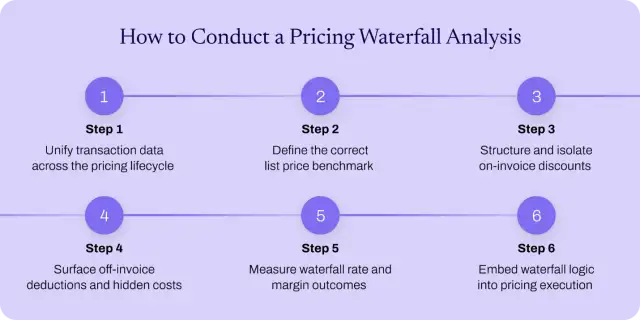
Pricing visibility alone doesn’t recover margin. The objective is to translate insight into controlled, repeatable execution, ensuring every step in the waterfall is governed and aligned with pricing strategy.
1. Unify transaction data across the pricing lifecycle
Pricing teams must consolidate data across pricing, rebates, contracts, and transactions to reconstruct the full waterfall from list price to margin. Without this unified foundation, pricing decisions remain fragmented and governance can’t be enforced.
2. Define the correct list price benchmark
The list price is the baseline for all waterfall analysis. Selecting the correct starting point and ensuring discounts aren’t embedded in it is essential for accurately measuring erosion and comparing deals across segments.
3. Structure and isolate on-invoice discounts
On-invoice discounts are the first layer of visible margin erosion. Pricing teams must track each discount type separately and apply discounts in a defined sequence. This reveals where discretionary discounting deviates from policy. Quoting speed and discount discipline are closely linked; and in fast-moving deal cycles, the stakes are even higher. A common failure is allowing multiple discount types to overlap without clear ownership, which makes accountability and enforcement impossible. See how the first-to-respond often comes out on top.
4. Surface off-invoice deductions and hidden costs
Off-invoice elements such as rebates, incentives, and freight are a major source of lost governance. Integrating them into the waterfall allows pricing teams to reveal true deal economics, prevent hidden leakage, and align negotiated and realized value. In many organizations, rebates are among the least governed, and therefore most impactful sources of margin erosion, yet they often remain disconnected from deal-level pricing decisions.
5. Measure waterfall rate and margin outcomes
By calculating pocket price and waterfall rate, pricing teams can assess execution quality across deals. Wide variation signals weak governance, while controlled bands indicate strong pricing discipline. Rather than tracking averages, leading pricing teams segment the waterfall rate by product, customer, region, and sales team to isolate where margin erosion is structural versus behavioral. Used correctly, the waterfall rate becomes a control signal, not just a KPI, triggering pricing rule adjustments, approval thresholds, and discount guardrails. Most organizations track discounts. Leading organizations manage the waterfall rate.
6. Embed waterfall logic into pricing execution
The final step is where pricing teams close the loop, embedding waterfall logic into execution to enforce pricing strategy at scale. By embedding waterfall rules, pricing teams can see pricing that follows a consistent structure; exceptions are governed, and margin impact is visible in real time. This transforms the waterfall from a reporting tool into a system of control, structured so that pricing strategy is consistently executed, not overridden, in every transaction.
For industries where pricing complexity runs especially deep, like building materials or medtech, embedding waterfall logic into CPQ is often the difference between recoverable and irrecoverable margin erosion.
How Pricing Technology Improves Price Waterfall Accuracy
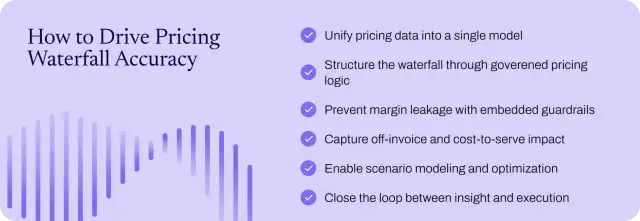
The Price Waterfall analysis identifies where margin leaks occur, but without a governed pricing layer, those patterns persist. Pricing technology transforms the waterfall from a retrospective view into a continuous proactive control model, designed so that every pricing input, adjustment, and outcome is structured, validated, and aligned with defined strategy.
Unify pricing data into a single model
Pricing technology consolidates pricing, rebate, contract, and cost data, so that the waterfall reflects true execution, not disconnected systems.
Structure the waterfall through governed pricing logic
Pricing teams can define standard benchmarks from list to margin, explicit discount and cost components, and controlled sequencing of adjustments. Sequencing is critical because the order in which discounts, rebates, and costs are applied directly determines the final margin outcome. This provides full transparency and auditability, and also enables consistent ‘price build logic’ across channels, so that the same pricing structure applies whether a deal is quoted, negotiated, or transacted digitally.
Prevent margin leakage with embedded guardrails
Pricing rules enforce discount thresholds, exception governance, and margin floors and visibility during decision-making. This stops leakage before it occurs. The same logic that governs waterfall pricing should inform how CPQ software is selected and configured so those rules travel all the way to the quote.
Capture off-invoice and cost-to-serve impact
Advanced pricing platforms integrate rebates, incentives, and allowances directly into the waterfall, providing full visibility into margin realization across every deal. They should be treated as part of the pricing decision, not as finance adjustments. That’s why native integration with a rebate management solution helps maintain alignment between negotiated and realized value.
Enable scenario modeling and optimization
With the right technology, pricing teams can simulate changes to the different components, compare strategies and quantify margin impact before execution. This allows them to transform the waterfall analysis into a proactive decision framework rather than a post-deal forensics exercise.
Close the loop between insight and execution
Insights feed directly into pricing policies and rules, reinforcing guardrails in quotes and contracts, supporting continuous strategy improvement, and consistent execution at scale. This is the architecture behind predictable, repeatable revenue built on consistent, governed execution.
Bain & Company research shows that companies leading in pricing strategy outperform peers by 5–11 percentage points in profit margin, underscoring the impact of disciplined pricing execution at scale.
Best Practices for Operationalizing Price Waterfall Control
| Best practice | What pricing teams do | Why it matters | Business outcome |
| Move from static analysis to continuous pricing control | Unify pricing and key commercial data into a single pricing model. Embed waterfall visibility into workflows. | Pricing teams shift from retrospective analysis to real-time control, where every deal reflects current pricing rules, agreements, and commitments. | Early visibility into margin impact prevents leakage before it occurs and offers consistent execution of pricing strategy. |
| Expose the full waterfall | Integrate rebates, incentives, and costs into the waterfall model. Link all deductions directly to transactions. | Eliminates blind spots where governance typically breaks down, like off-invoice elements and post-sale costs that distort true margin. | Accurate pocket margin visibility, enabling more precise, confident pricing decisions. |
| Structure and govern the waterfall end-to-end | Define clear benchmarks. Standardize all pricing elements as sequenced differentials. | Discounts, rebates, and costs are explicitly captured and applied in the correct order, preventing distortion or hidden erosion. | A consistent, auditable waterfall improves pricing accuracy, comparability across deals, and policy enforcement. |
| Embed pricing guardrails | Apply pricing rules, thresholds, and approval logic. Control where and how exceptions can occur. | Prevents unmanaged discounting and policy deviations before they impact margin, restoring pricing governance at the point of decision. | Reduced margin leakage, improved pricing discipline, and fewer uncontrolled concessions across sales teams. |
| Use scenario modeling | Use what-if analysis to simulate changes in discounts, rebates, and costs. Compare outcomes across segments and pricing strategies. | Moves pricing teams from reactive reporting to proactive optimization, understanding trade-offs before committing to pricing decisions. | Better-informed pricing strategies, improved margin outcomes, and faster response to market dynamics. |
| Drive accountability | Segment and monitor waterfall rates, pocket price distribution, and margin variability across deals. Surface insights in executive dashboards. | Provides a clear, measurable view of pricing performance and highlights where execution deviates from strategy and where governance interventions are required. | Increased accountability, tighter control over pricing execution, and sustained margin improvement at scale. |
Take Control of Margin Leakage with Conga Price Management
Built with purpose-designed pricing analytics and waterfall insights, Conga Price Management enables pricing leaders to not only understand margin erosion but systematically prevent it through structured pricing execution.
By unifying pricing, rebate, discount and cost data into a single model and embedding structured waterfall logic into pricing execution, Conga allows every adjustment and exception to be transparent, sequenced, and aligned with strategy. The result isn’t just clearer insight into where margin leaks. It’s the ability to enforce guardrails, improve consistency, and drive sustained margin performance across every transaction.
This enables organizations to move from inconsistent execution to predictable, governed margin performance across every deal, and the confidence to scale pricing decisions across every channel without introducing new leakage. For teams working through broader quote-to-cash transformation, price waterfall control is one of the highest-leverage places to start.
Ready to see how Conga Price Management and Conga CPQ can close the gaps in your pricing waterfall? Explore the CPQ benefits guide.
Frequently Asked Questions
-
What does price waterfall analysis show pricing teams?
It shows how value erodes from list price to margin across every discount, rebate, and cost layer, highlighting exactly where governance breaks down.
-
Why is the waterfall rate important?
The waterfall rate measures how consistently pricing strategy is executed across deals. It’s the best indicator of pricing discipline and the clearest signal of whether your pricing model is actually being followed in the field.
-
What causes margin leakage in B2B pricing?
The most common causes are uncontrolled discounting, hidden off-invoice deductions, fragmented systems, and inconsistent policy enforcement.
-
How does pricing technology improve waterfall accuracy?
It unifies data, structures pricing logic, integrates on-invoice and off-invoice elements, and enforces governance, ensuring the waterfall reflects true execution.
-
Who benefits from price waterfall analysis?
Pricing teams gain control, finance gains margin visibility, sales gains clarity, and executives gain actionable insights into profitability. For a deeper look at how CPQ solves selling challenges across these teams, the overlap with waterfall pricing is significant.
-
How often should waterfall analysis be conducted?
Leading B2B organizations move from periodic audits to continuous monitoring, embedding waterfall visibility directly into pricing and quoting processes.
Related Resources
-
Conga Solutions Named to 2026 Constellation ShortListTM BlogCPQConga Solutions Named to 2026 Constellation ShortListTM
Conga Solutions has been named to the 2026 Constellation ShortList for Revenue Intelligence, Price Optimization, and CPQ, recognizing leadership in revenue optimization.09/08/202611 min read -
Conga Named Leader in the Gartner® Magic Quadrant™ for B2B Pricing and Rebate Optimization Software Analyst ReportCPQConga Named Leader in the Gartner® Magic Quadrant™ for B2B Pricing and Rebate Optimization Software
See how Conga performed in the Gartner Magic Quadrant for B2B Pricing and Rebates Optimization.04/13/20262 min read -
The Executive’s Guide to AI Pricing Optimization GuidesCPQThe Executive’s Guide to AI Pricing Optimization
How AI pricing optimization transforms forecasting accuracy and protects revenue.03/10/20261 min read -
How to Shorten Your Sales Cycle: Fix the Handoffs, Not the Hustle BlogAIHow to Shorten Your Sales Cycle: Fix the Handoffs, Not the Hustle
Learn how to shorten your sales cycle by removing the hidden friction between teams, pricing, approvals, contracting that stalls deals right when they should close.04/29/20269 min read