How to Shorten Your Sales Cycle: Fix the Handoffs, Not the Hustle
07/24/2026
9 min read

93%
of companies say deals struggle across teams
45%
lost a deal to slow quote approval
72%
say slow contracts increase compliance risk
8%
only can measure the impact of pricing decisions
The Paradox of the Fast Slow Sales Cycle
You’ve seen this pattern before. A strong opportunity moves quickly through prospecting, discovery, and product demo. The buyer is engaged. The forecast looks solid. Everyone expects a clean close. Then momentum fades. The deal hits the approval stage, goes quiet, and misses the date it was supposed to land.
That’s why so many leaders feel stuck despite consistent efforts to shorten the sales cycle. Early-stage activity looks healthy, but the final stretch moves at a crawl. Deals that should close this week roll into next month. Forecast calls get tense.
If you’re feeling this drag in your sales cycle, you’re not alone. According to Conga’s new report, The State of Commercial Operations: Fragmentation in the Age of AI, 93% of companies say deals struggle to move smoothly across sales, legal, finance, pricing, and IT.
When late-stage deals keep slowing down, the problem usually isn’t the funnel. It’s the friction that’s hidden behind it.
Sales Velocity is a Handoff Problem, Not a Rep Problem
Most sales leaders know how to improve motion inside the sales team:
- Better discovery
- Stronger qualification
- Cleaner follow-up
- Tighter pipeline discipline
Those changes matter, but they only affect the part of the sales cycle that’s directly controlled by sales. True sales velocity depends on what happens next.
A deal can move quickly through the early stages because one owner drives it forward. But then it reaches pricing sign-off, quote approval, and terms review. Now progress depends on multiple teams with different priorities, timelines, and systems. That’s where momentum slows.
Every step in the sales handoff process creates an opportunity for delay. A request waits in someone’s queue. A number gets challenged. A stakeholder asks for clarification. None of this reflects poor rep performance, but it all extends cycle time.
In fact, The State of Commercial Operations report found that:
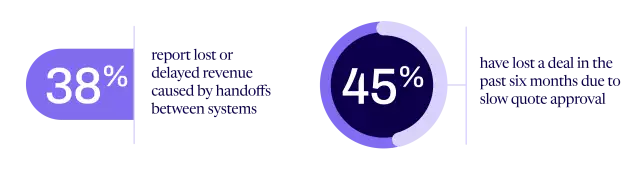
- 38% report lost or delayed revenue caused by handoffs between systems
- 45% have lost a deal in the past six months due to slow quote approval
Coaching reps harder won’t fix late-stage slowdowns, because you can’t train your way around a broken operating model. If you want better sales process efficiency, start where deals change hands.
Where Deals Actually Die: 4 Friction Points
Deals rarely die in one dramatic moment. Instead, they grind to a halt through a series of small failures. To reduce deal friction and shorten the sales cycle, you need to understand where momentum breaks down.
Most late-stage losses trace back to a few points in the sales handoff process:
Non-standard pricing creates rework.
A buyer asks for custom terms, volume pricing, or a packaged offer outside the norm. The rep submits the request, then waits. Questions come back. Numbers change. Days pass while the customer’s urgency fades.
Upstream approval gets rejected downstream.
The opportunity looks clean in the CRM. Sales leadership signs off. Forecast confidence rises. Then finance challenges margin or legal flags terms that no one surfaced earlier. What looked like a green light in one system was never truly approved across the business.
Late-cycle quote revisions stall progress.
The deal reaches the point where everyone expects signature, then the quote changes. Product mix shifts. Pricing gets updated. Terms need correction. The rep reissues paperwork just as the buyer was ready to close. Confidence drops at the worst possible time.
Approval black holes stop everything.
A request gets submitted into the quote approval process and disappears. No clear owner. No status update. No timeline expectation. The rep can’t answer the buyer’s questions. Time passes with no movement.
If these patterns feel familiar, your slowdown likely isn’t a selling problem. It’s friction after the sale is already in motion.
Why Deals Slow Down at the Finish Line
Sometimes it feels personal when a great deal goes silent. The fact is, slowdowns are usually structural.
Most organizations ask teams to execute a unified selling process across systems that were never designed to work together. Sales manages opportunities in one place. Pricing decisions happen somewhere else. Legal reviews contracts in a separate workflow. Finance checks risks and margin in their own platform.
That disconnected setup weakens execution when precision matters most. No team is trying to create a drag; they’re dealing with incomplete information and siloed processes.
That’s why sales process efficiency breaks down. Each function works responsibly inside its own lane, but the overall motion slows down because there no’s shared operating layer to carry the deal cleanly from pricing to approval to contract.
The problem is nearly universal. Conga’s The State of Commercial Operations report found that:
- 93% of organizations say deals struggle to move smoothly across sales, legal, finance, pricing, and IT
- 72% say slow contract processes increase compliance and business risk
- Only 8% can confidently measure the business impact of pricing decisions
Real revenue operations alignment is more than meetings and dashboards. It requires a quote approval process where every downstream handoff can hold up under pressure.
What Predictable Sales Execution Actually Looks Like
In a well-run commercial organization, deals don’t depend on last-minute heroics to close. They move through a series of steps that are clear, repeatable, and scalable. Reps spend time advancing buyer conversations, not chasing internal updates. Leaders trust projections because the path to close works the same way every time.
That’s what strong sales execution looks like.
Pricing follows clear rules across products, regions, and channels. Reps know what they can offer, when exceptions apply, and how quickly decisions get made. Approvals move because ownership, thresholds, and routing are defined in advance, not because someone keeps sending reminder messages.
Predictability feels fast because terms align earlier and revisions are controlled. Customers don’t get surprises after they’ve agreed to buy. Internal teams protect margin, risk, and compliance through consistent operating discipline rather than late-stage interruptions.
This is how stronger sales process efficiency creates confidence across the business. Most of all, predictable execution creates predictable revenue. When every handoff works reliably, speed stops being random and starts becoming expected.
Start Shortening the Sales Cycle: 3 Things to Audit in Your Sales Process
Finding the problem doesn’t have to be complicated. You can start with a simple audit to figure out where deals are slowing down. Most leaders have the data—they just haven’t looked at it through the lens of execution friction.
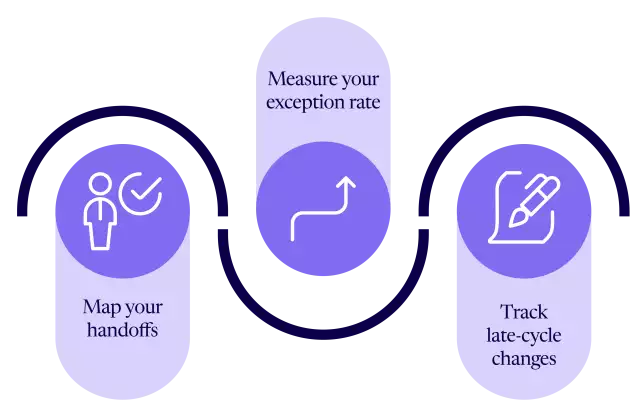
These three steps can surface issues quickly:
Map your handoffs.
At what point does a deal leave the sales team and move to pricing, finance, legal, or operations? What triggers each move, and how long does each handoff take? If no one can answer clearly, you’ve found a source of delay.
Measure your exception rate.
What percentage of deals need manual intervention on pricing, discounts, terms, or approvals? Use that number as a friction score. The higher it climbs, the more your process depends on one-off decisions rather than repeatable execution.
Track late-cycle changes.
How often do quotes get revised after the proposal stage? Count pricing edits, product swaps, legal redlines, and approval resets. Each revision drains momentum and usually points to misalignment earlier in the cycle.
Sales, finance, legal, and operations should all participate in these audits. You’re not looking for blame, you’re looking for patterns. Once you can see where deals slow down, you can start making changes to shorten the sales cycle.
The Data is Clear, the Gap is Closable
If late-stage deals keep slowing down, you’re far from alone. Conga research shows that 93% of companies face friction as deals move across teams. But some organizations are reducing that drag and gaining speed, control, and more reliable execution.
The gap usually isn’t talent. It’s how work moves between teams.
To see where companies are getting stuck and what top performers are doing differently, download The State of Commercial Operations: Fragmentation in the Age of AI.
Frequently Asked Questions
-
What is the most common reason B2B sales cycles slow down?
The most common cause is friction at handoff points between teams — not poor rep performance. According to Conga's State of Commercial Operations research, 93% of companies say deals struggle to move smoothly across sales, legal, finance, pricing, and IT. When a deal leaves the sales team and enters pricing sign-off, quote approval, or legal review, it enters a zone controlled by multiple teams with different priorities and systems — and that's where momentum typically stalls.
-
How do I know if my sales cycle problem is a handoff problem?
Look for these four signals in your pipeline data: non-standard pricing requests that create rework loops; approvals that get rejected downstream after being signed off earlier in the process; late-cycle quote revisions that arrive just as a buyer is ready to sign; and approval requests that disappear into a queue with no clear owner or timeline. Conga research found that 45% of companies have lost a deal in the past six months due to slow quote approval, and 38% report lost or delayed revenue caused by handoffs between systems. If any of these patterns sound familiar, the bottleneck is structural, not behavioral.
-
What's the difference between sales velocity and sales cycle length?
Sales cycle length measures the total time from first contact to closed deal. Sales velocity is a broader measure that factors in the number of deals, average deal size, win rate, and cycle length together to express how quickly revenue is being generated. The article's key insight is that true sales velocity depends on what happens after the early stages — once a deal reaches pricing sign-off, quote approval, and terms review, progress depends on multiple teams with different priorities, timelines, and systems. Improving rep performance only affects the part of the cycle sales directly controls.
-
What are the 3 steps to audit where deals are slowing down?
Conga recommends a three-part audit:
- Map your handoffs — identify every point where a deal moves from sales to pricing, finance, legal, or operations, and measure how long each transition takes.
- Measure your exception rate — calculate what percentage of deals require manual intervention on pricing, discounts, terms, or approvals. The higher that number climbs, the more your process depends on one-off decisions rather than repeatable execution.
- Track late-cycle changes — count how often quotes are revised after the proposal stage, including pricing edits, product swaps, legal redlines, and approval resets. Each revision drains momentum and typically signals a misalignment that occurred earlier in the cycle.
-
Can CPQ software help shorten the sales cycle?
Yes — configure, price, quote (CPQ) tools directly address the handoff friction that causes late-stage delays. By building pricing rules, approval thresholds, and routing logic into the quoting process upfront, CPQ reduces the number of exceptions that require manual review. In a well-run commercial organization, pricing follows clear rules across products, regions, and channels — reps know what they can offer, when exceptions apply, and how quickly decisions get made — and approvals move because ownership, thresholds, and routing are defined in advance. CPQ creates that operating structure, replacing ad hoc approvals with a repeatable system.
Related Resources
-
Pricing Opportunity Framework: See What You’re Leaving on the Table GuidesAIPricing Opportunity Framework: See What You’re Leaving on the Table
Estimate how much revenue your pricing process is losing and what it would take to recover it.04/06/20262 min read -
Conga Named Leader in the Gartner® Magic Quadrant™ for B2B Pricing and Rebate Optimization Software Analyst ReportCPQConga Named Leader in the Gartner® Magic Quadrant™ for B2B Pricing and Rebate Optimization Software
See how Conga performed in the Gartner Magic Quadrant for B2B Pricing and Rebates Optimization.08/07/20262 min read -
From Pricing to Profitability: How AI is Reshaping B2B Decision-Making BlogAIFrom Pricing to Profitability: How AI is Reshaping B2B Decision-Making
Discover how AI pricing is reshaping B2B decision-making—from improving speed and margin consistency to building trust and smarter commercial strategies.06/16/20266 min read -
Building CFO Buy-in for Pricing Transformation BlogAIBuilding CFO Buy-in for Pricing Transformation
Under pressure to deliver growth, CFOs are turning to AI pricing. Discover how modern pricing improves margins, forecasts, and governance.06/16/20268 min read