Dynamic Pricing Optimization to Maximize Revenue and Margins
08/13/2026
10 min read

Every time tariffs change, market conditions shift, or a rep pushes through an unsanctioned discount, your margins take a hit. By quarter close, finance needs to spend time patching up the damage. Dynamic pricing optimization gives your teams a number they can trust, so every quote and renewal reflects true costs and market demands.
This guide covers how dynamic pricing optimization works, why this process is critical for enterprise teams, and six steps to implement it in your quote process.
Key highlights:
- Dynamic pricing optimization is the continuous adjustment of prices using live cost, demand, competitor, and account signals, replacing quarterly list updates with a daily operating layer.
- The benefits of dynamic pricing show up in tighter price realization, faster deal velocity, and consistent margins across direct, partner, and digital channels.
- Conga Price Optimization and Management unifies segmentation, waterfall diagnostics, neural-network AI, and CPQ guardrails so pricing intelligence reaches sellers in the moment.
What Is Dynamic Pricing Optimization?
Dynamic pricing optimization is the automatic process of adjusting prices in real time with software that pulls in signals such as:
- Cost shifts
- Demand patterns
- Market conditions
- Inventory levels
- Transaction history
- Seasonality
The goal is to increase revenue, margins, or sales volume by ensuring the right price reaches the best account at the right moment, during a quote, transaction, or user interaction. A dynamic pricing engine reads signals, blends them with your margin floors and segmentation rules, and then publishes the updated price to sellers and digital channels.
The demand for dynamic processes is accelerating as enterprises face mounting pressure from tariff volatility, competitor repricing, and shrinking margins. According to Stratistics MRC, the global dynamic pricing optimization market was worth $5.65 billion in 2025 and can reach $10.21 billion by 2032, growing at a CAGR of 8.8% over the period. This forecast signals that enterprises are abandoning static price lists in favor of engines that respond to changing conditions in real time.
Why Enterprises Need Dynamic Pricing Automation
Market conditions no longer move on a quarterly schedule, but most pricing processes still do. Tariffs shift mid-cycle, input costs fluctuate, and strategic accounts push for rebates weeks before renewal. When your list prices update only a few times a year, each event creates a window in which your team quotes based on outdated numbers, leaving margin on the table or losing deals on price.
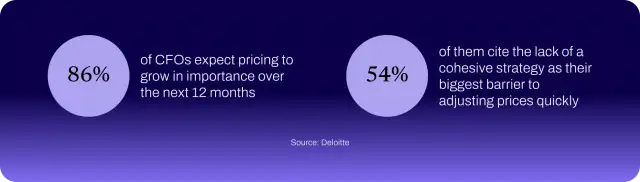
A Deloitte survey of 200 CFOs at companies with $1 billion or more in revenue found 86% expect pricing to grow in importance over the next 12 months. Yet 54% cite the lack of a cohesive strategy as their biggest barrier. A pricing engine closes that gap, recalculating prices from live cost, contract, and competitive data and pushing them into CPQ, channels, and renewals within minutes.
Discover why now is the time to adopt price optimization software.
Key Benefits of Dynamic Pricing
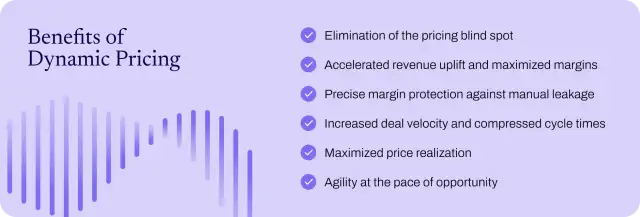
Dynamic pricing replaces spreadsheets and one-off exceptions with guardrails that recalculate inside the quote. When deal terms change, the recommended price and approval path update instantly. With manual work out of the table, you get these benefits:
- No more pricing blind spots: sellers, finance, and product see the same waterfall and margin drivers.
- Revenue uplift and maximized margins: a live pricing engine estimates the price elasticity of demand before you send a quote, identifying accounts that are under- or overpriced relative to your own segmentation targets and nudging both back to a defensible number.
- Precise margin protection against manual leakage: approval routing, floor checks, and discount caps move from spreadsheets into the quote flow, so the system flags any out-of-policy deal before signature.
- Increased deal velocity: auto-approvals within a discount band eliminate deal desk delays, cutting cycle times from days to hours.
- Maximized price visibility across the commerce chain: digital quotes, rep-sent contracts, and partner portal pricing all pull from the same source, so everyone sees a single number everywhere.
- Agility at the pace of opportunity: your price list updates within hours after competitors reprice or a jump in input costs, not at the next planning cycle.
How to Implement a Dynamic Pricing Strategy for Profitable Growth
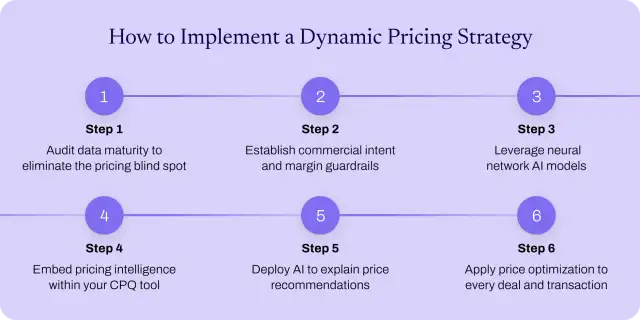
A dynamic pricing strategy is how you turn market signals into consistent, defensible prices across every quote. Without one, cost shifts and competitor moves force reactive discounting that erodes margin over time. Follow these six steps to implement a plan to boost your profits:
1. Audit data maturity to eliminate the pricing blind spot
According to Forrester, more than one quarter of organizations estimate they lose over $5 million annually due to poor data quality, with 7% reporting losses of $25 million or more. For sales teams, those losses show up as margin leakage, unsanctioned discounts, and deals closed at the wrong number. Auditing your data maturity before deploying your dynamic pricing engine tells you where you’re losing margin and why.

Start by pulling three to five years of transactional data from ERP, CRM, and billing, then map list, negotiated, and realized prices to the same account and product hierarchies. With this foundation work, you trace where the margin moves and where it leaks.
2. Establish commercial intent and margin guardrails to operationalize your pricing strategy
Pricing engines run on rules. Before training a model, define the commercial intent for each segment: growth orientation, defend mode, or renewal protection. Each intent maps to guardrails like:
- Floor prices: the minimum rate the engine quotes without escalation
- Discount ceilings: the maximum offer a rep applies before triggering an approval route
- Approval routes: the workflow that kicks in when a proposed price falls outside the allowed range for that segment's intent
Commercial intent ensures the pricing model isn't just responding to market trends, but also advancing business goals, whether that's acquiring new accounts, protecting high-value relationships, or defending margin throughout a renewal cycle.
3. Leverage neural network AI models for precise account-specific pricing
Neural networks for B2B pricing outperform rule-based engines in environments with many SKUs and overlapping discount programs. Rather than following predefined rules, the model trains on historical transaction data: past quotes, accepted prices, rejected offers, and order patterns across thousands of accounts and SKUs.
That training identifies non-obvious relationships. For example, the algorithm finds that a distributor with three years of buying history responds to a 4% price increase differently than a direct original equipment manufacturer (OEM) signing a first contract. It then uses those learned patterns to generate a recommended price for each new quote, weighted by the specific combination of factors present in that account at that moment.
4. Embed pricing intelligence within the CPQ workflow
Pricing recommendations drive higher adoption when they appear directly in the seller's workflow, not in a separate tool they have to go check. With Conga CPQ, when deal scoring, floor checks, and competitive context are in place at quote time, the rep sees the approved band before typing a number, and exceptions route to the right approver.
See how Conga Price Optimization fits inside your CPQ workflows
5. Deploy AI to explain price recommendations and boost sellers’ confidence
Sellers who understand the reasoning behind prices are far better equipped to hold them in a negotiation. AI pricing tools surface that context at the point of quote, so sales teams can see:
- Peer account context: how this account's pricing compares to similar accounts in the same segment
- Pricing win probability signals: what the elasticity model predicts will happen to the close rate if the price moves up or down
- Active guardrails: which floor prices, discount ceilings, or approval thresholds apply to this quote and why
Learn more about how AI pricing optimization works behind the scenes.
6. Scale the commercial flywheel by applying price optimization to every deal and transaction
Your entire commerce chain should pull recommendations from one model instead of separate tools. This unification eliminates price inconsistencies across channels and ensures every transaction generates usable training data.
As closed and lost deals accumulate, retrain your model on a regular cadence to incorporate shifts in costs and market conditions. Start with the segment where data quality is strongest, prove margin impact, then expand from there.
Best Practices for Building a Dynamic Pricing Engine
You can build a dynamic pricing engine that operates as a true commercial capability when you follow these six best practices:
| Dynamic Pricing Optimization Best Practices | How to Implement | Business Impact |
| Establish a Unified Commercial Data Foundation | Reconcile negotiated, realized, and list pricing across ERP, CRM, billing, and rebate systems on one source | Pricing analytics hold up in deal reviews, with no contradictions across finance, sales, and legal |
| Integrate Real-Time Market and Demand Signals | Connect cost inputs, demand signals, and inventory levels so the engine reads from your own operational data in real time | List prices update in hours, and renewal offers reflect current cost and demand conditions |
| Build AI Models to Capture Demand, Forecast Trends, and Learn Price Elasticity by Account and Product | Train dynamic pricing models on multi-year data covering discount patterns, win-loss outcomes, and contract terms by segment | Recommendations capture interactions that linear segmentation misses, raising win rates and price realization |
| Embed Pricing Governance and Decision Rules | Encode floor prices, discount ceilings, approval thresholds, and segment-specific guardrails into CPQ and channel storefronts | Margin holds under negotiation pressure, and the exceptions route to the right approver without manual sales cycle handoffs |
| Expose AI Logic and Performance to Make Pricing Decisions Visible and Accountable | Publish the inputs, weights, and reasoning behind each recommendation so sellers and approvers see the why, not just the number | Override rates drop, seller adoption climbs, and decisions stand up in negotiations and audits |
| Implement Continuous AI Model Evaluation and Optimization | Monitor accuracy, override frequency, and outcome lift, then retrain the model on closed deals, lost deals, and drifted discounts | The model sharpens every quarter, protecting prices as market conditions shift |
Optimize Dynamic Pricing Automation with Conga
The Conga Price Optimization and Management platform brings neural-network AI recommendations, waterfall diagnostics, and CPQ guardrails into one layer. Data flows from ERP, CRM, billing, and rebate systems into a single foundation, with each customer's data kept in an isolated environment and models trained exclusively on that customer's own data. This enables our engine to produce account-specific recommendations with explainable reasoning, so sellers see a price that holds up before the quote leaves their desk.
See what you can do with Conga:
- Set guardrails that enforce your pricing strategy across every channel, product, region, and segment
- Automatically update prices as costs, demand, or market conditions change
- Keep every published price aligned with current market dynamics and your commercial goals
Contact our sales team to discover how automated dynamic pricing with Conga connects to your deal flow.
Implement automated dynamic pricing in your commerce chain
Frequently Asked Questions
-
How does dynamic pricing work?
Dynamic pricing works by using algorithms and data analysis to feed live signals into an engine that recalculates the optimal price for products in real time and pushes the result into sales, channel, and renewal workflows.
The engine reads cost shifts from ERP, demand patterns from sales data, and account history from CRM. Dynamic pricing tools weigh each signal against margin floors and segment rules, then output a price recommendation.
See examples from companies specializing in dynamic pricing algorithms.
-
How to evaluate the accuracy of automated recommendations for dynamic pricing?
To evaluate the accuracy of automated pricing recommendations, track:
- Predicted versus realized win probability
- Predicted versus realized margin
- Override frequency by segment and rep
A real-time pricing engine should expose all three metrics in a single view, so pricing and sales leaders see the drift the same week it starts.
Learn how to avoid pricing erosion.
-
How does a dynamic pricing algorithm differ from a traditional pricing model?
A dynamic pricing algorithm differs from a traditional pricing model because traditional tools run on quarterly batch updates from ERP and CRM, use rule-based logic, and feed a static price list. A dynamic pricing engine pulls from real-time data feeds, advanced logic, and pushes prices into CPQ, channels, and renewal offers without pause.
-
Why do I need a real-time pricing engine to maintain a competitive advantage?
You need a real-time pricing engine because it keeps your prices up to date with market conditions. Tariffs change mid-cycle, input costs fluctuate, and large accounts negotiate against information you do not yet have. Teams that treat each cost and demand signal as input can respond faster than those still running on annual price lists.
-
Conga Solutions Named to 2026 Constellation ShortListTM BlogCPQConga Solutions Named to 2026 Constellation ShortListTM
Conga Solutions has been named to the 2026 Constellation ShortList for Revenue Intelligence, Price Optimization, and CPQ, recognizing leadership in revenue optimization.09/10/202611 min read -
The Total Economic Impact™ Study of Conga Price Optimization and Management Analyst ReportPrice Optimization & ManagementThe Total Economic Impact™ Study of Conga Price Optimization and Management
A Forrester Total Economic Impact™ Study commissioned by Conga08/24/20261 min read -
Conga Named Leader in the Gartner® Magic Quadrant™ for B2B Pricing and Rebate Optimization Software Analyst ReportCPQConga Named Leader in the Gartner® Magic Quadrant™ for B2B Pricing and Rebate Optimization Software
See how Conga performed in the Gartner Magic Quadrant for B2B Pricing and Rebates Optimization.08/07/20262 min read -
Why AI-Powered Pricing is Now a Business Necessity for Margin and Growth BlogAIWhy AI-Powered Pricing is Now a Business Necessity for Margin and Growth
Learn why AI pricing is becoming essential for businesses facing rising market volatility, increased pricing pressures, and growing need for agility.07/16/20267 min read