
What Is a Contract Repository? Features and Best Practices
05/04/2026
8 min read

A contract repository is a centralized digital solution that organizes and secures all agreements in one searchable location. Unlike traditional filing cabinets or scattered folders, a modern online system captures structured contract data and tracks versions and obligations.
In this guide, we explore the features that make a contract repository system effective, and the best practices for implementing and maintaining a cloud-based solution that scales with your business needs.
Key highlights:
- A contract repository is a centralized digital hub that organizes, secures, and tracks all agreements, transforming static agreement files into actionable, searchable business assets.
- Cloud-based contract repositories improve efficiency, reduce manual work and costs, and enhance visibility into agreements, enabling you to locate documents instantly, track obligations, and make informed decisions.
- Modern contract repositories integrate AI, automated workflows, and analytics to proactively manage risk, monitor compliance, and accelerate the commerce chain.
- Conga CLM delivers the best contract repository solution, combining OCR-powered search, role-based access control, automated workflows, and AI-driven insights to help you manage contracts quickly, accurately, and with confidence.
What Is the Purpose of a Contract Repository System?
A contract repository system eliminates operational inefficiencies and legal risks arising from storing agreements in scattered, inaccessible locations. According to a Gartner survey, 47% of digital workers struggle to find the information or data they need to perform their jobs effectively. When organizations manage hundreds or thousands of contracts, a lack of visibility can lead to missed renewals, compliance issues, and lost revenue opportunities.
A repository establishes a single source of truth for all your contracts, improving visibility, strengthening control, and enabling informed decision-making across your organization.
Benefits of Cloud-Based Contract Repositories
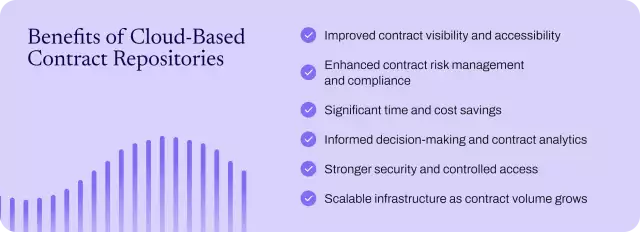
A secure contract repository in the cloud provides a faster, more adaptable way to handle agreements at scale, offering instant access from any location. Benefits include:
Improved contract visibility and accessibility
In a midsize organization, teams store contract-related data across 24 different systems, lacking a unified repository, according to research by WorldCC with Conga and Salesforce. The result is low visibility into active agreements, delays in negotiations, and slow vendor onboarding.
With a centralized contract repository, legal, sales, procurement, and finance teams know where to find all the company's agreements, gaining easier access to the documents they need.
Enhanced contract risk management and compliance
A secure repository serves as a primary line of defense against contract risk. It provides a centralized, organized location where legal teams can identify and track high-impact clauses, such as liability limits, indemnities, and termination rights.
A legal contract repository with granular role-based access control (RBAC), such as Conga CLM, restricts who can view or modify sensitive agreements, protecting data integrity and supporting regulatory requirements.
Explore the best practices of contract risk management.
Significant time and cost savings
A central contract repository eliminates hours wasted searching for agreements, chasing approvals, or recreating lost documents. Cloud-based deployment also eliminates the costly server maintenance, manual upgrades, and infrastructure scaling required for on-premises systems. According to McKinsey, cloud-first systems can reduce operational costs by more than 35%, helping organizations lower contract management expenses while accelerating business operations.

Informed decision-making and contract analytics
By structuring and tagging all key data points (for example, termination clauses, pricing structures, and key performance indicators), a digital contract repository system enables real-time analytics.
Finance and legal teams can build instant contract dashboards and reports to uncover hidden risks, monitor compliance performance, and identify opportunities for favorable renegotiation. This data-driven approach grounds decisions about capital, vendors, and customers in accurate, easily accessible agreement terms.
Keep learning: top 25 contract analytics
Controlled access and stronger security
The best contract repository tools provide enterprise-grade security that surpasses on-premises file servers. Cloud-based systems like Conga CLM protect sensitive agreement data with strong encryption both at rest and in transit, and integrate with corporate identity providers via single sign-on (SSO) and multi-factor authentication (MFA) to verify every user.
Scalable infrastructure as contract volume grows
A cloud-based contract repository system automatically scales as agreement volume and user demand grow, eliminating the need for IT teams to manage infrastructure upgrades or server capacity.
Features to Look for in Contract Repository Software
Dataintelo projects that the global contract repository software market will grow at a 13.6% CAGR through 2033, reaching $ 5.34 billion. As the market expands, organizations should look beyond basic document storage and prioritize features that address real business needs
When evaluating contract repository management software, focus on these features:
| Contract Repository Software Feature | Why You Need It |
| Advanced search and metadata extraction | Optical character recognition (OCR) text extraction, such as the one in Conga CLM, converts unstructured contract files into searchable data, enabling fast retrieval by clause, date, party, or obligation |
| Centralized, structured storage | A single, organized repository eliminates fragmented contract storage and ensures teams have access to the most current agreements from one trusted location |
| Automated version control | Automatic version tracking prevents teams from using outdated contracts and preserves a complete history of edits, approvals, and changes |
| Role-based access control | Granular permissions, such as those supported by Conga CLM RBAC, ensure only authorized users can view, edit, or approve sensitive agreements |
| Workflow automation and approvals | Automated contracting processes route documents through reviews and approvals without manual handoffs, reducing delays and keeping deals moving |
| Renewal and obligation alerts | Proactive notifications prevent missed renewals, expirations, and contractual obligations, helping teams avoid revenue leakage and compliance gaps |
| eSignature integrations | Native or integrated eSignature capabilities accelerate execution by allowing contracts to move from approval to signature without leaving the system |
| Integration with CRM and ERP systems | Integrations sync contract data with sales, finance, and procurement systems, ensuring accuracy and reducing duplicate data entry |
| Reporting and contract analytics | Built-in reporting transforms contract data into insights that support forecasting, risk analysis, and performance tracking across the contract portfolio |
| Scalable cloud architecture | Cloud-native infrastructure supports growing contract volumes and users without performance degradation or additional IT overhead |
Conga CLM brings these capabilities together in a single, enterprise-grade contract repository—combining OCR-powered search, role-based access control, automated workflows, and real-time analytics to help you manage contracts with speed and confidence.

Best Practices for Effective Contract Repository Management
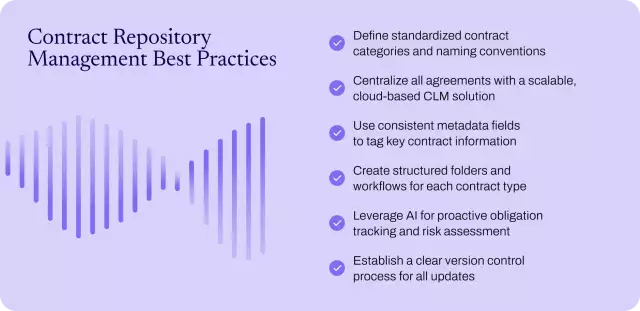
Learning how to organize contracts effectively enables a proactive legal strategy as you keep agreements secure, searchable, and actionable. Follow these best practices to manage your contract repository.
1. Define standardized contract categories and naming conventions
Start by establishing a framework for how teams organize contracts before uploading a document. Define a master list of contract categories—such as vendor services, NDAs, licensing, or employment—and apply a consistent naming format. For example:
- [Counterparty][AgreementType][YYYYMMDD]_[Version].pdf
By enforcing consistency from day one, you can quickly identify and locate agreements without prior deal knowledge, reducing confusion and saving time otherwise lost to manual searches or misidentified documents.
2. Centralize all agreements with a scalable, cloud-based CLM solution
Migrate all agreements into a cloud-based CLM system. A centralized platform makes every contract visible and accessible, helping teams identify hidden risks, prevent missed obligations, and avoid duplicate agreements with the same vendor. Choose a platform such as Conga CLM that scales as deal volume grows.
3. Use consistent metadata fields to tag key contract information
Define and enforce a mandatory set of metadata fields for every contract entered into the system. Important fields include:
- Contract value
- Effective date
- Expiration/renewal date
- Counterparty
- Responsible department
- Key clauses (such as termination or liability)
By structuring contract information, you locate agreements faster, track obligations reliably, and generate insights without manual review or data cleanup.
4. Create structured folders and workflows for each contract type
Organize your central contract repository with a clear hierarchy that mirrors your organizational structure, such as by business unit, regional office, or department. Assign each folder a specific purpose, so teams know exactly where to store and access deals. Link automated workflows to these folders to ensure each contract follows the proper review and approval process from the moment it enters the system.
5. Leverage AI for proactive obligation tracking and risk assessment
An AI contract repository management software extracts obligations, deadlines, and risk indicators directly from agreement language, eliminating the need for manual review.
Conga CLM with AI capabilities transforms agreements into accurate, searchable data. Our platform continuously monitors critical commitments—such as delivery milestones, performance guarantees, insurance requirements, and compliance certifications—alerting the right stakeholders before deadlines pass.
Learn more: what is AI for contract management?
6. Establish a clear version control process for all updates
Implement automated version control that records every contract change with timestamps, user attribution, and version history. This practice replaces confusing file names like Final_v2_updated with native check-in and check-out controls that lock documents during editing and automatically increment version numbers on save.
Streamline Collaboration With Conga’s Central Contract Repository
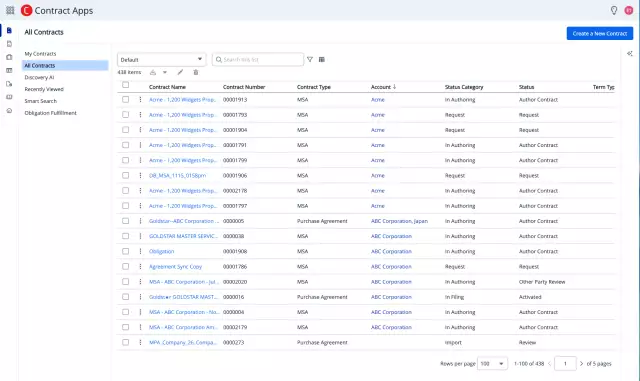
Conga CLM brings legal, sales, finance, and procurement teams together in a single collaborative environment, making it easier to create, review, and manage agreements without switching tools. By combining centralized storage with intelligent intake and built-in collaboration, our contract lifecycle management platform delivers the speed and control enterprises need to execute deals more quickly.
Streamline agreements with the best contract repository management solution. Connect with a Conga expert.
Frequently Asked Questions
-
How does a centralized contract repository differ from traditional document storage?
Traditional storage is a general archive for all files, while a centralized contract repository offers a specialized space for legal teams to manage obligations, track metadata, maintain version histories, automate workflows, and monitor key dates.
Let's review key differences between traditional document storage and a contract repository.
Traditional document storage Centralized contract repository Purpose General file retention and sharing Strategic management of the full contract lifecycle Metadata tracking Manual and generic (for example, department, date) Purpose-built for legal data (for example, liability cap, indemnity) with AI-assisted extraction Searchability Primarily keyword and filename-based Deep search across specific clauses, obligations, and legal metadata Version control Basic file history often relies on manual naming Automated check-in/out with an immutable audit trail of legal changes Access control Folder-level permissions Granular, role-based access down to the document and data-field level Automated workflows Basic sequential sharing Complex, conditional routing based on contract value, legal risk, or department Renewal alerts Manual reminders or static dates Proactive, automated notifications triggered by specific contractual milestones Audit readiness Manual compilation of files and emails Instant, exportable reporting of all actions, approvals, and signatures -
Is it safe to store contracts in an online repository?
Definitely. Storing contracts in an online repository is secure when the system uses encryption, role-based access controls, and continuous monitoring. Modern cloud-based CLM platforms, such as Conga CLM, protect sensitive data while providing authorized users anytime, anywhere access.
See how Conga CLM protects your data. Download our Security Data Sheet. -
Can I manage legacy contracts in a repository?
Yes. Managing legacy contracts in a centralized repository consolidates historical agreements alongside new ones. You can import documents, extract metadata, and apply workflows to bring older deals under the same visibility, control, and compliance standards as current agreements.
-
Connect and Learn With Peers in the Conga Customer Community BlogCLMConnect and Learn With Peers in the Conga Customer Community
Join 40,000+ peers in the Conga Customer Community—connect, learn, and grow with resources, training, and support to fuel smarter business outcomes.09/30/20266 min read -
The Contract Management Strategy You Might Be Overlooking BlogCLMThe Contract Management Strategy You Might Be Overlooking
Discover the contract management strategy that improves collaboration, clarity, and results—without overcomplicating your process.09/17/20267 min read -
The Quote to Cash Process in 10 Steps BlogCLMThe Quote to Cash Process in 10 Steps
Discover how to streamline your quote-to-cash (Q2C) process to accelerate sales cycles, improve customer experience, and boost revenue. This comprehensive guide covers every stage—from configuration and pricing to contract management, billing, and renewals—plus tips for finding the right automation solution. Learn how to eliminate silos, reduce errors, and drive efficiency across your CRM and ERP systems.08/12/20269 min read -
The Complexity Tax: How Manufacturers Can Stop Leaving Revenue on the Table BlogManufacturingThe Complexity Tax: How Manufacturers Can Stop Leaving Revenue on the Table
Product lines grow. Quoting slows. Contracts pile up. Learn how manufacturers are tackling commercial complexity with CPQ and CLM to recover lost revenue.07/29/20267 min read