Simplify Quoting with CPQ for Complex Products
09/18/2026
8 min read

Complex products require complex quotes. Think industrial equipment with dozens of configurable components, telecom bundles that combine hardware and services, or software packages with subscriptions, add-ons, and usage tiers. Configure, price, quote (CPQ) solutions bring your entire catalog into one controlled workflow, guiding reps through valid selections, applying the right pricing rules, and creating proposals for each item.
In this guide, we break down how CPQ turns tangled configurations into accurate quotes, which businesses benefit the most from the technology, and how to evaluate the tools built for real product complexity.
CPQ for complex products is software that turns multi-option, rule-heavy items into accurate quotes without manual engineering review.
Evaluate CPQ on configuration engine, guided selling, validation, pricing, BOM and document generation, integrations, and governance at scale.
Conga CPQ follows your business rules to block configurations you can't build and prices every deal against account-based terms.
Conga CPQ catches discounts that violate guardrails and applies the same rules whether a buyer configures with a rep, partner, or portal.
What Is CPQ for Complex Products?
CPQ for complex products is software that replaces manual configuration and spreadsheet pricing with a single quoting tool. You tell the CPQ system which items work together and what each combination usually costs; the technology uses that information to apply your rules to future quotes. The result is a quote that reflects only what your business can deliver, priced to protect your margin, and ready to send without manual processes.
Read our CPQ guide to see how the software covers product, pricing, and quoting logic.
Why Quoting Complex Products Breaks Down without CPQ
Manual quoting fails with complex products because the work quickly outgrows the tools. Spreadsheets don’t enforce compatibility rules, email doesn’t route approvals, and no rep can memorize every dependency across a catalog of thousands of SKUs.
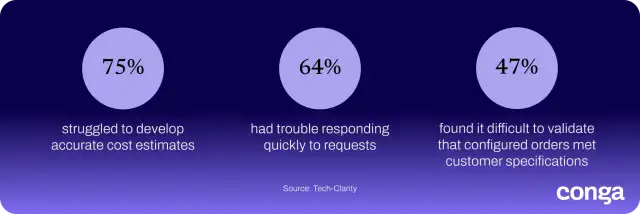
Product complexity makes it harder to maintain both accuracy and speed. In a Tech-Clarity survey of 234 companies selling to-order products, 75% struggled to develop accurate cost estimates, 64% had trouble responding quickly to requests, and 47% found it difficult to validate that configured orders met customer specifications.
Using enterprise CPQ to build quotes lets you cut down on manual handoffs that stall deals, because the solution evaluates each choice against what you’ve already defined.
- Product rules: What reps can or cannot sell together
- Technical constraints: Whether the selected components work in the final product (for example, whether a power supply can support the chosen equipment or a part fits within the available space)
- Compatibility requirements: Which items, components, or options work with each other
- Customer entitlements: What a specific customer can buy or receive
- Pricing logic: Which prices, discounts, fees, and other adjustments apply to the CPQ configuration
The Benefits of CPQ for Complex Product Configurations
CPQ for complex products pays off in improved speed, accuracy, and margin control. Each benefit traces back to the same foundation: rules and pricing live in one governed system.
- Faster quote turnaround: Guided workflows and automated validation cut quote generation from days to minutes, so reps respond while the buyer is still deciding.
- Zero misconfigurations: Real-time validation across multi-level dependencies blocks invalid combinations before a quote ever reaches the buyer.
- Protected margins: Dynamic pricing intelligence and automated discount governance hold the line on every deal, so reps can’t approve quotes that don’t follow the business rules.
- Sales reps close complex deals independently: Teams close technical deals without pulling engineers into routine configuration reviews.
- Automated outputs: The CPQ generates BOMs, proposals, and downstream documents straight from the configuration with no manual assembly.
- Multichannel scalable sales: Shared rules within the CPQ help sellers and partners in different touchpoints present consistent products and prices. This is especially important as modern B2B buyers navigate an average of 10 channels across their purchasing journey, according to McKinsey.

Which Businesses Benefit Most from CPQ for Complex Products?
Complex sales CPQ creates the most value when product variety, deal volume, or pricing complexity exceeds what spreadsheets and basic CRM tools can manage.
Businesses that often face this level of complexity include:
- Industrial manufacturers selling configure-to-order or engineer-to-order equipment
- Healthcare and life sciences managing regulated product combinations
- Telecommunications providers bundling hardware, connectivity, and services
- Technology companies selling subscriptions, usage-based services, and add-ons
- Energy and construction businesses quoting site-specific systems
- Distributors managing large catalogs, partner pricing, and regional rules
Simplify Complex Product Configurations in 5 Steps
Complex configurable products get much simpler when you bring rules, pricing, and quotes into one connected system. Here are the five steps to integrate your commerce chain and enable your sales team to move deals forward.
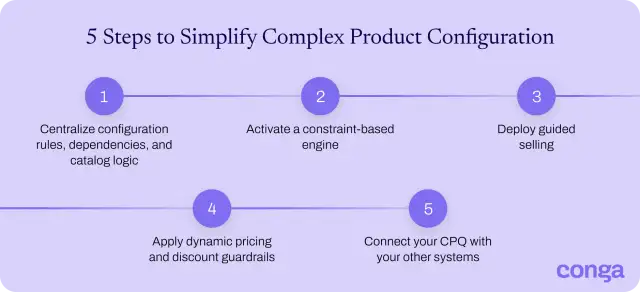
1. Centralize configuration rules, dependencies, and catalog logic
Start by moving product knowledge out of spreadsheets, documents, and individual inboxes. Create one governed source for compatibility rules, item hierarchies, required components, exclusions, and regional availability.
The best AI-powered CPQ solutions like Conga rely on the product knowledge to build accurate quotes, so centralize that information before you bring in quoting tools.
2. Activate a constraint-based engine to validate selections in real time
A constraint-based engine reads your business rules and prevents invalid selections as the rep builds the quote. When someone adds an item, the system compares it with its dependencies and compatibility requirements, then blocks combinations you can’t deliver.
Constraint-based logic resolves nested rules and multi-level dependencies in real time, which is the difference between catching an error at configuration and discovering it after the buyer signs.
3. Deploy guided selling to accelerate complex quote cycles
Guided selling walks reps through technical products by asking questions about the customer’s needs and use case. The rep answers each question, and CPQ uses those responses to narrow the available options to valid configurations. That means sellers don’t need to memorize the full catalog to build an accurate quote.
Think of guided selling as a sales quote automation layer that turns a specialist task into something any rep can do. This extra help in the workflow reduces technical bottlenecks and helps sales teams move complex deals faster.
4. Apply dynamic pricing intelligence and discount guardrails
Pricing is where complex quotes either protect margin or create leakage. A dynamic approach applies account-specific rates, contracted terms, and volume logic automatically, while discount guardrails route anything outside policy for approval.
You can also run a price waterfall analysis before setting the guardrails to see where margins slip and then fix the discount rules before they turn into leakage.
5. Connect CPQ across your CRM, ERP, and commerce ecosystem
Integrating your systems allows data to flow through them without rekeying. CPQ pulls opportunity history from your CRM, extracts product and inventory information from your ERP, and then pushes approved quotes, BOMs, and orders downstream.
Connected workflows carry a quote cleanly from configuration to contract to billing, working as the backbone of a functioning quote-to-cash process.
See how Conga CPQ integrates with your entire commerce ecosystem
How to Evaluate the Leading CPQ Tools for Complex Product Configurations
The demand for CPQ tools for complex products is rising fast. According to Grand View Research, the global CPQ software market is projected to reach $10.9 billion by 2033, with North America holding the largest regional share as enterprises adopt automated quoting. With more vendors offering AI, pricing, and configuration capabilities, you need to evaluate each tool by testing it against your most complex configuration.

| CPQ Evaluation Criteria | Best-in-Class Capability | Common Limitation |
| Configuration engine | Constraint-based engine that resolves multi-level dependencies, nested rules, and compatibility logic in real time | Rules-based engines that require custom scripts and manual validation |
| Guided selling | Dynamic questionnaires and intelligent recommendations that surface only valid configurations | Static product catalogs that depend on rep expertise and engineering reviews |
| Configuration validation | Real-time enforcement of compatibility rules that prevent invalid configurations | Validation performed after quote creation, resulting in rework and delays |
| Dynamic pricing | Real-time, account-specific pricing with discount guardrails and margin visibility | Static price lists with limited pricing flexibility and weak margin controls |
| BOM and document generation | Automatic generation of quotes, proposals, and BOMs | Manual document creation and post-quote engineering handoffs |
| Enterprise integrations | Native enterprise CPQ integration with CRM, ERP, PLM, and quote-to-cash workflows | Siloed systems connected through fragile custom integrations |
| Scalability and governance | Centralized rules management, version control, and support for large, complex product catalogs | Growing maintenance overhead and performance issues as product complexity increases |
Conquer Every Configuration Challenge with Conga’s CPQ Tools for Complex Product Configurations
Conga CPQ connects configuration, pricing, quoting, and downstream execution in a single solution, allowing sales teams to turn complex product catalogs into fast, accurate quotes. Conga runs across your CRM, ERP, and commerce chain, so the same rules hold whether a buyer purchases items from a rep, a partner, or a self-service portal.
Let your sales team focus on closing more deals while Conga CPQ handles:
- Catalogs of 10,000+ line items without slowing down the quoting process
- Pricing rules and calculations so reps can build accurate, margin-conscious quotes
- Product configuration rules that guide sellers toward valid combinations
Talk to our sales team to see how our CPQ engine turns your most complex configurations into accurate, margin-protected quotes.
Simplify quoting for complex products with Conga
Frequently Asked Questions
-
How does CPQ handle complex product configurations?
CPQ handles complex product configurations by encoding your catalog rules, dependencies, and pricing into a single engine that validates every selection as a rep builds a quote. When a seller picks an item, the engine checks it against every compatibility and dependency rule, then blocks combinations that you can’t deliver to the buyer. The product validation runs in real time, so errors surface at configuration instead of after the buyer signs.
-
Can CPQ handle nested dependencies in multi-level complex products?
Yes. A constraint-based solution like Conga CPQ reads nested dependencies across parent and child components together. When a rep makes a selection, the system adds any required parts and removes incompatible options from the remaining choices.
-
How does a CPQ rules engine prevent invalid configurations for complex products?
A CPQ rules engine prevents invalid configurations by checking each selection against your compatibility and constraint requirements before the quote moves forward. If a rep chooses two parts that can’t work together, CPQ flags the conflict and blocks the combination. Because the rules live in the engine rather than in a rep’s memory, enforcement stays consistent across every quote and every channel.
-
How can CPQ simplify the selling process for highly technical or complex products?
CPQ simplifies selling technical items by replacing specialist knowledge with guided workflows that any rep can follow, shortening sales cycles and freeing your staff. The guided-selling workflow asks the rep questions and surfaces valid options based on the answers, and builds the configuration, product pricing analytics, and proposal automatically.
Conga CPQ pairs guided selling with automated BOM and document generation, so a very technical product quotes as smoothly as a simple one.
See how Manitou cut ordering time from 30 days to 1 day with Conga Smart CPQ.
Related Resources
-
Connect and Learn With Peers in the Conga Customer Community BlogCLMConnect and Learn With Peers in the Conga Customer Community
Join 40,000+ peers in the Conga Customer Community—connect, learn, and grow with resources, training, and support to fuel smarter business outcomes.09/30/20266 min read -
5 B2B Buying Behaviors You Can’t Ignore BlogCPQ5 B2B Buying Behaviors You Can’t Ignore
Discover the 5 B2B buyer behaviors redefining sales and learn how companies can adapt their sales strategies to win in a buyer-led world.06/23/202511 min read -
Conga Recognized in the 2026 Gartner Peer Insights™ Voice of the Customer for Configure, Price, and Quote Applications BlogCPQConga Recognized in the 2026 Gartner Peer Insights™ Voice of the Customer for Configure, Price, and Quote Applications
Learn more about how customers rate Conga CPQ and our position in the Gartner Peer Insights™ Voice of the Customer: Configure, Price, and Quote Applications report.08/19/20264 min read -
The Future of SteelBrick Salesforce CPQ: Are You Ready? BlogCPQThe Future of SteelBrick Salesforce CPQ: Are You Ready?
SteelBrick Salesforce CPQ is changing. Learn what’s next, why it matters, and how to choose a modern CPQ that fits your business now and in the future.07/22/20256 min read