AI Pricing Readiness Starts with a Strong Foundation
07/15/2026
7 min read

AI pricing readiness is a continuum, not a prerequisite project.
People and culture matter as much as technology for smooth adoption.
It's cross-functional — pricing, IT, finance, and sales aligning is what makes it work.
Start before the algorithm — build on what you have, don't leap straight to AI.
AI pricing is quickly moving from an emerging concept to a practical business priority. As organizations look for ways to improve pricing agility, reduce manual effort, and respond faster to changing business conditions, many are considering a more important question first: are we actually prepared for AI pricing?
The good news is, AI readiness is a continuum. You don’t need to complete a massive transformation project or get your systems perfectly aligned before you can begin. In many cases, companies already have the foundational pieces in place through existing pricing processes, ERP systems, CRM platforms, and commercial workflows.
What matters most is understanding how those pieces connect to support faster, more consistent pricing decisions.
To help with that process, we’ve developed a practical AI readiness checklist designed to help organizations evaluate how well they’re positioned to support faster, more consistent pricing decisions.
AI Readiness Checklist for Pricing Technology
AI readiness doesn’t mean dotting every ‘i’ and crossing every ‘t’ before you get started. It’s about understanding where your organization is already well prepared and identifying opportunities to strengthen pricing agility over time.
Our AI readiness checklist focuses on four core areas that support successful AI pricing initiatives.
1. Core Operational Requirements
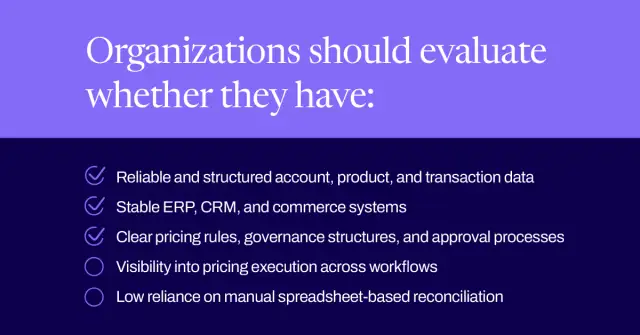
Strong AI pricing starts with reliable data and connected workflows. Many organizations already have much of the necessary infrastructure in place through their existing ERP, CRM, CPQ, and commerce systems. AI transformation is often less a matter of replacing technology and more about improving visibility, consistency, and coordination across pricing operations.
Organizations should evaluate whether they have:
- Reliable and structured account, product, and transaction data
- Stable ERP, CRM, and commerce systems
- Clear pricing rules, governance structures, and approval processes
- Visibility into pricing execution across workflows
- Low reliance on manual spreadsheet-based reconciliation
Why this matters: Connected operational foundations help companies improve pricing consistency, support more scalable price optimization initiatives, and respond faster to changing market conditions.
2. Leadership and Team Alignment
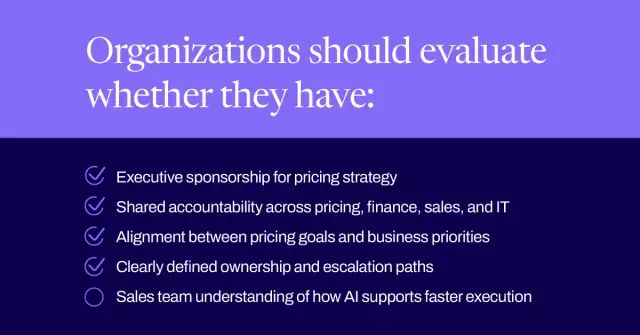
Pricing agility depends on alignment across teams like finance, pricing, sales, IT, and leadership. Organizations often see stronger results when pricing strategy is treated as a shared business priority with clear ownership, executive buy-in, and alignment on pricing goals.
Organizations should evaluate whether they have:
- Executive sponsorship for pricing strategy
- Shared accountability across pricing, finance, sales, and IT
- Alignment between pricing goals and business priorities
- Clearly defined ownership and escalation paths
- Sales team understanding of how AI supports faster execution
Why this matters: Alignment helps businesses operationalize pricing decisions more consistently across channels, workflows, and customer interactions.
3. Technology and Infrastructure Confidence
AI pricing success depends on organizational trust in the technology itself. Pricing, IT, and leadership teams need confidence that the AI pricing solution is secure and practical to support. Transparency and explainability are also critical, as teams should understand how pricing recommendations are generated.
Organizations should evaluate whether they have:
- Confidence that the solution fits within the existing tech stack
- Trust that the platform can be supported without specialized coding skills
- Executive confidence in AI-assisted pricing workflows
- Clear governance and auditability around pricing decisions
- Visibility into how pricing recommendations are calculated
Why this matters: Organizations are more likely to succeed with AI pricing initiatives when teams trust the technology, understand how recommendations are generated, and feel confident integrating AI into existing operational workflows.
4. Change Management and Cultural Readiness
Successful AI adoption is as much about people and processes as technology. Organizations that position AI pricing as a tool for improving decision-making—not replacing human expertise—tend to create smoother implementation experiences and have stronger long-term results.
Organizations should evaluate whether they have:
- Structured onboarding and adoption plans
- Training and enablement for affected teams
- Clear communication around pricing workflows
- Executive support for AI-assisted pricing initiatives
- A culture that views AI as a tool to improve decision-making
Why this matters: Companies that build confidence and prepare their teams for AI implementation are better positioned to scale AI pricing initiatives successfully across the business.
5. Execution at Scale Across Commercial Operations
AI pricing doesn’t stop at generating recommendations – it requires consistent execution across every commercial touchpoint. Organizations should evaluate whether they can:
- Deliver prices in real time across CPQ, CLM, eCommerce, and other channels
- Enforce pricing policies and guardrails directly within selling and contracting workflows
- Connect pricing decisions to agreements, rebates, and downstream financial outcomes
- Enable consistent pricing across regions, business units, and channels
- Close the loop between pricing strategy, execution, and realized margins
Why this matters: AI pricing only delivers impact when recommendations are operationalized at scale. The ability to execute pricing consistently across the entire revenue lifecycle is what turns insight into measurable margin improvement.
AI Pricing is a Team Sport
AI pricing creates value across the organization, which is why successful initiatives often bring pricing, technology, finance, and sales teams together around a shared goal: improving pricing agility and execution.

For pricing leaders, AI pricing helps teams move beyond manual spreadsheets and focus more on pricing strategy, decision quality, and execution speed. With improved visibility into pricing recommendations and business performance, teams can respond more quickly to cost changes while maintaining stronger pricing governance.
For digital transformation leaders, AI pricing offers an opportunity to improve operational efficiency without a large-scale transformation effort. Modern pricing solutions like Conga Price Optimization and Management (POM) are designed to work alongside existing ERP, CRM, CPQ, and commerce systems, using each customer’s own business data in a secure, isolated environment to help companies improve pricing execution across channels while maximizing existing technology investments.
For finance leaders, AI pricing creates a more direct connection between pricing strategies and business performance. Better pricing consistency and reduced manual errors can help to improve revenue quality, reduce margin leakage, and support measurable revenue outcomes over time.
When these teams align around shared pricing goals, organizations are better positioned to operationalize AI pricing in a way that feels practical, scalable, and measurable across the business.
AI Pricing Readiness Starts Before the Algorithm
You don’t need perfect systems or flawless data to start exploring AI pricing. For many organizations, the foundational capabilities already exist within current workflows, systems, and teams.
Once the basics are in place, it’s important to build on those foundations by improving connectivity, operational consistency, organizational alignment and execution.
As companies explore AI pricing and price optimization strategies, readiness assessments can help to identify practical next steps while uncovering opportunities to improve pricing agility across the business. The goal isn’t to leap directly to AI – it’s to build on existing capabilities and progressively increase pricing sophistication while delivering value at each stage.
Looking to review your AI readiness?
To learn how AI pricing can support your organizational goals
Frequently Asked Questions
-
Do we need to overhaul our systems before we can start with AI pricing?
No. Most organizations already have what they need to get started. Your ERP, CRM, and CPQ systems hold the pricing data that AI works from. The real question is whether that data is structured, accessible, and consistent across workflows.
AI readiness is a continuum. You're building on what's already there, not tearing it down.
-
What does "AI readiness" actually mean for a pricing team?
It comes down to 4 things: connected operational data, cross-functional alignment, trust in the technology, and a team prepared to actually use it. Pricing leaders who check those 4 boxes tend to see faster time-to-value and stronger adoption. The checklist in the article helps you figure out which of the 4 needs the most attention before you move forward.
-
How do we get sales, finance, and IT aligned around AI pricing?
Shared ownership helps more than shared meetings. AI pricing works best when pricing goals connect directly to what each team cares about: sales wants faster quotes, finance wants margin visibility, IT wants something they can support without custom code. When you frame AI pricing around those specific outcomes, alignment follows a lot more naturally.
The playbook here is to get executive sponsorship early, define clear ownership, and position AI as a tool that helps each team do their job better.
-
How does AI pricing actually improve margin, and how do we measure it?
Margin improvement comes from 2 places: reducing leakage from inconsistent or over-discounted pricing, and improving the quality of price recommendations at the deal level. Conga's AI pricing uses neural network models to analyze willingness-to-pay and demand elasticity, delivering customer-specific price guidance with demonstrated average revenue uplift of 8% and 200-500 basis point margin improvement.
Measurement starts with your current state, specifically win rates, discount rates, and realized margin versus target. Those become your baseline.
-
What's the difference between AI pricing and just better rules-based pricing?
Rules-based pricing is static. It reflects what you decided was true when you built the rules. AI pricing learns from actual transaction data, customer behavior, and market signals, and adjusts recommendations accordingly. The practical difference shows up when conditions change fast: cost increases, competitive pressure, demand shifts. Rules require someone to update them. AI pricing adapts.
That said, governance still matters. Good AI pricing keeps humans in control of guardrails and approval workflows. The goal is faster, better decisions with pricing teams setting the strategy and AI doing the heavy lifting on execution.
-
How to Shorten Your Sales Cycle: Fix the Handoffs, Not the Hustle BlogAIHow to Shorten Your Sales Cycle: Fix the Handoffs, Not the Hustle
Learn how to shorten your sales cycle by removing the hidden friction between teams, pricing, approvals, contracting that stalls deals right when they should close.07/24/20269 min read -
Stop Guessing & Start Deciding: The Forrester Framework for Buy vs. Build Analyst ReportIndustry InsightsStop Guessing & Start Deciding: The Forrester Framework for Buy vs. Build
AI lowered the cost of building software. It didn't lower the cost of running it. Get the Forrester framework that helps you decide what to buy, build, or generate.07/22/20264 min read -
Only the Agile Thrive BlogIndustry InsightsOnly the Agile Thrive
Discover how business agility, AI, and connected data help companies respond faster to tariff disruptions, reduce risk, and make confident go‑to‑market decisions.07/22/20265 min read -
Why AI-Powered Pricing is Now a Business Necessity for Margin and Growth BlogAIWhy AI-Powered Pricing is Now a Business Necessity for Margin and Growth
Learn why AI pricing is becoming essential for businesses facing rising market volatility, increased pricing pressures, and growing need for agility.07/16/20267 min read