Commodity Costs Move Daily, Should Your Pricing Too?

10/09/2026
9 min read

700+
cost data points in edible oils outpace manual pricing.
32%
average reduction in rogue discounting for Conga CPQ customers.
Most margin leaks from smaller accounts, priced on stale data.
One food manufacturer gained 2% division margin with Conga.
In food manufacturing, margin is everything. More than revenue. More than market share. Margin is top of mind for leaders and the cause of many headaches. And the single biggest threat to it is usually not your competitors. It is your own pricing process.
Most food manufacturers price the same way they have for decades: a small team of pricing experts, a stack of spreadsheets, and institutional knowledge built up over years. That model works until the market moves faster than the team can. And right now, the market is always moving faster than the team can.
Here is where the margin actually goes. Not in the top handful of accounts that get careful, well-resourced attention. It’s in the long tail of many smaller accounts priced quickly, often without full market context, by reps working from data that was already stale when they looked at it. That is where recoverable margin leaks, quietly and consistently at scale.
6 Reasons Why Manual Pricing Breaks Down at Scale
The problem is not that pricing teams are bad at their jobs. It is that manual pricing has structural limits, and those limits hit hardest exactly when you need pricing to work: when commodity costs spike, when a customer portfolio grows, when a key person leaves.
Six failure modes show up in almost every food manufacturing pricing operation.
- Stale data at the point of decision. In edible oils alone, product cost involves over 700 discrete data points: futures prices, blend ratios, sourcing origin, production materials, delivery time, volume, and currency exchange rates. No manual process can keep pace with that at the speed the market demands. Pricing decisions made on yesterday's data cost real margin points today.
- Margin leakage on smaller accounts. Often, pricing teams focus their energy on large, strategic customers. The long tail of smaller accounts gets priced inconsistently and under the radar, leaving revenue on the table.
- Inconsistency across teams and regions. Without a single source of truth, the same customer receives different prices from different reps. That erodes trust. It also means your pricing quality is only as stable as your least consistent region.
- Key-person dependency. When pricing expertise lives in the heads of two or three people, staff turnover is an operational risk. A team restructure is a pricing crisis. The knowledge is not in the system. It is walking around.
- No learning from market signals. Manual processes cannot systematically incorporate commodity cost movements, regional capacity utilization, or win/loss patterns into margin guidance. It’s why pricing remains reactive rather than strategic.
- Rebates are ignored during pricing decisions. Pricing gets all the attention, but rebates are the blind spot. You can set a price that looks competitive and still be sitting on decent margin, but if you're not looking at rebates at the same time as pricing, you don't know your true customer profitability. You're making a margin decision half-blind.
Pricing Pressure Continues to Intensify
The pressures driving food manufacturers toward more streamlined pricing processes are well-documented. Commodity price volatility has made real-time pricing accuracy a competitive necessity. Meanwhile, consolidation among large customers has increased pricing sophistication and bargaining power, compressing margins further.
At the same time, pricing teams are being asked to cover more accounts with fewer resources. The combination of growing account complexity and constrained human capacity creates exactly the conditions where manual processes fail:
- More decisions
- Less time
- No systematic way to ensure each one is made with current market and cost data
Below, we share a few Conga customer stories of food manufacturers who have leveraged systematic pricing solutions to protect margins and remain competitive in their respective markets.
A 2% Margin Improvement in a Single Division
One of the largest food companies in North America faced this exact problem in its edible oils division. Thousands of account managers across 125 countries were pricing manually: rummaging through spreadsheets, commodity market data, and past transaction history to estimate the best price for each customer.
Our pricing was ad hoc, with lots of individual spreadsheets and emails.
Their legacy system could handle only four or five customer segments. As their Strategic Pricing Manager put it, measurement and execution on those segments were "really tough." The company needed to move from ad hoc pricing to an intelligent strategy at global scale.
They deployed Conga's Price Optimization and Management and Conga CPQ across the edible oils division. The system now calculates over 1,000 pricing benchmarks and more than 150 data lookups, in real time, every time a salesperson produces a quote. It also pulls in live commodity futures, SAP customer and product data, and AI-driven margin guidance delivered directly in Salesforce.
This Conga customer saw:
2% | 5% | 70+ | 1,000+ |
| margin improvement in edible oils | top-line revenue improvement in first division | countries in the company’s global footprint | pricing benchmarks per quote in real time |
Fonterra: Eliminating the Version Problem
Fonterra, one of the world's largest dairy exporters, had a different version of the same problem. Pricing was managed through a decentralized web of Excel spreadsheets. Different teams maintained different versions. Currency exchange rates were often outdated by the time account managers used them. Data entry into SAP was manual and error-prone.
Everyone had different versions of Excel...CPQ allowed us to standardize those processes.
Fonterra implemented Conga CPQ with Price Management and Price Optimization layered on top, along with a real-time pricing engine that incorporates weekly futures market data. The result: every account manager globally sees the same price on the same dates.
Everyone, when they're logged in, would see the same price on the same dates...You were reducing the value leakage when it went into SAP.
Fonterra then expanded into index-based and risk-managed pricing strategies, capabilities that were simply not possible under the prior manual approach.
A Food Ingredients Manufacturer Hits $18M in Year One
A global food ingredients manufacturer that transforms corn, tapioca, wheat, and potatoes into starches, sweeteners, and specialty ingredients also struggled with manual pricing processes. For years, their pricing in South America ran almost entirely on spreadsheets, informal emails, and in some cases handwritten notes. With five currencies to track and input costs that shifted monthly, the manual approach had hit its limit. Margin performance was essentially invisible. Teams knew they were setting margin floor targets. They had no way of knowing whether they were hitting them.
They deployed Conga Price Management and Price Optimization and Conga CPQ over a 10-month implementation, centralizing pricing onto a single platform connected to both SAP and Salesforce. Spot and contract prices that used to take days to calculate now take minutes. Index-linked recalculations that once required manual intervention now trigger automatically. Pricing and sales teams that had previously overlapped in responsibilities and operated in silos now work from a single source of truth.
The company had set a five-year revenue goal of $25 million to measure the value of the investment. They hit $18 million in year one. For the first time, they could see whether they were actually hitting their margin targets.
How Conga Price Optimization and Management Works
Across these deployments, the shift is consistent: from manual, expert-dependent pricing to a governed, intelligent system that improves over time. Four Conga capabilities drive most of the value for food manufacturers.
- Commodity-indexed pricing. Price decisions tie directly to commodity market inputs: wheat futures, soybean oil prices, dairy indices. Pricing adjusts when inputs change based on rules your pricing team sets, not when a pricing analyst manually reviews the data. A leading commodity and agribusiness company’s Conga CPQ deployment processes commodity price updates with only a 15-second delay. Fonterra uses weekly futures data for global alignment.
- AI-driven margin guidance with floor enforcement. Machine learning models analyze your own historical transactions, regional demand signals, win/loss history, and account-specific patterns to generate margin guidance ranges. Configurable guardrails prevent quotes below acceptable margin thresholds. Conga customers see a 32% reduction in rogue discounting.
- A system that learns from your pricing team, not instead of them. Overrides and corrections get captured, attributed to customer and SKU context, and fed back into the model. The gap between system recommendations and expert judgment narrows over time. Pricing team expertise becomes institutional, not personal.
- Rebates and incentives, tied to the same pricing engine. Volume rebates and growth incentives are modeled alongside price, not tracked in a separate spreadsheet after the fact. That means margin guidance already accounts for what you're giving back, so the number your pricing team sees is the number that actually hits the P&L.
- Also Read: AI-powered Pricing Strategies with Rebate Management
A note about implementation:
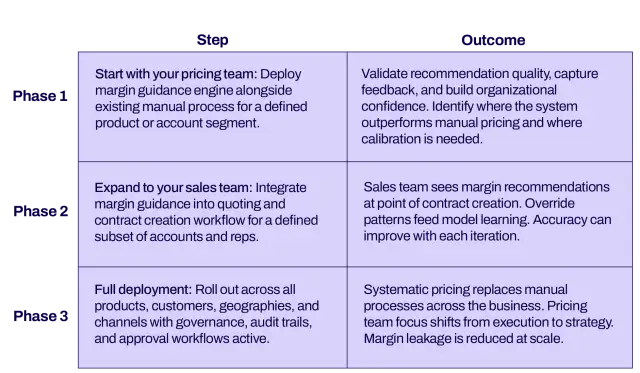
Every deployment is configured around the customer’s own data and goals, but many customers follow a similar path. Start with one product line, one region, one account segment. Prove the value. Then scale with data, confidence, and organizational buy-in behind you.
From Spreadsheet Complexity to Margin Discipline
The manufacturers in this post share a common starting point: pricing processes that had outgrown the tools running them. One standardized global pricing across currencies and markets. One drove measurable revenue gains across an entire region. And one improved margin by 2% in a single division — a meaningful number at global commodity scale.
None of them transformed pricing overnight. They started focused, proved the value, and expanded. The common thread is not the product. It is the decision to stop treating pricing as a manual, expert-dependent function and start treating it as a system.
In an industry where commodity markets move daily, customer portfolios are numerous, and every basis point of margin is visible at the board level, that shift matters. It is the difference between reacting to market changes and being ready for them.
Frequently Asked Questions
-
Why do food manufacturers lose margin on pricing?
Most food manufacturers still price with spreadsheets, a small team of experts, and institutional knowledge. That leads to stale data, inconsistent prices across reps and regions, too much reliance on a few key people, and rebates left out of pricing decisions. The losses pile up in smaller accounts that get less attention.
-
What is commodity-indexed pricing?
Commodity-indexed pricing ties prices directly to market inputs like wheat futures, soybean oil prices, or dairy indices. When input costs change, prices update automatically based on rules defined by your pricing team, without waiting for an analyst to review the data. Fonterra, for example, uses weekly futures data so every account manager worldwide sees the same price on the same dates.
-
How does AI help improve pricing decisions in food manufacturing?
Machine learning models study past transactions, regional demand, commodity trading, and account-specific patterns to suggest a margin range for each quote. Guardrails block quotes that fall below a set margin floor. The system also learns from every override your pricing team makes, so their expertise stays with the company instead of leaving when people do.
-
Why should rebates be included in pricing decisions?
A price can look competitive and profitable until you subtract the volume rebates and incentives you've promised that customer. If you model rebates alongside price, the margin your team sees is more representative of the margin that actually hits the P&L.
-
How should a food manufacturer roll out pricing optimization?
Start small: one product line, one region, or one account segment. Run margin guidance next to your current process, check its recommendations, and build confidence. Then add it to sales quoting workflows before rolling out across all products, customers, and regions, with governance and approval workflows in place.
Related Resources
-
Conga Solutions Named to 2026 Constellation ShortListTM BlogCPQConga Solutions Named to 2026 Constellation ShortListTM
Conga Solutions has been named to the 2026 Constellation ShortList for Revenue Intelligence, Price Optimization, and CPQ, recognizing leadership in revenue optimization.09/08/202611 min read -
The Total Economic Impact™ Study of Conga Price Optimization and Management Analyst ReportPrice Optimization & ManagementThe Total Economic Impact™ Study of Conga Price Optimization and Management
A Forrester Total Economic Impact™ Study commissioned by Conga05/16/20231 min read -
Conga Named Leader in the Gartner® Magic Quadrant™ for B2B Pricing and Rebate Optimization Software Analyst ReportCPQConga Named Leader in the Gartner® Magic Quadrant™ for B2B Pricing and Rebate Optimization Software
See how Conga performed in the Gartner Magic Quadrant for B2B Pricing and Rebates Optimization.04/13/20262 min read -
Why AI-Powered Pricing is Now a Business Necessity for Margin and Growth BlogAIWhy AI-Powered Pricing is Now a Business Necessity for Margin and Growth
Learn why AI pricing is becoming essential for businesses facing rising market volatility, increased pricing pressures, and growing need for agility.06/30/20267 min read