
Perspective: Responsible AI for Pricing
10/25/2024
7 min read
Key Takeaways
- Trust matters: Responsible AI builds customer confidence.
- Fair pricing: Ensure unbiased, ethical AI-driven decisions.
- Transparency focus: Explainable algorithms enhance trust.
- Data compliance: Adhere to privacy and legal standards.
- Reliability counts: Accurate AI fosters sales team confidence.
Buyers trust algorithms more than people – Responsible AI for pricing means adopting practices that sustain and enhance this trust.
According to a recent survey by EY, even though only 22% of consumers reported having a good understanding of AI, three in four (77%) are neutral or comfortable with AI being used to improve purchase experiences.
As companies work to build consumer trust, AI touchpoints become opportunities to build and strengthen that trust. As EY says, “in the age of AI, touch points become trust points.”
This survey is further supported by Conga research. In 2019 and 2021, Conga collaborated with Hanover Research on an independent study of B2B buyer behavior. Hanover surveyed over 1,000 B2B buyers on their perspectives regarding algorithmic pricing. That is, what are their views on and preferences for suppliers that use algorithms as a basis for price setting?
We know that consumers are increasingly exposed to algorithmic dynamic pricing – but what about B2B? Do they embrace this practice by suppliers, or do they prefer the thrill of the high-stakes negotiation dance of price determination that has been predominant since the beginning of commerce?
In fact, B2B buyers have an inherent affinity for suppliers that use algorithms for price determination. Hanover’s data shows that B2B buyers trust the objectivity and fairness of algorithms which overcome the typical obfuscation of people negotiating price.
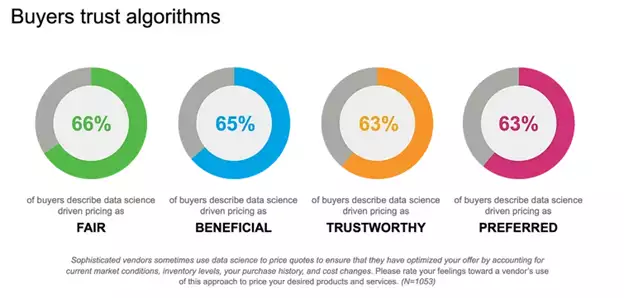
However, the potential for AI algorithms to optimize pricing does not come without the need for vigilance. It is incumbent on companies to maintain and enhance the trust in AI for pricing. So how can this be achieved?
Table Stakes in Responsible AI for B2B Pricing
Before companies dive into the details of how to build customer trust in its AI enabled pricing strategies, there are 2 “table stakes” questions and issues to address.
- Brand Equity and Value
From a brand perspective, we know that AI-based pricing has the potential to create positive brand equity. Market-relevant prices can be available more quickly, and there is potential to provide more customized price/package bundles for customers and expand the total addressable market. Will this positioning resonate with customers and is it consistent with the company’s overall brand promise?
On the flipside, is there a risk of negative brand impact through perceived price discrimination? We know that guardrails can be put in place to ensure pricing strategies are consistent and that there is no differential treatment across customer segments at the same point in time, but it is important that the company have in place the adequate tools and technologies in place to do this.
- Legal Compliance
There are some legal considerations that focus on privacy and anti-trust that companies need to navigate to ensure compliance.
As AI-driven pricing systems rely heavily on vast amounts of data, privacy and security concerns become paramount. Data privacy laws should be strictly adhered to, and personal data should never be used to calculate pricing recommendations.
Companies must ensure that their data practices comply with privacy regulations such as GDPR and CCPA, safeguarding customer data against unauthorized access and breaches.
Additionally, implementing robust data anonymization techniques can help mitigate privacy risks while still allowing AI systems to function effectively. For any consumer-related data, the data should be de-identified (i.e., cannot be associated with any particular consumer or reveal their identity).
Companies that adopt AI for pricing need to consider these table stake factors. Buyers need assurance that vendors are committed to Responsible AI practices. Such commitment is not a nice to have in this age of AI, it’s a must have to ensure AI serves ethical and beneficial purposes.
Trifecta of Trust
- Fair and Unbiased
When implementing AI for pricing, it is crucial to address ethical and bias considerations to ensure fairness. This involves regularly auditing and updating algorithms to prevent any unintended consequences that may disadvantage certain customer segments. By prioritizing fairness considerations, businesses can ultimately enhance their reputation and customer loyalty.
- Transparent and Explainable
For AI trust to be meaningful, transparency is essential. Buyers need clarity on the factors influencing AI-generated outputs. More precisely, AI pricing decisions must be explainable. Companies must be able to clearly communicate the factors influencing AI-driven pricing and provide mechanisms for customers to challenge or inquire about pricing decisions.
Beyond the transparency in decision, transparency in data usage is also important. Businesses should inform customers about what data is being collected, how it is used, and the measures in place to protect it.
- Competent and Reliable
Organizations, regardless of their sector, are typically risk-averse, especially when it comes to pricing. This is understandable. Pricing decisions are emotional decisions; no salesperson wants to lose an opportunity over price.
Transitioning from human intuition or spreadsheet-based pricing to AI-informed decisions demands high accuracy. That is, the AI must be competent. The AI-driven price must utilize the latest data, market trends, commodity prices, and competitive benchmarks to ensure both optimal and market relevance for the company and the customer. Moreover, the AI’s high accuracy performance must be consistent, so salespeople can count on it and find it reliable. When pricing AI is inaccurate, salespeople lose faith in the system. They may revert to outdated practices that could yield short-term sales but ultimately harm the company’s revenue potential. This highlights the importance of informed pricing strategies and the real benefit of Responsible AI powering them.
Deploying AI-based pricing offers only one chance to make a strong first impression. Salespeople who consistently close deals with accurately priced offers build confidence in the AI’s decision-making process.
Bottom Line
People trust algorithms more than humans. Responsible AI means maintaining and enhancing that trust.
By embedding Responsible AI principles into pricing strategy, companies can achieve a Price Advantage while enhancing consumer trust in the company’s brand. This Responsible AI must be transparent, fair, and competent to build confidence in the company’s approach to pricing.
Lastly, Responsible AI must be relevant to the market and environment in which it is being deployed. This requires companies to pick the best AI systems which can efficiently and accurately handle the many internal and external predictors and use algorithms that can practically translate these components into market-relevant prices.
Choosing the right AI and pricing strategy is critical. A poor choice can erode salespeople’s confidence, leading to wasted time and resources. Ultimately, it will degrade customers’ trust in the price, the AI, and the brand. Therefore, this is not a responsible use of AI pricing solutions.
AI-based pricing is here – and here to stay. It has proven to be the most efficient and adaptive way of helping companies outperform in today’s volatile market. However, companies need to ensure a responsible use of this powerful technology to reap the long-term benefit from it.
Frequently Asked Questions
-
What is Responsible AI for pricing?
Responsible AI for pricing ensures that AI-driven pricing strategies are fair, transparent, and reliable. It focuses on building trust with customers by adhering to ethical practices, avoiding bias, and maintaining data privacy.
-
Why is fairness important in AI-driven pricing?
Fairness prevents unintended bias in pricing decisions, ensuring that all customer segments are treated equitably. Regular audits and updates to algorithms help maintain fairness and enhance customer loyalty.
-
How does transparency improve trust in AI pricing?
Transparency allows businesses to explain how AI-generated prices are determined. By clearly communicating data usage and decision factors, companies can build customer confidence in their pricing strategies.
-
What role does data compliance play in Responsible AI?
Data compliance ensures that AI systems adhere to privacy laws like GDPR and CCPA. This includes safeguarding customer data, using anonymization techniques, and preventing unauthorized access to sensitive information.
-
How can businesses ensure reliability in AI pricing?
Reliability comes from using accurate, up-to-date data and market trends in AI-driven pricing. Consistent performance builds trust among sales teams and customers, ensuring long-term success.
-
What are the risks of not adopting Responsible AI practices?
Failing to implement Responsible AI can lead to biased pricing, loss of customer trust, legal non-compliance, and reduced confidence in AI systems, ultimately harming brand reputation and revenue.
-
How does Responsible AI benefit businesses and customers?
Responsible AI enhances customer trust, ensures ethical pricing, and improves operational efficiency. It helps businesses optimize pricing strategies while maintaining a positive brand image.
-
Streamline your sales processes with the click of a button VideosDocument AutomationStreamline your sales processes with the click of a button
Skip the time-consuming manual tasks associated with creating and updating your sales documents. With Conga Composer, you can leverage Salesforce data directly in your digital documents for quick, easy sales cycles.01/19/20216 min watch -
Getting started with the Document Automation Wizard VideosDocument AutomationGetting started with the Document Automation Wizard
With our Document Automation Wizard, you can quickly and easily create a custom Conga Composer solution from a simple guided interface. Gather data, add templates, and assign behaviors to your solution for faster automation and distribution. Want to see the Document Automation Wizard in action? Check out this quick demo video.08/17/20212 min watch -
The customer-centric path to revenue with Manny Medina of Outreach VideosIndustry InsightsThe customer-centric path to revenue with Manny Medina of Outreach
In the latest episode of Revenue Reinvention with Accenture, Manny takes us on a journey through the core principles that have propelled Outreach to success.02/06/202545 min watch -
Contract Analytics: Definition and 25 Metrics to Track BlogCLMContract Analytics: Definition and 25 Metrics to Track
Discover 25 contract analytics that reduce risk, speed negotiations, and unlock revenue—turning contracts into strategic business assets.09/03/202513 min read