
8 Best AI-Powered CPQ Solutions: An In-Depth Comparison
05/18/2026
13 min read

Traditional, rules-based quoting can lead to technical mistakes, slower sales cycles, and lost profits. As companies grow and their product catalogs expand, manual configuration struggles to keep pace with the complexity of pricing. AI-powered CPQ tools help by predicting which deals are likely to close, automatically validating configurations, and spotting cross-sell opportunities in real time.
This guide reviews the top eight AI-powered CPQ solutions. Identify the platform that best aligns sales objectives with profitability to enhance your quoting process.
| AI CPQ software | Best for | Key features |
| Conga Smart CPQ | Global enterprises managing complex products, high-volume quotes, and long-term agreements across multi-system environments |
|
| Salesforce CPQ | Salesforce-native organizations running the quote-to-cash process within a single CRM platform |
|
| Oracle CPQ | Enterprises requiring ERP-connected quoting across direct and channel sales |
|
| SAP CPQ | SAP-centric environments leveraging ERP data and variant configuration models |
|
| DealHub.io | SaaS and B2B companies managing subscription, usage-based, and hybrid monetization |
|
| ServiceNow CPQ | Organizations connecting sales with service, IT, and workflow operations |
|
| Tacton | Industrial manufacturers with engineer-to-order and configure-to-order complexity |
|
| Model N | Life sciences and high-tech firms with regulated pricing and channel complexity |
|
The 8 Best Enterprise CPQ Solutions with AI-Driven Insights
Enterprise CPQ platforms can play different roles depending on contract complexity, pricing models, and their integration with CRM, ERP, and billing systems. Some platforms focus on configuration and execution. Others use AI to improve pricing, discounts, and deal strategies for large-scale sales.
According to Data Intelo, the CPQ AI market reached $1.78 billion in 2024 and is expected to grow to $8.72 billion by 2033 at a 19.7% CAGR, as more companies adopt smart automation over manual quoting.
This list compares eight enterprise CPQ solutions with AI-driven insights, highlighting where each platform fits and how it supports sales environments.
1. Conga Smart CPQ
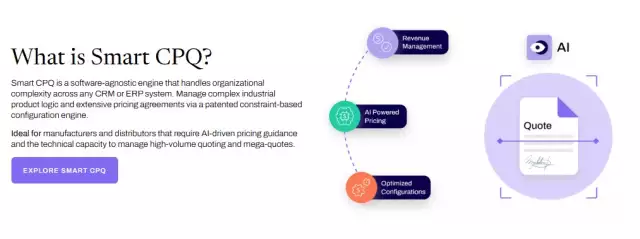
Conga Smart CPQ is an enterprise-grade AI-based quote configuration platform designed for large-scale quoting, complex configuration, and long-term agreements. Its constraint-based engine, neural-network pricing AI, and high-performance quoting support up to 10,000 line items, making it a reliable choice for enterprises operating in complex, multi-system environments.
Built for: global enterprises in distribution, manufacturing, and transportation and logistics, managing high-volume quotes, large product catalogs, and long-term agreements across multiple CRM and ERP systems.
What makes Conga the most reliable AI-powered CPQ solution for enterprises:
- Patented AI pricing: the neural network analyzes over 400 million data points to give account-specific recommendations with 90% prediction accuracy, with full price visibility and automated discount controls at every step.
- High-performance quoting at scale: manage thousands of product line items, run bulk operations, and manipulate large datasets without latency, purpose-built for RFPs and bids.
- Constraint-based configuration engine: get instant validation of complex product combinations, automated BOM and routing, and no engineering bottlenecks, even with catalogs of up to 100,000 SKUs.
- Contract lifecycle management: achieve full control over creating, amending, renewing, and ending customer agreements—mass price updates and ERP syncing help prevent margin loss in multi-year deals.
- CRM-agnostic architecture: connect natively with Salesforce, Dynamics 365, and SAP, or integrate with any system via a headless, API-first architecture.
- Embedded deal analytics: gain real-time insights into contract performance, profitability, and pricing, so that sales teams can negotiate and close deals with confidence.
Enterprises using Conga Smart CPQ report up to a 20% increase in win rate, 5% revenue growth, and a 2% improvement in margins.
Accelerate quoting with AI pricing and margin control
2. Salesforce CPQ (Agentforce)
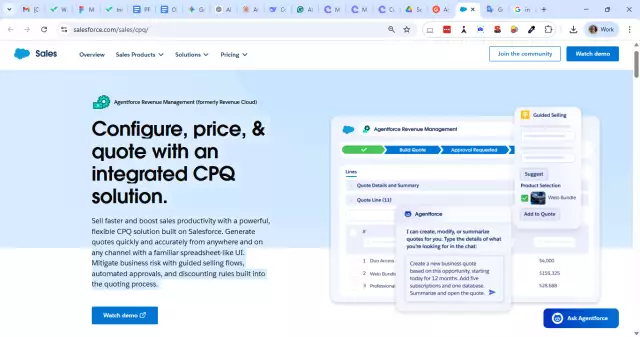
Salesforce CPQ, now part of Agentforce Revenue Management (formerly Revenue Cloud), is a configure-price-quote solution native to the Salesforce platform. It covers the full quote-to-cash cycle, from product configuration and pricing to contracts, orders, and billing, with AI-assisted quoting.
Built for: Salesforce-centric organizations that need CPQ tightly connected to their CRM, billing, and contract workflows within a single platform.
Salesforce CPQ pros:
- Native Salesforce integration that unifies quoting, contracts, orders, and billing in one platform
- Agentforce AI helps generate, update, and summarize quotes
- Attribute-based catalog and pricing engine working across different channels and revenue models
Salesforce CPQ cons:
- Implementation complexity often requires additional training and dedicated resources to get teams up to speed
- Platform dependency limits flexibility for organizations not fully invested in the Salesforce ecosystem
- Licensing costs increase as features and user numbers grow
3. Oracle CPQ
Oracle CPQ is a cloud-based configuration and pricing application that connects CRM and ERP systems. It applies AI to guide product selection, enforce pricing rules, and automate quote generation across direct and channel sales motions.
Built for: large enterprises already operating within the Oracle ecosystem or requiring deep ERP connectivity across complex, multi-channel sales environments.
Oracle CPQ pros:
- Support for complex product models and reusable configuration templates
- AI-driven deal scoring and discount recommendations
- Connectivity with ERP systems, including SAP and Microsoft Dynamics
Oracle CPQ cons:
- Setting up and configuring the system takes time and technical know-how
- Companies that don’t use Oracle may find integration harder and face higher overall costs
- Regular customizations often require specialist support, which can add extra work for teams without technical skills
4. SAP CPQ
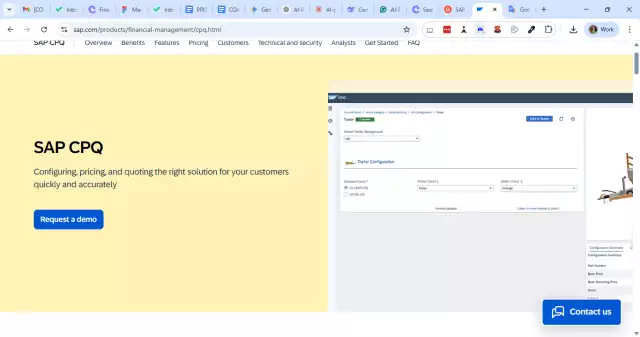
SAP CPQ is a cloud-based configure-price-quote software that integrates with SAP's suite (SAP Sales Cloud, SAP Commerce Cloud, and SAP S/4HANA) to handle complex quoting, pricing controls, and approval workflows.
Built for: SAP-centric enterprises that need quoting tightly connected to existing ERP data, variant configuration models, and SAP commerce infrastructure.
SAP CPQ pros:
- Integration with SAP Sales, Commerce, and Service Cloud, leveraging existing variant configuration models and ERP data
- Embedded AI for up-sell, cross-sell, and pricing recommendations across customer and channel pricing
- High-volume quoting with automated approval and exception workflows
SAP CPQ cons:
- Complex setup and customization for non-SAP use cases
- Limited flexibility outside the SAP ecosystem
- The interface and overall user experience create a steep learning curve at rollout
Learn how Conga optimizes your SAP S/4HANA Migration.
5. DealHub.io
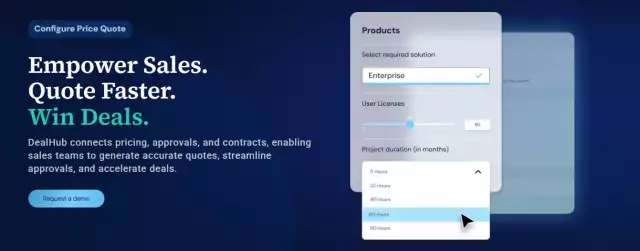
DealHub.io is an AI-powered quote-to-revenue platform that centralizes pricing, approvals, and contracts with an API-first architecture designed to support multiple monetization models, from sales-led to product-led and self-serve.
Built for: SaaS companies and B2B enterprises looking to consolidate quoting, contracts, and revenue management across multiple monetization models.
DealHub.io pros:
- Support for multiple pricing models, including subscription, usage-based, and tiered pricing
- Guided selling and automated approval workflows for quote generation
- API-first architecture for headless and self-service quoting
DealHub.io cons:
- Limited depth for complex manufacturing or situations that require heavy configuration
- Customization constraints for advanced pricing and enterprise needs
- Teams report integration and setup challenges in multi-system environments
6. ServiceNow CPQ
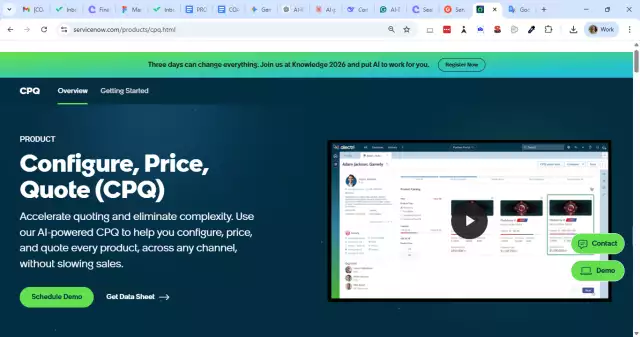
ServiceNow CPQ is an API-first configuration and pricing engine built on the ServiceNow AI Platform. It applies AI to guide product discovery, automate configuration logic, and generate quotes across direct sales, partner, and e-commerce channels.
Built for: organizations using ServiceNow that want to integrate sales and order management with IT or customer service operations.
ServiceNow CPQ pros:
- Unified platform that connects CPQ with workflows, data, and service operations
- AI-driven discovery helps users choose products without needing to set up rules manually
- API-first, modular design allows quoting across field sales, partners, and e-commerce channels
ServiceNow CPQ cons:
- Advanced configurations and integrations require specialized knowledge
- Integration with third-party systems such as Salesforce CRM and SAP can be technically challenging
- Limited documentation makes self-guided adoption of advanced features difficult
7. Tacton
Tacton is a CPQ platform purpose-built for industrial manufacturers and configure-to-order workflows. It applies generative AI to accelerate product modeling and combines configuration logic, 3D visualization, and CAD automation to generate quotes for manufactured equipment.
Built for: industrial manufacturers (automotive, heavy equipment, and capital goods), managing engineer-to-order and configure-to-order products with component complexity and large catalogs.
Tacton pros:
- Constraint-based configuration engine handles millions of valid product variants across industrial catalogs
- Real-time 3D visualization and automatic CAD file generation
- Omnichannel capabilities support direct sales, resellers, and self-service e-commerce
Tacton cons:
- The focus on manufacturing limits the application in SaaS or service sectors
- Requirement for configuration rule and logic maintenance
- Limited native CLM functionality compared to unified revenue platforms
8. Model N

Model N is a revenue management platform with Salesforce-native CPQ capabilities designed for regulated industries. It combines quoting, pricing, and contract management with channel data tracking and compliance controls.
Built for: life sciences and high-tech companies that need to manage large pricing, channel relationships, and regulatory compliance for both direct and indirect sales.
Model N pros:
- Natively interoperable with SAP for master data synchronization and order management
- Support for subscription, usage-based, and outcome-based pricing and billing models
- Channel management tools track partner pricing, ship-and-debit, and incentive programs
Model N cons:
- Industry focus limits applicability outside life sciences and high-tech
- Implementation and setup can be difficult for large organizations
- Integration challenges in non-Salesforce or multi-system environments
Benefits of AI in CPQ for Enterprise Sales Teams

AI elevates CPQ from a basic configuration tool to a significant revenue driver. By analyzing transaction data in real time, these platforms enable sales teams to work faster while maintaining strong margins. The main benefits for enterprise sales teams include:
- Faster quote-to-cash cycles: automated workflows compress quote-to-cash cycles by 30-40% and increase total sales by 20-25%, according to research from Custom Market Insights. The platform accelerates cycles by eliminating manual handoffs and the back-and-forth between sales, finance, and product teams.
- More accurate pricing and stronger margins: neural-network AI provides account-specific pricing with high accuracy. Conga Smart CPQ applies this technology to analyze past win rates and price sensitivity, suggesting optimal prices that maintain margins and eliminate pricing blind spots.
- Increased deal size through smarter recommendations: intelligent algorithms can boost the average contract value by suggesting relevant cross-sell and upsell options during the quoting process. The system analyzes customer segments and purchase history to make data-driven suggestions that increase profits without adding more work for sales reps.
- Fewer configuration and pricing errors: constraint-based engines help prevent technical mistakes by checking product rules in real time. Accurate configuration ensures every build stays valid, protecting margins throughout the commerce process.
Keep learning: benefits of CPQ software
How to Choose the Most Reliable AI-Powered CPQ Solution in 4 Steps
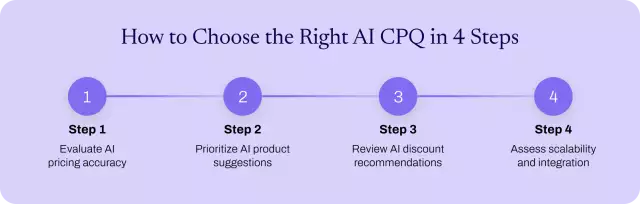
To choose a reliable AI CPQ, balance predictive intelligence with stability at scale. Use these four criteria to make sure your platform protects margins and speeds up deals.
1. Evaluate AI-driven CPQ analytics providers for pricing accuracy
When considering AI-driven CPQ analytics providers, evaluate how their systems generate price recommendations and the data sources they use. Key factors include:
- Dataset scale: platforms processing hundreds of millions of data points can identify detailed, account-specific pricing patterns that rule-based systems may overlook.
- Machine learning vs. static logic: models trained on historical win-loss data and customer behavior typically provide more accurate pricing than fixed price lists or tiered matrices.
- Price waterfall transparency: a complete breakdown of price changes, from base price and regional adjustments to final discounts, enables you to identify and address revenue leakage.
- Explainable AI outputs: recommendations based on specific factors, such as price sensitivity and competitive trends, provide sales representatives with the context needed to act confidently.
- Dynamic margin guardrails: real-time alerts notify you when discounts exceed profitability limits, allowing a shift from static approval processes to more intelligent, profit-focused controls.
2. Look for CPQ software with AI-powered product suggestions and guided selling
AI-powered product suggestions help you find relevant bundles, add-ons, and upgrades during configuration, so you don’t have to rely on the sales rep’s memory. Here are key things to look for:
- Needs-based discovery: structured questionnaires connect customer requirements directly to valid SKUs, which saves time when working with large catalogs.
- Context-aware suggestions: recommendations use account history, segment patterns, and product affinity instead of relying on generic cross-sell rules.
- Constraint-based validation: the system automatically removes invalid product combinations in real time, so unbuildable configurations never make it into the quote.
- Automated technical outputs: platforms that create bills of materials (BOMs) and manufacturing routing automatically eliminate the need for manual engineering review.
- Self-service readiness: guided selling flows that work across direct, partner, and digital channels help extend the value of CPQ beyond just the sales rep’s workflow.
3. Look for CPQ providers that offer AI-powered discount recommendations for your sales team
AI-powered discounting helps sales teams avoid random price cuts by giving specific guidance for each deal. Machine learning analyzes win rates, product mix, and customer segments to suggest discount ranges based on the likelihood of closing a deal. By comparing your deals to similar successful ones, the system finds the best price to win without hurting your margins.
Leading solutions show these recommendations right in the quoting process, so sales reps can see how changes affect their commissions and the company’s profits. Built-in intelligence automates approvals for low-risk quotes that fall within AI-approved limits.
4. Assess integration, implementation speed, and scalability for complex pricing
Integration, implementation speed, and scalability are key to CPQ systems handling large numbers of deals efficiently. Make sure the platform integrates with your CRM, ERP, and billing systems so you have a single, reliable data source and don’t need additional custom integrations.
CPQ implementation speed depends on how the platform handles product models, pricing rules, and approvals. Using prebuilt templates, existing catalog data, and low-code tools can speed up deployment and make maintenance easier. Check that the system can handle large catalogs, complex pricing, and high-volume quotes without slowing down.
Explore Conga integrations.
Accelerate Revenue with Conga’s AI-Based Quote Configuration Platform
Conga Smart CPQ provides AI-driven pricing and scalable configuration for sales environments. Our CRM-agnostic, API-first architecture integrates predictive pricing and constraint-based configuration to streamline high-volume sales processes.
Your team can tap into a patented neural network that analyzes over 400 million data points to deliver account-specific recommendations with 90% prediction accuracy. With Conga CPQ, you can process quotes with more than 10,000 line items and validate configurations against catalogs without latency.
Contact our sales team to optimize pricing decisions and protect margins with Conga.
Leverage predictive pricing intelligence with Conga Smart CPQ
Frequently Asked Questions
-
What are the best AI-powered CPQ solutions available today?
The best AI-powered CPQ solutions combine accurate pricing intelligence, scalable configuration, and seamless integration across the revenue stack. For global enterprises, Conga Smart CPQ stands out for managing high-volume, multi-system environments with a CRM-agnostic, API-first architecture.
The platform uniquely combines a patented neural network for pricing accuracy with a high-performance engine that processes over 10,000 line items and 100,000+ SKUs without latency.
Learn more about Conga CPQ. Watch our video.
-
What should I look for in AI-driven CPQ analytics and insights providers?
When choosing an AI-driven CPQ analytics provider, look for these features:
- Predictive intelligence that benchmarks historical win rates and account-specific behavior to recommend optimal price points
- Transparent price waterfalls that provide a clear breakdown of every adjustment from base price to final discount
- Explainable AI logic that surfaces the specific variables behind a recommendation to build trust with sales representatives
- Real-time margin guardrails that trigger alerts or approval routings when discounts threaten profitability
Explore the best platforms to reduce manual CPQ steps.
-
How does CPQ software with AI-powered product suggestions improve sales performance?
CPQ software with AI-powered product suggestions improves sales performance by automatically identifying relevant upsell and cross-sell opportunities during the configuration process. This intelligence increases average deal size and win probability while ensuring every quote remains technically buildable and accurate.
Read more: KPIs to measure CPQ performance
-
How do CPQ solutions use AI-driven discount recommendations for sales teams?
CPQ solutions use AI-driven discount recommendations to help sales teams identify the specific price-to-win that maximizes win probability without sacrificing excessive margin. The system analyzes deal attributes to automate approval routing for low-risk quotes, eliminating manual bottlenecks and accelerating the overall sales cycle.
-
How long does CPQ software implementation typically take?
Setting up CPQ software is a major project that usually takes several months of planning. Conga follows an agile process with six main steps:
- Readiness
- Planning
- Design
- Build
- Test
- Launch
To get results faster, it’s important to clean up your catalog and data before starting. During the build phase, teams set up pricing rules and product models in short cycles to keep checking their work. After launch, there’s a support period to help users adjust and keep the system running.
Download the Conga CPQ implementation guide.
-
Selling and contracting in the age of regulated AI GuidesAISelling and contracting in the age of regulated AI
Explore strategies to manage AI compliance in sales, quoting, and contracting.11/19/20251 min read -
Navigating US trade and tariff policy: leverage technology to protect revenue BlogAINavigating US trade and tariff policy: leverage technology to protect revenue
Protect your revenue amidst US trade and tariff policy changes. Discover how technology can help you analyze contracts, optimize relationships, and improve efficiency.04/29/20256 min read -
The future of SteelBrick Salesforce CPQ: Are you ready? BlogCPQThe future of SteelBrick Salesforce CPQ: Are you ready?
SteelBrick Salesforce CPQ is changing. Learn what’s next, why it matters, and how to choose a modern CPQ that fits your business now and in the future.07/22/20254 min read -
From Pricing to Profitability: How AI is Reshaping B2B Decision-Making BlogAIFrom Pricing to Profitability: How AI is Reshaping B2B Decision-Making
Discover how AI pricing is reshaping B2B decision-making—from improving speed and margin consistency to building trust and smarter commercial strategies.04/09/20266 min read